



Before removing the engine, it is necessary to prepare a reliable stand on which the engine should stand steadily.
Note: Before disconnecting hoses and electrical wires, we recommend that you mark them to avoid confusion during assembly.
You will need: wrenches "10", "13", "15", "17", screwdrivers, pliers, nippers or a knife, a hoist or other lifting device, slings (strong rope).
1. Remove the decorative engine cover (see "Removing and installing the decorative engine cover").
2. Reduce the pressure in the fuel system if the work is carried out immediately after a ride (see "Lower fuel pressure in the fuel system").
3. Disconnect the wire from the negative terminal of the battery.
4. For ease of operation, remove the battery (see "Removing and installing the battery").
5. Remove the engine splash guard (see "Removing and installing the engine mudguard").
6. Drain the coolant (see "Replacing the coolant").
7. Remove the air filter (see "Removing and installing the air filter").
8. Disconnect from the cylinder head, throttle body and intake manifold all hoses, pipes and wires that were disconnected before removing the cylinder head to replace its gasket, as well as the throttle actuator cable together with its bracket (see "Replacing the cylinder head gasket").
9. Disconnect the wiring harness connectors from the speed sensor, crankshaft position sensor and knock sensor (see "Engine Management System Sensors").
10. Disconnect the wires from the starter (see "Removing and installing the starter") and generator (see "Removing and installing the generator").
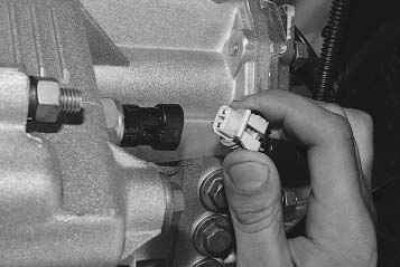
11. Disconnect the wiring harness connector from the reverse light switch on the transmission.
12. Disconnect the oxygen concentration sensor wire harness connectors and remove their wire holders from the openings in the steering gear heat shield (see "Replacing the cathode collector").
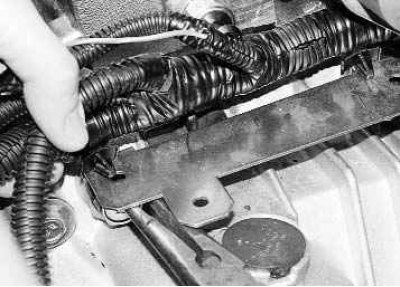
13. Disconnect the engine wiring harness holders from the bracket on the engine and move the harness to the side.
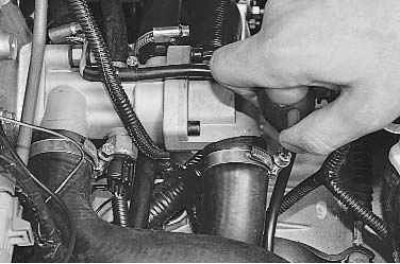
14. Loosen the clamps…
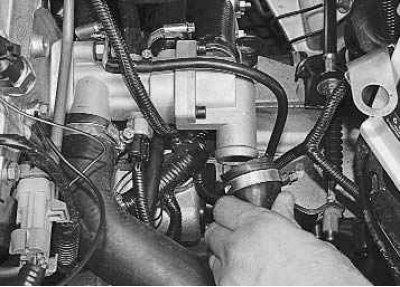
15. …and disconnect all hoses from the thermostat.
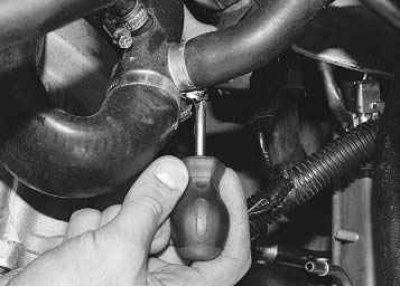
16. Loosen the clamp..
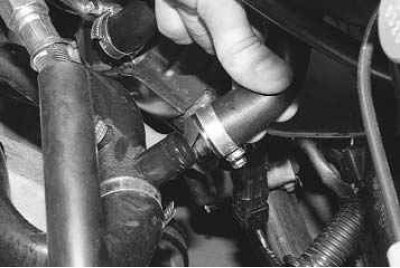
17. …and disconnect the heater hose from the water pump inlet pipe.
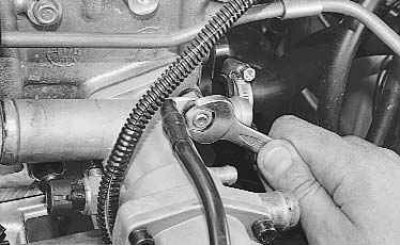
18. Use a 13 mm wrench to loosen the nut securing the ground wire tip…
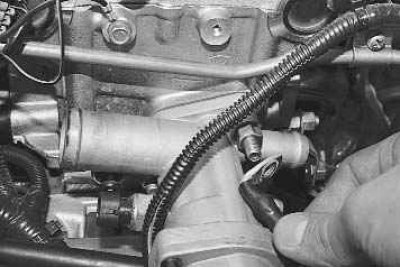
19. …and remove the wire.
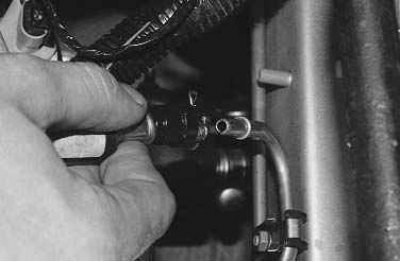
20. Disconnect the fuel hose from the tube secured to the engine shield.
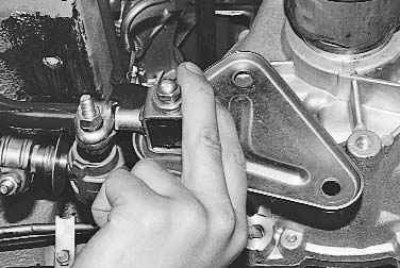
21. Disconnect the torque rod from the gearbox (see "Removal and installation of the gearbox").
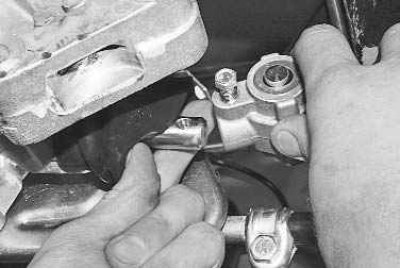
22. Disconnect the gear shift rod from the gearbox (see "Removal and installation of the gearbox").
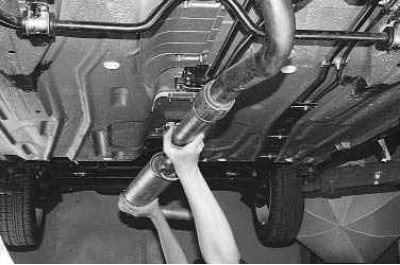
23. Remove the additional muffler, as its inlet pipe prevents the engine from lowering (see "Replacing the additional muffler").
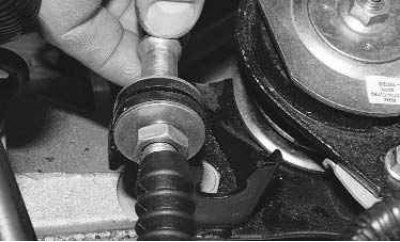
24. Disconnect the lower end of the clutch cable from the gearbox (see "Replacing the clutch release cable").
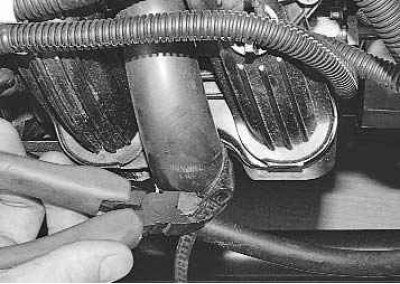
25. Cut the clamp that holds the throttle cable and the crankcase ventilation hose together and move the cable away from the engine.
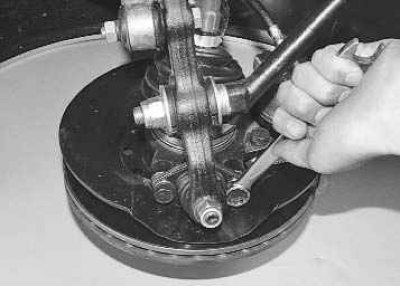
26. Disconnect the front suspension arms from the steering knuckles by using a 17 mm spanner to unscrew the two bolts securing the ball joints to the knuckles on both sides of the vehicle.
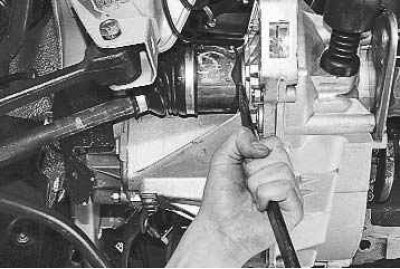
27. Using a mounting blade on the gearbox housing, push the inner hinges of the left… out of it
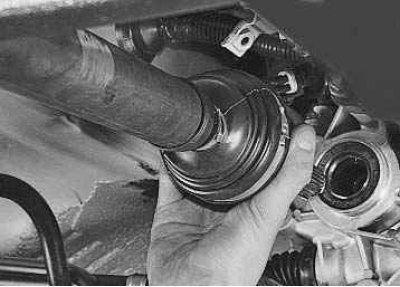
28. …and the right front wheel drive. Move the drives away from the gearbox by moving the corresponding front suspension shock absorber struts outward.
Note: The steering rods prevent the shock absorber struts from moving. In order to eliminate their influence, when disconnecting the right drive from the gearbox, turn the steering wheel all the way to the left, and when disconnecting the left drive, turn it all the way to the right.
Caution! Disconnect the right drive only after removing the front clutch housing cover (see "Replacing the oil pan gasket"), otherwise the mounting blade can bend the cover and the flywheel will touch it.
Caution! Do not disconnect both drives at the same time, as this may cause the axle gears to shift in the differential and it will be impossible to install the drives without disassembling the gearbox. If it is necessary to disconnect both drives, after disconnecting one of them, insert a technological plug or an old inner joint housing in its place and tie the plug or housing to the gearbox with wire so that they do not fall out when removing the gearbox. After this, disconnect the second drive.
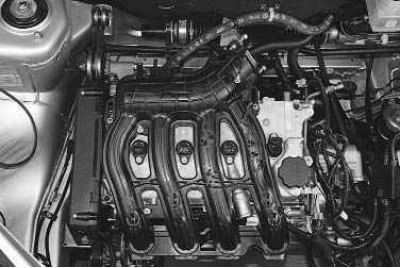
29. Make sure all wires, hoses and controls are disconnected from the power unit.
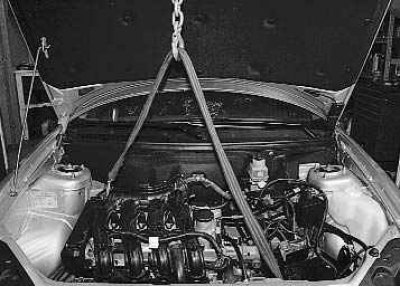
30. Attach the lifting gear slings to the engine and tighten them slightly to relieve the load on the power unit support cushions.
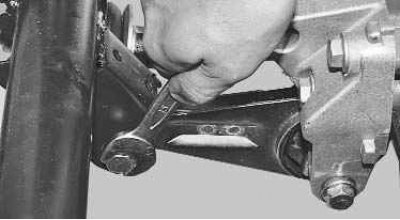
31. Using a 15 mm spanner, unscrew the bolt securing the right powertrain support rod to the crossmember.
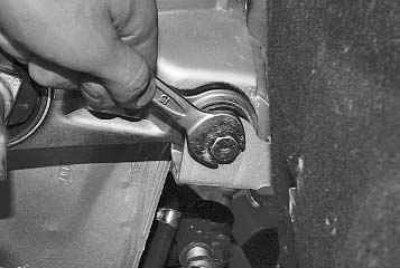
32. Using a 15 mm spanner, unscrew the bolt securing the left powertrain support rod to the body.
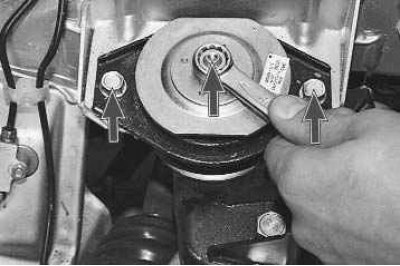
33. Using a 15 mm wrench, unscrew the nut securing the rear powertrain support bracket to the support cushion and use a 13 mm wrench to unscrew the two bolts securing the cushion to the body. Remove the support cushion (see "Replacing the powertrain supports").
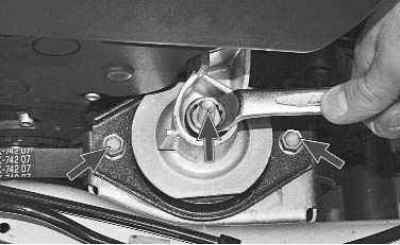
34. Using a 17 mm wrench, unscrew the nut securing the front powertrain support bracket to the support cushion and use a 13 mm wrench to unscrew the two bolts securing the cushion to the body. Remove the support cushion (see "Replacing the powertrain supports").
35. Place a pre-prepared support under the engine, lower the power unit onto it, lift the car and remove the engine from under it.
Note: This section describes how to remove the engine downwards in accordance with the manufacturer's recommendations (as part of the power unit, together with the gearbox). This requires lifting mechanisms to raise the front of the car higher. In a garage, it is easier to remove the engine upwards, having first removed the gearbox. In this case, it is not necessary to remove the additional muffler.
36. Install the engine in the reverse order of removal. After installation, fill the engine crankcase with oil and the cooling system with fluid.
37. Adjust the throttle actuators (see "Replacing the throttle cable") and gearbox control (see "Adjusting the gearbox control drive").
38. Start the engine and check for fuel, oil and coolant leaks. Check the oil pressure. Listen to the engine: it should run smoothly, without any extraneous noise or knocking.