



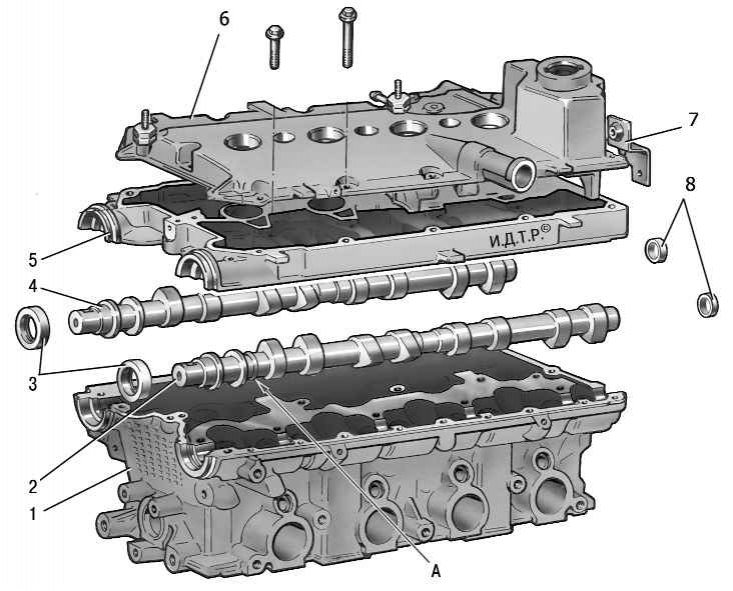
Figure 5.9. Cylinder head parts: 1 – cylinder head; 2 – intake camshaft; 3 – oil seal; 4 – exhaust camshaft; 5 – camshaft bearing housing; 6 – cylinder head cover; 7 – wiring harness mounting bracket; 8 – plugs; A – distinctive belt of the intake camshaft
Head 1 (figure 5.9) the cylinder block is common to all four cylinders, cast from an aluminum alloy, with tent-shaped combustion chambers. The intake and exhaust channels are located on different sides of the cylinder head. The valves are arranged in a V-shape in two rows: inlet valves on one side and outlet valves on the other.
Metal-ceramic valve seats and brass valve guide bushings are pressed into the head. The inner diameter of the guide bushings is (7±0.015) mm, the outer diameter is (for bushings supplied as spare parts) – 12.079–12.090 mm and 12.279–12.290 mm (bushing increased by 0.2 mm).
The diameter of the intake valve plate is 29 mm, the exhaust valve plate is 25.5 mm. The diameter of the intake valve stem is (6.975±0.007) mm, the exhaust valve plate is (6.965±0.007) mm.
Each valve has one spring installed. The length of the spring in a free state is 38.19 mm, under a load of (240±9.6) N [(24.5±0.98) kgf] it should be 32 mm, and under a load of (550±27.5) N [(56.1±2.8) kgf] – 24 mm.
The valves are actuated by the camshaft cams through cylindrical hydraulic tappets located in the guide holes of the cylinder head along the axis of the holes for the valves. Hydraulic tappets automatically eliminate the clearance in the valve mechanism, so there is no need to check and adjust the clearance in the valve mechanism during vehicle maintenance.
Oil for the operation of hydraulic tappets is supplied from the lubrication system through a vertical channel in the cylinder block to a channel in the cylinder head near the 5th mounting bolt, and then through the upper channels made on the lower plane of the bearing housing. Oil is also supplied through these same channels to lubricate the camshaft journals. In the vertical channel of the cylinder head there is a check ball valve that prevents oil from draining from the upper channels after the engine has stopped.
Two camshafts are used to drive the valves: intake and exhaust. The shafts are cast from cast iron and are equipped with five support journals that rotate in sockets made in the cylinder head and in one common camshaft bearing housing. To increase wear resistance, the working surfaces of the cams and the neck under the oil seal are bleached. In order to distinguish the intake camshaft from the exhaust camshaft, a distinctive belt A is made on the intake shaft near the first support.
The shafts are held from axial movement by thrust flanges located on both sides of the front support. The front ends of the camshafts are sealed with self-tightening rubber seals. The rear openings located along the axis of the shafts in the cylinder head and bearing housing are closed with rubberized cap plugs.
You will need: a device for compressing valve springs, a device for pressing out and a mandrel for pressing in valve stem seals, socket wrenches "8", "10", "13", wrenches "19", "21", a hex key "10", a screwdriver, tweezers.
1. Remove the cylinder head from the engine (see "Replacing the cylinder head gasket").
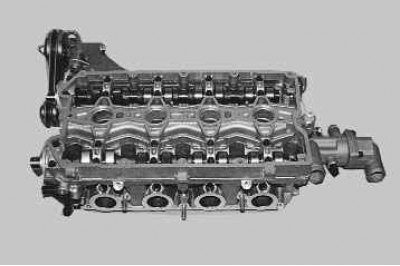
2. Install the cylinder head with the camshafts facing up, placing wooden spacers underneath it to avoid damaging the valves.
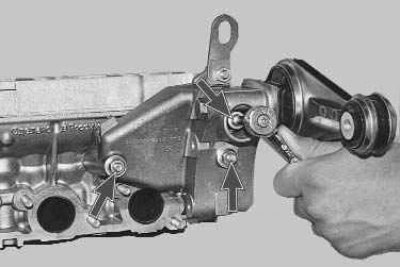
3. Using a 13 mm socket head, unscrew the three nuts securing the left support of the power unit…
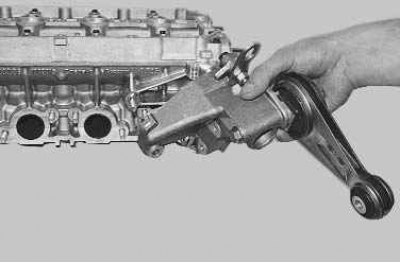
4. …and remove the support.
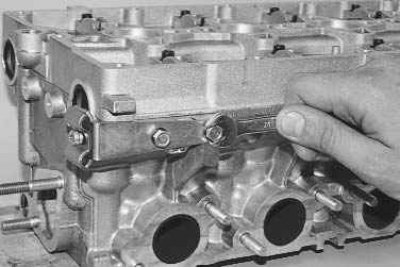
5. Use a 10 mm spanner to unscrew the two bolts securing the fuel pipe bracket…
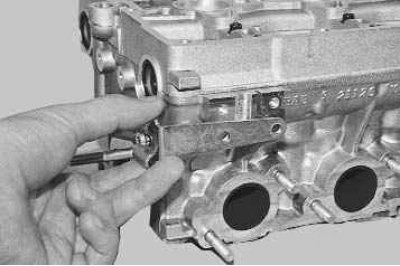
6. …and remove the bracket.
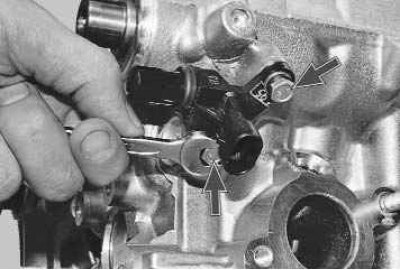
7. Use a 10 mm spanner to unscrew the two bolts securing the phase sensor…
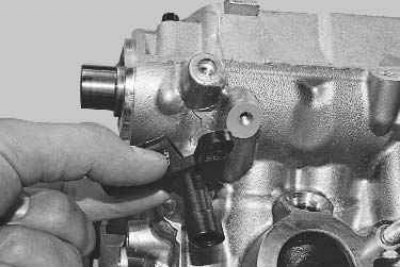
8. …and remove the sensor.
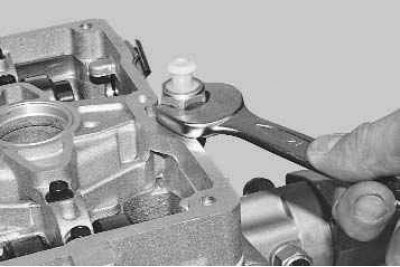
9. Using a 21 mm wrench, unscrew the low oil pressure warning light sensor from the camshaft bearing housing.
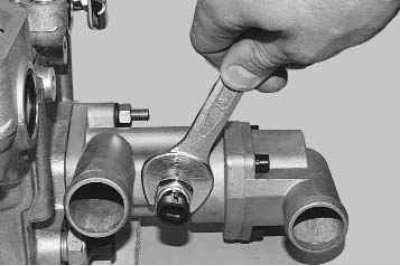
10. Using a 19 mm wrench, unscrew the coolant temperature sensor from the thermostat.
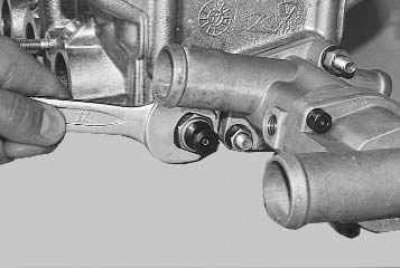
11. Using a 21 mm wrench, unscrew the coolant temperature gauge sensor from the rear end of the cylinder head.
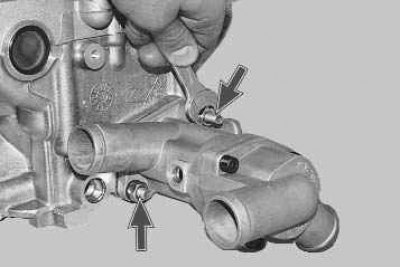
12. Use a 13 mm wrench to unscrew the two thermostat mounting nuts.
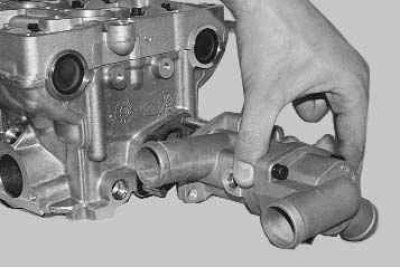
13. Remove the thermostat..
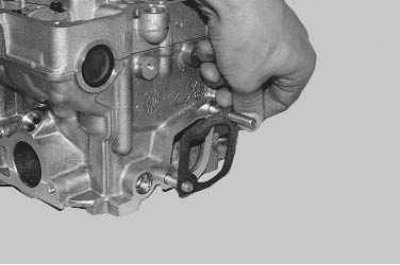
14. …and the sealing gasket installed underneath it.
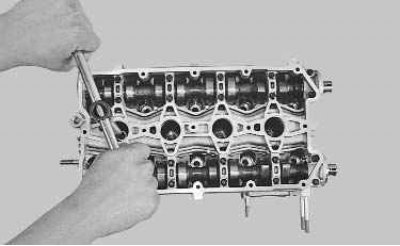
15. Use a spark plug wrench to remove the spark plugs so as not to accidentally damage them.
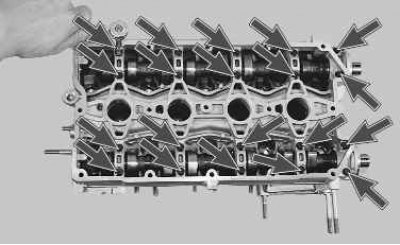
16. Using an 8 mm socket head, remove the twenty bolts securing the camshaft bearing housing...
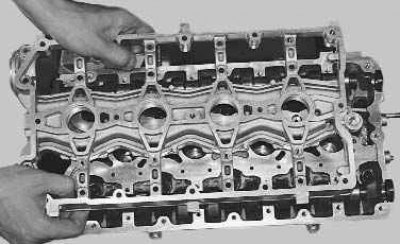
17. ...and remove the housing.
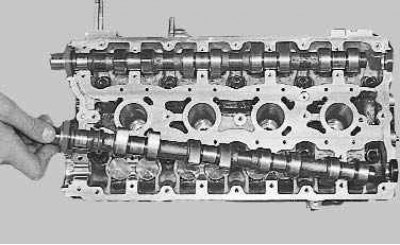
18. Remove the camshafts from the cylinder head supports and remove the seals from their front ends.
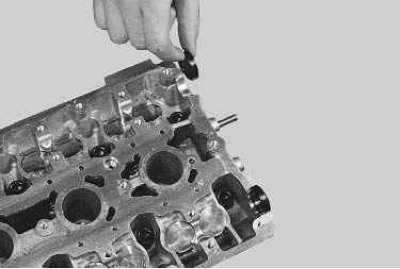
19. Remove the plugs from the rear end of the cylinder head.
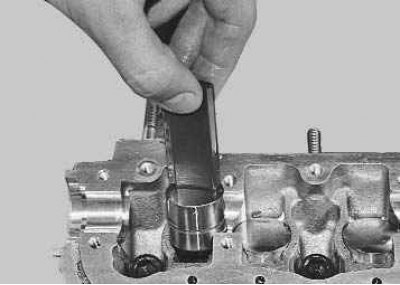
20. Remove the hydraulic valve lifters from the cylinder head holes.
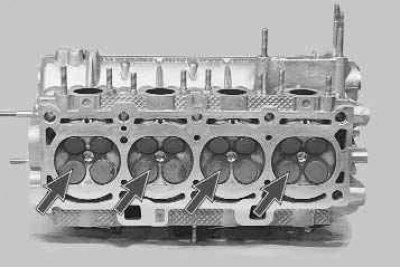
21. Clean the combustion chambers from carbon deposits. Inspect the cylinder head. If there are cracks or signs of burnout in the combustion chambers, replace the head. Remove burrs and nicks from the cylinder head surface.
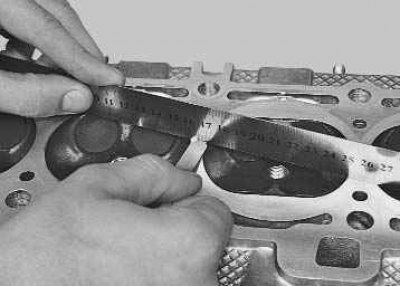
22. Check the flatness of the surface adjacent to the cylinder block. To do this, place the ruler edgewise on the surface of the head, first in the middle along the length, and then diagonally, and measure the gap between the surface of the head and the ruler with a feeler gauge. If the gap is greater than 0.1 mm, the mating surface can be ground. To do this, contact a specialized workshop.
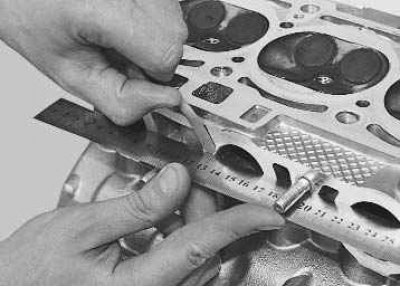
23. Similarly, check the flatness of the mating surfaces of the cylinder head under the intake manifold..
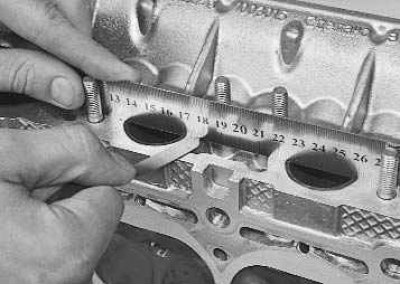
24. ...and the catalytic collector. The non-flatness of these surfaces should not exceed 0.1 mm.
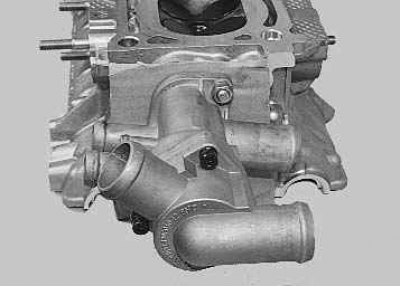
25. To check the tightness of the cylinder head, plug the hole in the head under the thermostat socket. This can be done, for example, by installing a blind gasket made of thick cardboard under the socket and tightening the nuts that secure it. Screw the coolant temperature gauge sensor back into place if it was removed.
26. Pour kerosene into the water jacket channels. If the kerosene level decreases after 15–20 minutes, it means there are cracks in the head and it needs to be replaced. After checking, do not forget to remove the cardboard gasket and take out the plugs.
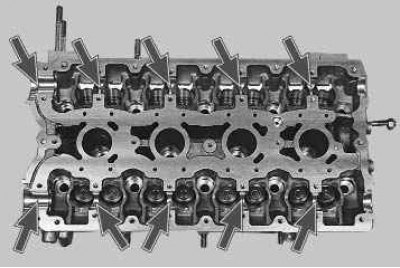
27. Check the condition of the bearing surfaces under the camshaft journals on the cylinder head…
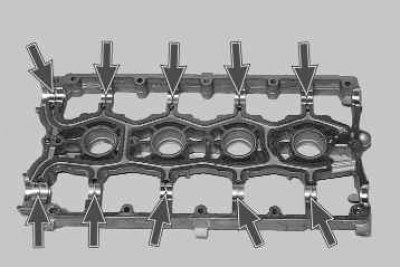
28. …and the bearing housing. If at least one of them shows signs of wear, scoring or deep scratches, replace the bearing head and housing.
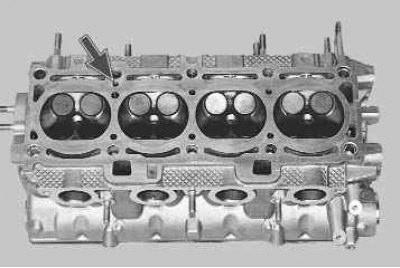
29. Flush the oil channels. To do this, plug the vertical oil channel on the combustion chamber side (the channel is located between the 3rd and 4th cylinders)...
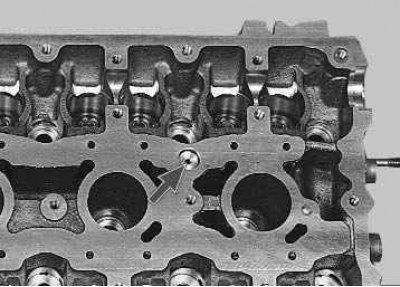
30. ...pour gasoline into the cylinder head oil channel…
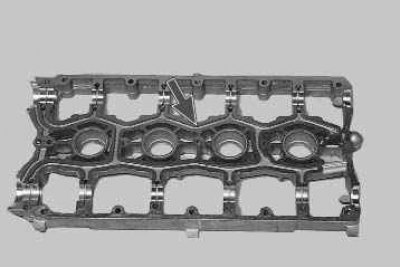
31. …and the camshaft bearing housings and leave for 15–20 minutes. Pour out the gasoline, remove the plug and finally flush the channels with gasoline using a bulb syringe.
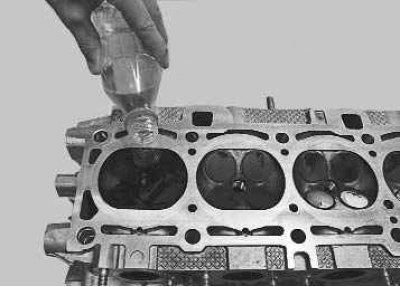
32. To check the tightness of the valves, screw in the spark plugs and pour kerosene into the combustion chambers. If kerosene does not leak from the combustion chambers into the channels within 3 minutes, the valves are sealed. Otherwise, rub (see "Valve grinding") or replace the valves.
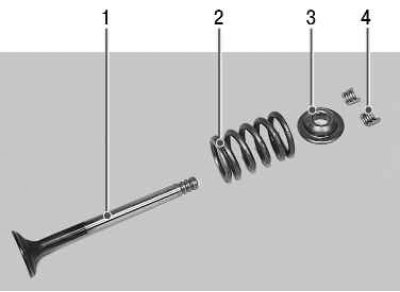
Note: To replace or grind the valves, remove the following parts from the cylinder head: 1 - valve; 2 – spring; 3 – plate; 4 – crackers.
33. Place a suitable stop under the valve to be removed.
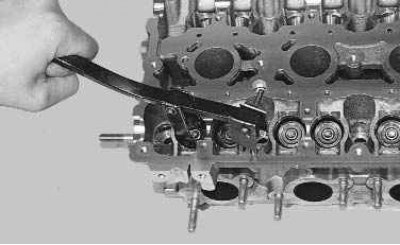
34. Install the valve spring compressor by screwing the camshaft bearing cap mounting bolt into one of the cylinder head holes and hooking the compressor onto this bolt. Compress the valve spring with the tool.
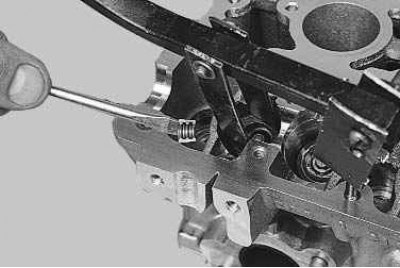
35. Remove the two crackers from the upper spring plate using tweezers or a magnetized screwdriver. Then remove the device.
Note: If the force required to move the lever of the device increases significantly and the crackers do not come out of the valve groove, lightly tap the spring plate with a hammer to release the crackers.
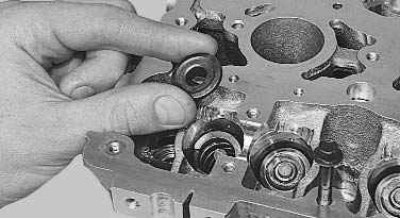
36. Remove the spring plate.
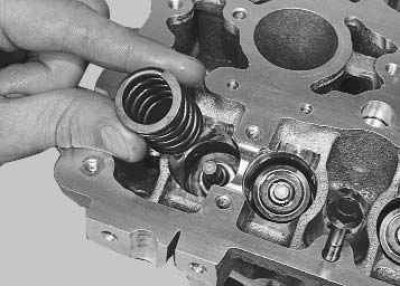
37. Remove the spring.
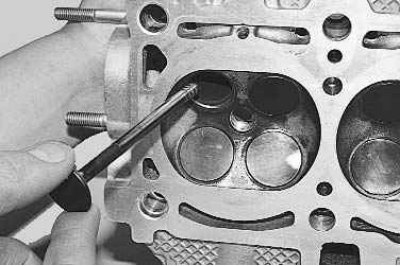
38. Push and remove the valve from the cylinder head.
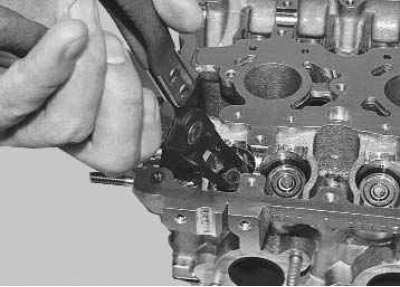
39. Press the valve stem seal off the valve guide bushing using a tool or pliers (see "Replacing the valve stem seals").
40. Clean the carbon deposits from the valve with a suitable tool (for example, with a metal brush). Then carefully inspect the valve.
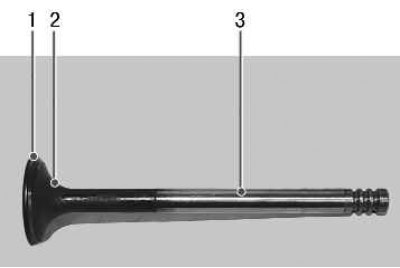
41. Replace valves with the following defects: deep grooves and scratches on the working chamfer 1, cracks, deformation of the stem 3, warping of the plate 2, traces of burnout. Shallow marks and scratches on the working chamfer can be removed by grinding the valves (see "Valve grinding").
42. If damage to the valve working chamfer cannot be removed by grinding, the chamfer can be ground on a special machine in a specialized workshop.
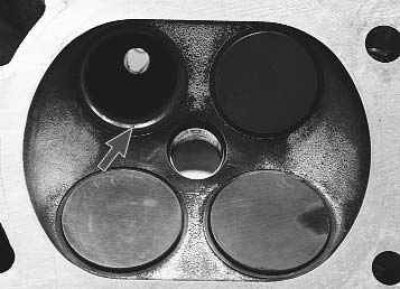
43. Check the condition of the valve seats. There should be no signs of wear, cavities, corrosion, etc. on the working chamfers of the seats. Valve seats can be replaced in a specialized workshop. Minor damage (minor scratches, marks, etc.) can be removed by grinding the valves (see "Valve grinding").
44. More significant defects of valve seats are eliminated by grinding. It is recommended to have the saddles polished in a specialized workshop.
[The original was published on the portal: LadaMan.ru]
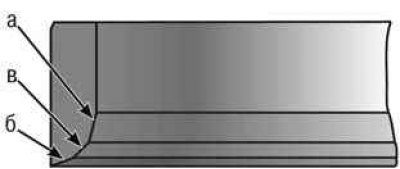
Figure 5.10. Valve seat chamfer machining locations
45. If you have metalworking skills, this work can be done manually using a set of special cutters. First, the chamfer is processed (figure 5.10) at an angle of 15°, then chamfer b at an angle of 20° and chamfer b at an angle of 45°. After grinding, it is necessary to lap the valves (see "Valve grinding").
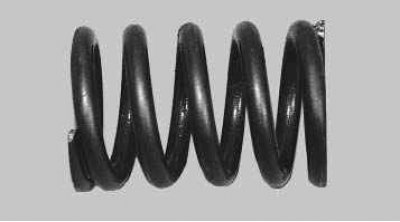
46. Check the condition of the valve springs. Replace bent, broken or cracked springs.
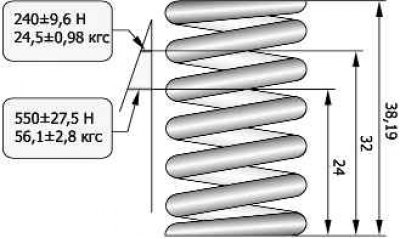
Figure 5.11. Valve spring test parameters
47. To check the elasticity of the outer spring, measure its height in a free state and then under two different loads (figure 5.11). If the spring does not meet the required parameters, replace it.
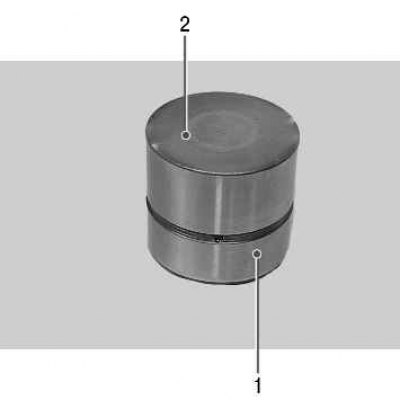
48. Inspect the hydraulic valve lifters. If there are burrs, scratches or other defects on the working surface 1, replace the hydraulic tappets. Measure the outside diameters of the tappets, replace worn tappets. The working surfaces 2 should not have any burrs, nicks, scratches, traces of stepped or uneven wear, or metal rubbing. Hydraulic tappets with such defects must be replaced. On surfaces 2, concentric traces of running-in with the camshaft cams are allowed.
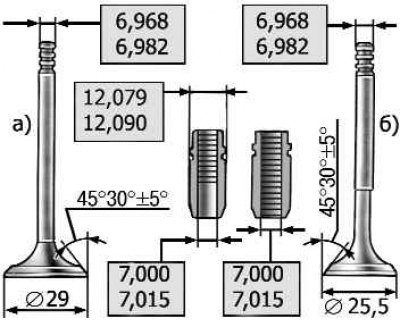
Figure 5.12. Dimensions of valves and their guide bushings
49. Check the clearances between the guide bushings and the valves. The clearance is calculated as the difference between the diameter of the hole in the bushing and the diameter of the valve stem (figure 5.12). It is recommended that the gap be checked in a specialized workshop, since a special tool (bore gauge) is needed to measure the diameter of the bushings.
Clearances between valve and guide bushing, mm:
- nominal for intake and exhaust valves - 0.018–0.047
- maximum permissible for intake and exhaust valves - 0.300
50. If the gap has not reached the maximum permissible value, you can try to eliminate it by replacing the valve. If this cannot be done or the clearance exceeds the maximum allowable value, replace the guide bushing. To do this, press out the defective bushing from the combustion chamber side using a special mandrel, having first measured the height of the protrusion of the upper part of the bushing above the surface of the cylinder head.
51. Cool the new bushing (for example, using a carbon dioxide fire extinguisher), lubricate it with engine oil, insert it into a special mandrel and press it in from the camshaft side so that the protruding height of the upper part of the bushing corresponds to the measured value. Ream the bore in the bushing using a reamer to 7.000–7.015 mm for intake and exhaust valves.
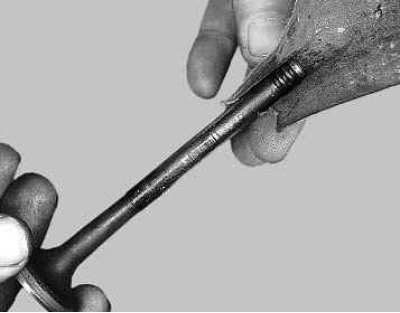
52. If you are installing an old valve, remove any burrs from the grooves under the crackers. After this, it is necessary to grind the valve to the seat (see "Valve grinding").
53. Install the valves into the cylinder head in accordance with the previously made markings, having first lubricated the rods with engine oil.
54. Install the oil seals (see "Replacing the valve stem seals").
55. Install the camshafts and camshaft bearing housing (see "Replacing the valve stem seals").
56. Install all parts and assemblies removed during disassembly onto the cylinder head.