



- fuel supply system including fuel tank 7 (pic. 4.11), fuel pump 9 with integrated fuel pressure regulator, lines 1, 4 and 5, fuel rail 5 (pic. 4.12) with 1 injectors as well as 6 fuel filter (see fig. 4.11);
- air supply system including air filter 6 (pic. 4.13), air inlet pipe 4, throttle assembly 7;
- fuel vapor recovery system, including adsorber 1 (pic. 4.14), canister purge valve 7, fuel vapor separator 9, gravity valve 11 and connecting pipelines 4, 5, 6 and 14.
The functional purpose of the fuel supply system is to ensure the supply of the required amount of fuel to the engine in all operating modes. The engine is equipped with an electronic control system with distributed fuel injection. In the distributed fuel injection system, the functions of mixture formation and dosing of the air-fuel mixture supply to the engine cylinders are separated: the nozzles carry out metered fuel injection into the intake pipe, and the amount of air required at each moment of engine operation is supplied by a system consisting of a throttle assembly and an idle speed controller. This control method makes it possible to ensure the optimal composition of the combustible mixture at each particular moment of engine operation, which allows obtaining maximum power with the lowest possible fuel consumption and low exhaust gas toxicity. The fuel injection system and the ignition system are controlled by an electronic engine control unit, which continuously monitors the engine load, the vehicle speed, the thermal state of the engine, and the optimal combustion process in the engine cylinders using appropriate sensors.
A feature of the fuel injection system of a car is the synchronism of the operation of the nozzles in accordance with the valve timing (the engine control unit receives information from the phase sensor). The controller turns on the injectors in series, and not in pairs, as in asynchronous injection systems. Each nozzle is activated through 720°of crankshaft rotation. However, in starting and dynamic modes of engine operation, an asynchronous method of fuel supply is used without synchronization with the rotation of the crankshaft.
The main sensor for the fuel injection system is the oxygen concentration sensor in the exhaust gases (Lambda probe). It is installed in the engine exhaust manifold and, together with the engine control unit and injectors, forms a control loop for the composition of the air-fuel mixture supplied to the engine. Based on the sensor signals, the engine control unit determines the amount of unburned oxygen in the exhaust gases and, accordingly, evaluates the optimal composition of the air-fuel mixture entering the engine cylinders at any given time. Having fixed the deviation of the composition from the optimal 1:14 (fuel/air), providing the most efficient operation of the catalytic converter of exhaust gases, the control unit changes the composition of the mixture using injectors. Since the oxygen concentration sensor is included in the feedback circuit of the engine control unit, the air-fuel ratio control loop is closed. A feature of the car engine management system is the presence (in addition to the control sensor) the second, diagnostic oxygen concentration sensor, installed at the outlet of the converter. According to the composition of the gases that have passed through the converter, it determines the efficiency of its work.
Fuel tank 7 (see fig. 4.11) welded, stamped, mounted on the car under the floor of the body in its rear part and secured with two steel clamps 15. In order to prevent fuel vapors from escaping into the atmosphere, the fuel tank is connected through a separator 9 (see fig. 4.13) fuel vapor and gravity valve 11 by pipeline 14 with an adsorber 1. A protective screen 16 is installed under the fuel tank (see fig. 4.11). An electric fuel pump 9 is installed in the flange hole in the upper part of the fuel tank, which combines the fuel pump itself, the fuel level indicator sensor and the fuel pressure regulator in a single module. In the rear part of the fuel tank there is a branch pipe for connecting the filling pipe 12. From the fuel pump, the fuel is supplied to the fuel filter 6 installed on the bottom of the fuel tank, and from there it enters the fuel rail 5 (see fig. 4.12), attached to the intake pipe of the engine. From the fuel rail, fuel is injected by injectors 1 into the intake pipe, and the fuel jet is directed to the intake valve. Excess fuel is drained into the fuel tank via a fuel pressure regulator installed in the fuel pump. Such a scheme for installing a fuel pressure regulator, in addition to eliminating a long backflow pipeline, helps prevent an increase in the temperature of the fuel in the fuel tank, which causes excessive vaporization.
Fuel pump 9 (see fig. 4.11) submersible, with an electric drive, rotary type, with a coarse fuel filter. The fuel pump provides fuel and is located in the fuel tank, which reduces the possibility of vapor lock, since the fuel is supplied under pressure, and not under vacuum. From the fuel tank, fuel is supplied through the main fuel filter to the injector rail at a pressure of more than 380 kPa.
Fuel filter 6 (see fig. 4.11) fine cleaning - full-flow, fixed in bracket 3 on the fuel tank. The fuel filter is non-separable, with a steel housing, with a paper filter element.
fuel rail 5 (see fig. 4.12), which is a hollow tubular part, serves to supply fuel to the injectors and is fixed on the intake pipe. The engine uses a drainless power supply system. The pressure in the fuel rail is maintained by the fuel pressure regulator installed in the fuel pump module. Injectors 1 are attached to the rail with clamps 2 through sealing rubber rings 3. To equalize the fuel pressure across the injectors, fuel is supplied to the middle part of the fuel rail, and not to any one end, as on previous VAZ injection engines.
nozzles with their atomizers enter the openings of the inlet pipe. The nozzles are sealed in the inlet pipe openings with rubber sealing rings. The nozzle is designed for metered injection of fuel into the engine cylinders and is a high-precision electromechanical valve in which the shut-off valve needle is pressed against the seat by a spring. When an electrical impulse is applied from the control unit to the electromagnet winding, the needle rises and opens the atomizer hole through which fuel is supplied to the engine intake pipe. The amount of fuel injected by the injector depends on the duration of the electrical impulse.
Fuel pressure control installed in the fuel pump module and designed to maintain constant fuel pressure in the fuel rail. The fuel pressure regulator is connected to the beginning of the supply line (immediately after the fuel filter) and is a bypass valve with a spring having a strictly calibrated force.
Air filter 6 (see fig. 4.13) mounted in front of the engine compartment on three rubber mounts. The filter element of the air filter is paper, flat, with a large area of the filtering surface. The air filter is connected to the throttle assembly 7 by a rubber corrugated air inlet pipe 4. A mass air flow sensor 5 is installed between the pipe and the filter, see Fig. «Electronic engine management system (fuel injection system)».
Throttle assembly attached to the intake module. It doses the amount of air entering the intake pipe. The intake of air into the engine is controlled by a throttle valve connected to the accelerator pedal drive.
The throttle assembly includes a throttle position sensor and an idle speed control. In the flow part of the throttle assembly (in front of and behind the throttle) there are vacuum extraction holes necessary for the operation of crankcase ventilation systems and trapping fuel vapors.
idle speed controller regulates the idle speed of the crankshaft by controlling the amount of air supplied to bypass the closed throttle. The idle speed controller consists of a two-pole stepper motor and a cone valve connected to it. The valve extends or retracts according to the signals from the engine control unit.
When the idle speed needle is fully extended (which corresponds to 0 steps), the valve completely blocks the air passage. When the needle is pushed in, an air flow is provided that is proportional to the number of steps the needle moves away from the seat.
By changing the opening and closing of the idle speed control valve, the control unit compensates for a significant increase or decrease in the amount of air supplied, caused by its suction through a leaky intake system or, conversely, by a clogged air filter.
Evaporative Emission System prevents the release of fuel vapors from the engine power system into the atmosphere, which adversely affect the environment.
In the fuel vapor recovery system, the method of vapor absorption by a coal adsorber is used 1 (see fig. 4.14). The carbon adsorber is mounted on the fuel tank and is connected by pipelines to the fuel vapor separator 9 installed in the niche of the right rear wheel, and to the adsorber purge valve 7 located in the engine compartment. The solenoid valve for purge of the coal adsorber, according to the signals of the engine control unit, switches the operating modes of the system.
Fuel vapors from the fuel tank are partially condensed in the separator 9, the condensate is drained back into the fuel tank through the pipeline 12. The remaining vapors through the pipeline 14 pass through the gravitational valve 11 installed in the separator into the adsorber 1. The second fitting of the adsorber is connected by a hose to the adsorber purge valve 7, and the third - with the atmosphere. When the engine is not running, the third fitting is blocked by a solenoid valve; in this case, the adsorber does not communicate with the atmosphere. When the engine is running, the engine control unit begins to supply control pulses to the valve.
The valve communicates the adsorber cavity with the atmosphere, and the sorbent is purged: gasoline vapors are discharged through hose 6 and throttle assembly 8 to the intake module.
Malfunctions in the evaporative emission control system result in unstable idling, engine shutdown, increased toxicity of exhaust gases and poor driving performance on the vehicle.
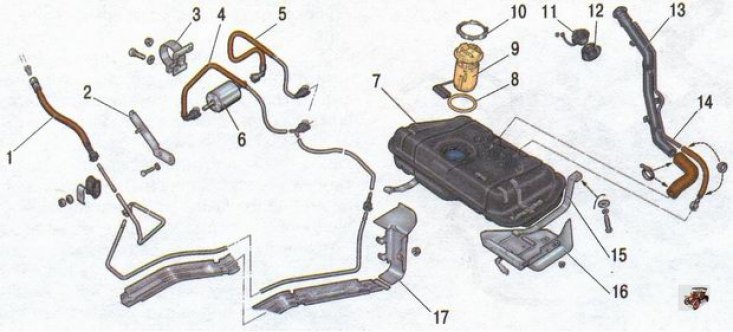
Pic. 4.11. Fuel supply system: 1 - fuel supply line; 2 - bracket; 3 - fuel filter mounting bracket; 4 - middle fuel line; 5 - fuel line from the filter to the fuel pump; 6 - fuel filter; 7 - fuel tank; 8 - sealing ring of the fuel pump; 9 - fuel pump; 10 - clamping ring for fastening the fuel pump; 11 - plug of the fuel tank filler pipe; 12 - filler pipe seal; 13 - filling pipe of the fuel tank; 14 - air outlet hose; 15 - fuel tank clamp; 16 - protective screen of the fuel tank; 17 - protective screen of fuel lines
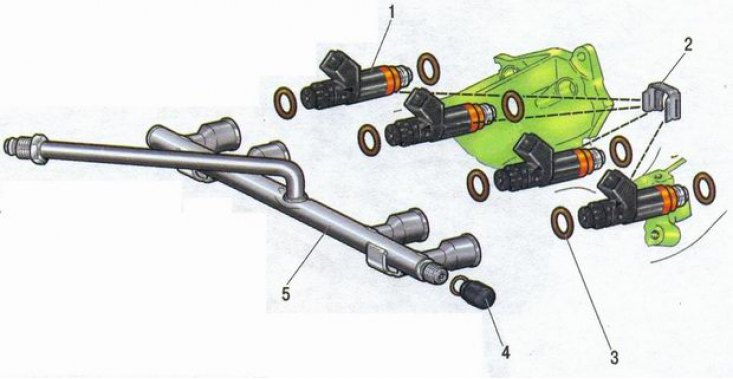
Pic. 4.12. Fuel rail and injectors: 1 - nozzle; 2 - nozzle lock; 3 - sealing ring; 4 - fitting for fuel pressure control; 5 - fuel rail
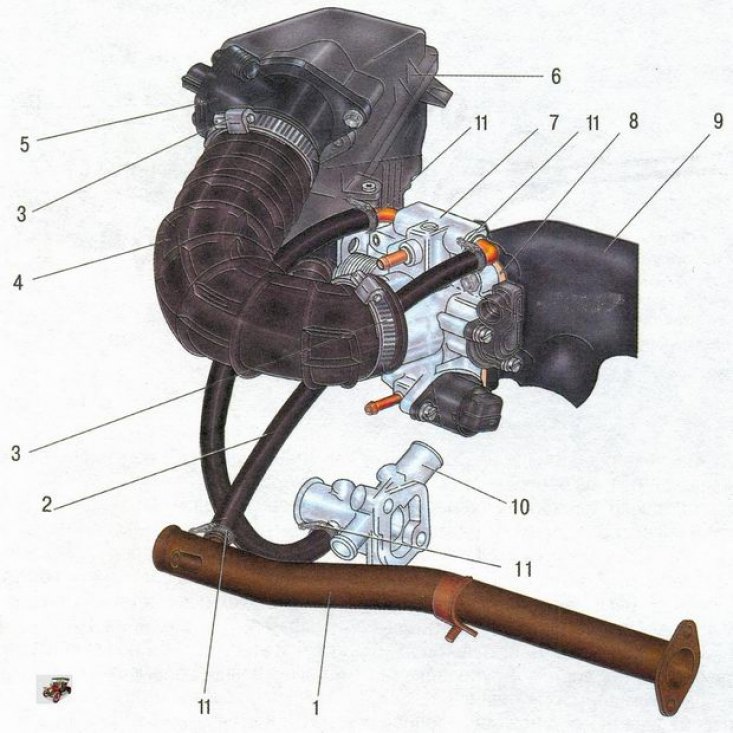
Pic. 4.13. Air supply system: 1 - inlet pipe of the coolant pump; 2 - hoses for heating the throttle assembly; 3 - clamps for fastening the air supply pipe; 4 - air supply pipe; 5 - mass air flow sensor; 6 - air filter; 7 - throttle assembly; 8 - sealing gasket of the throttle assembly; 9 - intake module; 10 - outlet pipe of the engine cooling system; 11 - hose clamp
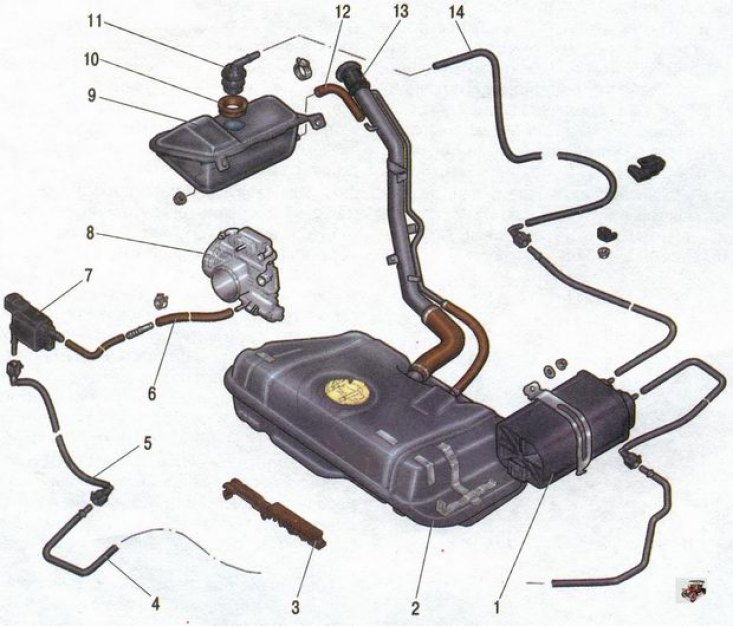
Pic. 4.14. Evaporative Emission System: 1 - adsorber; 2 - fuel tank; 3 - bracket; 4 - steam pipe from the adsorber to the purge valve; 5 - steam pipeline; 6 - pipeline hose from the purge valve to the throttle assembly; 7 - adsorber purge valve; 8 - throttle assembly; 9 - fuel vapor separator; 10 - valve gasket; 11 - gravity valve; 12 - hose for supplying fuel vapor to the separator; 13 - filling pipe of the fuel tank; 14 - steam pipeline from the separator to the adsorber