



Engine power supply system 1.6 (16V)
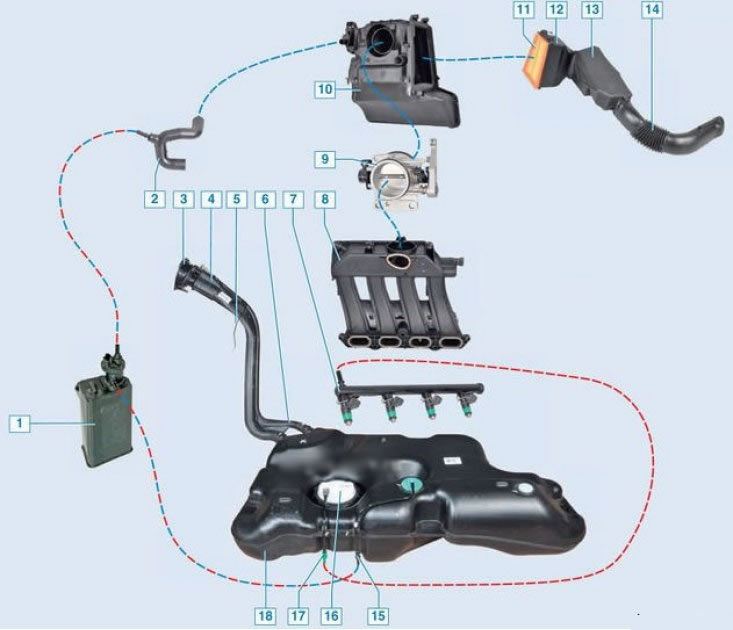
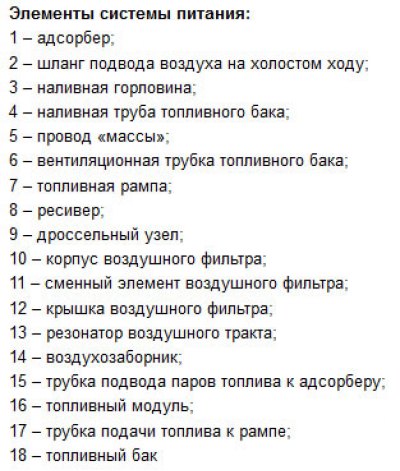
Fuel is supplied from a tank installed under the bottom in the area of the second row seat. The fuel tank, filler pipe and ventilation pipe are made of plastic.
The connection of the filler pipe and ventilation pipe with the tank nozzles is non-separable. The top of the filler pipe has a neck that is attached to the body. The ventilation tube serves to remove air displaced from the tank when it is filled with fuel.
The term manifold means "from one to many or from many to one". Intake manifold (also called a suction manifold) serves to distribute the fuel-air mixture coming from one source (air filter), between all engine cylinders.
The engine runs smoothly only if the same working pressure is created in all combustion chambers. To achieve this, it is necessary that all cylinders are supplied with equal portions of the fuel-air mixture of the same quality. All portions of the fuel-air mixture must have the same physical characteristics and the same composition.
Air entering the engine passes through the throttle chamber. All air entering the engine must be filtered.
Note: If the engine is operated without an air filter, its wear accelerates almost tenfold!
A question often asked is what the compartment located on the suction pipe is intended for. The shape of this pipe was chosen specifically to suppress resonant air vibrations that occur at certain frequencies under certain engine operating conditions. The length and shape of this pipe are chosen so that it absorbs shock waves generated in the air intake system and accumulates air, releasing it back into the air flow when the pressure decreases.
The overall effect of such resonance pipes is to reduce the noise level created by the air entering the engine.
Power supply system. Theses
1. Gasoline is a complex mixture of hydrocarbons. In order to facilitate engine starting and achieve maximum fuel economy, additives are added to gasoline to adjust its volatility in accordance with seasonal temperature fluctuations.
2. Using fuel designed for low ambient temperatures at elevated temperatures may cause the engine to idle roughly and stall due to the increased Reid Vapor Pressure (RVP) associated with the increased volatility of fuel grades designed for low ambient temperatures.
3. Violation of the normal combustion mode of the working mixture (also called detonation combustion) leads to an increase in temperature and pressure in the combustion chamber.
5. Oxygen-containing fuels are usually a mixture of gasoline with alcohol or methyl tributyl ether, the molecules of which contain oxygen - such fuels are used to reduce carbon monoxide emissions into the atmosphere.
6. You should fill up your car with gasoline at a gas station where many cars are filled up, and you should not overfill the fuel tank with gasoline.
7. The Positive Crankcase Ventilation (PCV) system pumps vapors and leaky gases from the crankcase into the intake manifold.
8. The air pump of the air supercharging system, until the engine has warmed up, supplies air to the exhaust manifold. As the engine warms up and begins to operate under the closed-loop control system, air is forced into the catalytic converter.
9. The evaporative emission prevention (EVAP) system, consisting of a carbon canister and a series of hoses and passages, captures and traps gasoline vapors, preventing them from escaping into the atmosphere.
10. The exhaust gas recirculation (EGR) system returns part of the exhaust gases to the combustion chamber to prevent it from overheating. The main purpose of the recirculation system is to reduce the concentration of nitrogen oxides (NOx) in the exhaust gases.
11. The catalytic converter in the exhaust system stimulates the exhaust gases to enter into a chemical reaction, but does not enter into it itself. It is where the nitrogen oxides contained in the exhaust gases are reduced, resulting in nitrogen (N) and oxygen (O2). In the second chamber of the neutralizer, hydrocarbons (HC) and carbon monoxide (CO) are oxidized, resulting in harmless carbon dioxide (CO₂ and water vapor (H2O).