



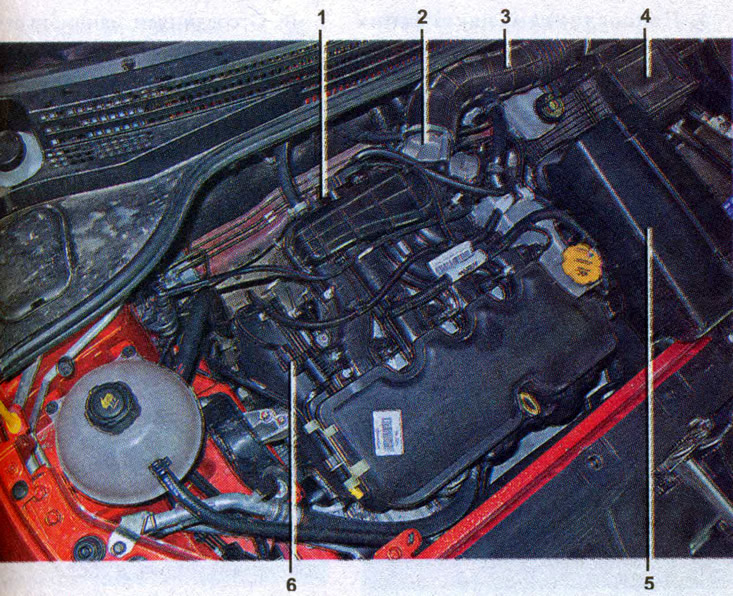
Engine intake system 21129: 1 - inlet module; 2 - throttle assembly; 3 - air supply hose to the throttle valve; 4 - air filter; 5 - resonator (air intake system muffler); 6 - electromagnetic valve of the intake manifold length variation system
The fuel system consists of a fuel tank, fuel module, fuel filter, fuel rail with injectors, air filter, fuel lines, air ducts, throttle assembly, intake manifold, and a gasoline vapor recovery system.
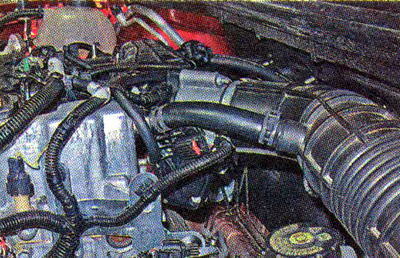
The air entering the engine cylinders is cleaned of dust by the air filter. The air filter is installed in the engine compartment. The filter element is replaceable and made of special paper. To prevent contaminated air from being sucked into the intake tract, there is a sealing edging at the top of the element. To replace the filter element, the filter cover is removable. The purified air passes through the air duct to the throttle valve.
The electric throttle valve regulates the amount of air entering the engine cylinders. The valve rotates on an axis in the housing (pipe). The throttle valve housing is fixed to the flange of the intake manifold receiver (for more details, see. "Engine management system"). The receiver has pipes for connection to the adsorber and the engine crankcase ventilation system.
The housing with the throttle valve with the position sensor and electric actuator installed on it form the throttle assembly.
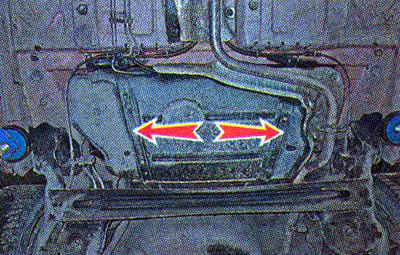
The fuel supply is stored in a 55-liter tank. The fuel tank is made of special plastic and is suspended from the bottom of the car on two steel clamps.
The fuel tank filler neck is located on the right side of the vehicle and is closed with a plug. Fuel is supplied from the tank by a submersible electric fuel pump.
The pump is installed in the fuel tank. To access the pump, there is a hatch with a cover in the bottom of the car under the rear seat cushion.
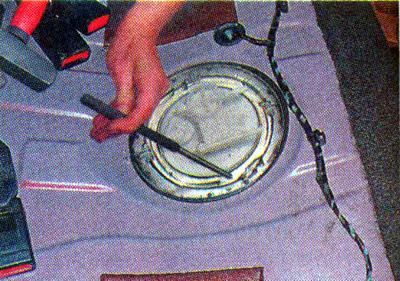
A mesh filter is installed on the inlet pipe of the fuel pump, which traps small solid particles of debris that enter the fuel tank along with gasoline. Voltage is supplied to the pump by command from the ECU when the ignition is turned on. If no attempt is made to start the engine, then after 2-3 seconds the ECU will turn off the fuel pump.
The fuel pump is combined with the fuel level indicator sensor and the fuel pressure regulator into a single unit - the fuel module (often called an electric fuel pump).
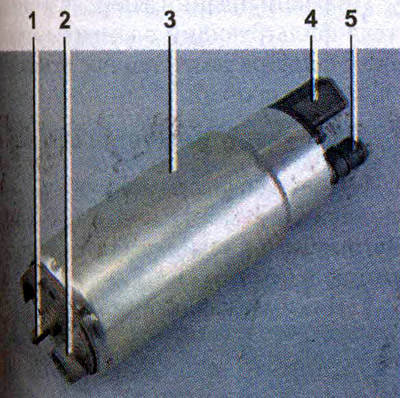
Fuel pump: 1 - protrusion for fastening the mesh filter; 2 - fuel intake pipe for connecting a mesh filter; 3 - body; 4 - Electrical connector block; 5 - day off (forcing) branch pipe for connection to the fuel module cover with a corrugated tube
Fuel from the pump (through the outlet pipe of the fuel module) enters the fuel filter. The purified gasoline is again fed through the fuel line and through the tee to the inlet pipe of the fuel module and then fed into the fuel rail. Excess fuel is released through the pressure regulator into the tank. The fuel pressure regulator is installed in the fuel module cover.
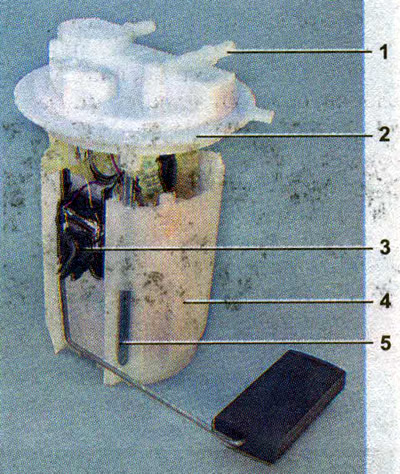
Engine fuel module: 1 - day off (forcing) pipe branch; 2 - module cover; 3 - fuel level indicator sensor; 4 - intake chamber; 5 - module cover guide
The fuel pressure regulator is a bypass valve that maintains pressure in the system (fuel line) operating pressure 364-400 kPa, necessary for the correct operation of the injection system.
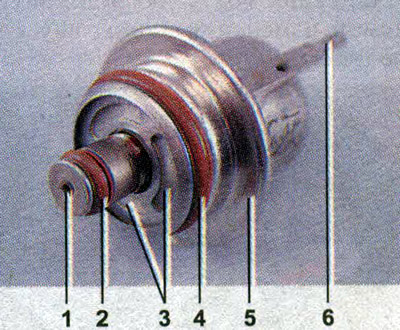
Engine Fuel Pressure Regulator: 1 - hole for draining excess fuel; 2, 4 - sealing rings; 3 - holes for supplying fuel to the regulator; 5 - body; 6-output for connecting the regulator to the "ground"
Main material on the website LADAMAN.RU
Fuel filter - paper, installed in the fuel module.
The purified fuel enters the fuel rail through the fuel line.
The fuel rail holds four injectors and supplies fuel to them. The connection between the ramp and the injectors is sealed with rubber rings. The ramp is secured to the intake manifold with bolts.
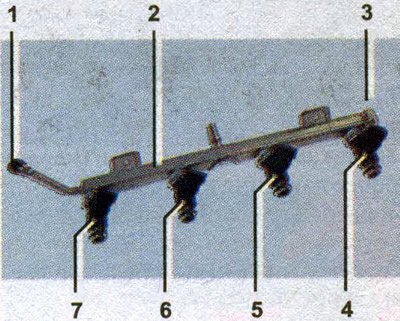
Fuel rail assembly with injectors: 1 - diagnostic nipple; 2 - fuel rail; 3 - nipple for connection to the fuel line; 4, 5, 6 and 7 - injectors
In accordance with current environmental requirements, the car is equipped with a fuel vapor recovery system; the space above the fuel tank is not directly connected to the atmosphere, but through elements of this system. The system consists of an adsorber, an adsorber purge valve, connecting tubes and hoses.
Gasoline vapors are fed through pipes and connecting hoses to the adsorber, which prevents the vapors from entering the atmosphere. An adsorber is a container where gasoline vapors are absorbed by activated carbon. When the engine is running at high crankshaft speed, the ECU sends a signal to open the purge valve of the adsorber, and gasoline vapors are sucked into the receiver of the intake manifold.
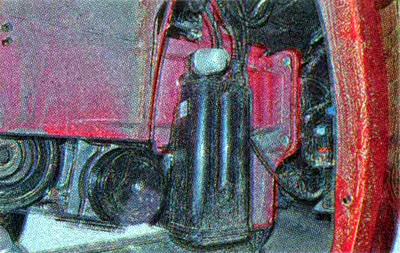
The adsorber is fixed under the front right hood of the car.
The intake manifold and receiver are combined into a single non-separable unit – the intake module.
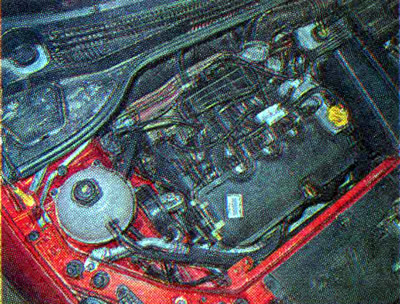
The intake module is equipped with a system for changing the length of the intake tract.
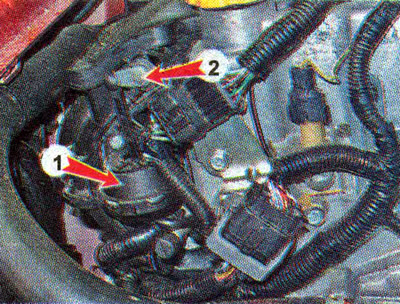
Depending on the engine operating mode, the ECU opens the electromagnetic valve, and the pneumatic drive 1 rotates the axis with flaps 2, switching the channels for the movement of incoming air. As a result, the ECU changes the length of the air path, adjusting it optimally depending on the crankshaft speed.
The filler cap has two valves: one for emergency release of fuel vapor pressure from the tank (what is possible with an increase in ambient temperature), and the other one is for the intake of air from the atmosphere when fuel is consumed from the tank (this eliminates the occurrence of a strong vacuum in the tank).