



Engine repair 21129 car Lada Vesta 1
 itemprop="image"
Basic data for control and repair
Engine Model 21129 Conventional designation 1.6 l 16-valve Engine type Petrol, four-cylinder, in-line Working volume, l (cm³) 1,6 (1596) Cylinder diameter, mm 82 Piston stroke, mm 75,6 Compression...
Engine Model 21129 Conventional designation 1.6 l 16-valve Engine type Petrol, four-cylinder, in-line Working volume, l (cm³) 1,6 (1596) Cylinder diameter, mm 82 Piston stroke, mm 75,6 Compression...

Description of the design of the engine 21129
Cross section of engine 21129: 1 - oil pan drain plug; 2 - crankshaft; 3 - oil filter; 4 —, catalytic collector; 5 - coolant pump; 6 - piston; 7 - catalytic collector gasket; 8 - oxygen concentration...
Cross section of engine 21129: 1 - oil pan drain plug; 2 - crankshaft; 3 - oil filter; 4 —, catalytic collector; 5 - coolant pump; 6 - piston; 7 - catalytic collector gasket; 8 - oxygen concentration...

Cleaning the engine and engine compartment
Warning! There are many electronic components in the engine compartment, therefore we do not recommend cleaning the engine compartment with high-pressure cleaners (as most car washes do). To perform...
Warning! There are many electronic components in the engine compartment, therefore we do not recommend cleaning the engine compartment with high-pressure cleaners (as most car washes do). To perform...

Engine — technical condition check
The technical condition of the engine depends on the vehicle's mileage, the timeliness of periodic maintenance, the quality of the operating materials used, and the quality of the repairs performed....
The technical condition of the engine depends on the vehicle's mileage, the timeliness of periodic maintenance, the quality of the operating materials used, and the quality of the repairs performed....

Checking the engine by external signs
1. Prepare the car for work (see " Preparing the car for maintenance and repair "). Remove the decorative engine cover (see " Engine trim panel - removal and installation "). Remove the engine...
1. Prepare the car for work (see " Preparing the car for maintenance and repair "). Remove the decorative engine cover (see " Engine trim panel - removal and installation "). Remove the engine...

Oil pressure — check
If the oil pressure warning light comes on while the engine is idling and warmed up to operating temperature, you must make sure that: a) the oil level in the engine oil pan is within the norm (see "...
If the oil pressure warning light comes on while the engine is idling and warmed up to operating temperature, you must make sure that: a) the oil level in the engine oil pan is within the norm (see "...

Compression in engine cylinders — check
To perform the work you will need a compression gauge. We perform the work with an assistant. Sequence of execution 1. Prepare the car for work (see " Preparing the car for maintenance and repair ")....
To perform the work you will need a compression gauge. We perform the work with an assistant. Sequence of execution 1. Prepare the car for work (see " Preparing the car for maintenance and repair ")....
Engine oil consumption — check
Checking should begin immediately after the next engine oil change. Sequence of execution 1. Warm up the engine to operating temperature (before turning on the electric fan). 2. After the electric...
Checking should begin immediately after the next engine oil change. Sequence of execution 1. Warm up the engine to operating temperature (before turning on the electric fan). 2. After the electric...

Engine oil level — check
Recommendation. The check should be carried out 70-75 minutes after the engine has been stopped. Sequence of execution 1. Prepare the car for work (see " Preparing the car for maintenance and repair...
Recommendation. The check should be carried out 70-75 minutes after the engine has been stopped. Sequence of execution 1. Prepare the car for work (see " Preparing the car for maintenance and repair...

Engine Oil and Oil Filter — replacement
The first oil change on a new or overhauled engine should be done after 2500-3500 km of mileage, then every 15,000 km. The volume of the lubrication system is 3.5 l. Recommendation. For more complete...
The first oil change on a new or overhauled engine should be done after 2500-3500 km of mileage, then every 15,000 km. The volume of the lubrication system is 3.5 l. Recommendation. For more complete...

Engine trim panel — removal and installation
The decorative trim is held in place by four rubber couplings that fit onto the studs of the intake module cover. Removal 1. Prepare the car for work (see " Preparing the car for maintenance and...
The decorative trim is held in place by four rubber couplings that fit onto the studs of the intake module cover. Removal 1. Prepare the car for work (see " Preparing the car for maintenance and...

Engine Mudguard — Removal and Installation
The work may be required to repair the engine, its systems, and also to access other parts of the car. To carry out the work, you will need an inspection pit or overpass. Note: The mudguard is not...
The work may be required to repair the engine, its systems, and also to access other parts of the car. To carry out the work, you will need an inspection pit or overpass. Note: The mudguard is not...

Accessory Drive Belt — check
The engine is equipped with one auxiliary drive belt. The basic configuration uses the 6PK 1039 belt. It drives the generator and the air conditioning compressor. The belt tension is provided by...
The engine is equipped with one auxiliary drive belt. The basic configuration uses the 6PK 1039 belt. It drives the generator and the air conditioning compressor. The belt tension is provided by...

Auxiliary Drive Belt — replacement
The need to replace the belt is determined during the inspection of its condition (see above). Removing the belt may be required when performing other repair work (for example, when replacing a...
The need to replace the belt is determined during the inspection of its condition (see above). Removing the belt may be required when performing other repair work (for example, when replacing a...

Timing Belt — Checking Condition
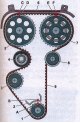
The engine camshafts are driven by a toothed belt. The drive is carried out from the crankshaft. The belt drive is equipped with a tensioner that automatically maintains the belt tension within the...
The engine camshafts are driven by a toothed belt. The drive is carried out from the crankshaft. The belt drive is equipped with a tensioner that automatically maintains the belt tension within the...
Timing Belt — replacement
The belt is replaced in accordance with the maintenance plan - every 180,000 km (see " Maintenance plan "). To perform the work you will need an assistant, and it is also desirable to have an...
The belt is replaced in accordance with the maintenance plan - every 180,000 km (see " Maintenance plan "). To perform the work you will need an assistant, and it is also desirable to have an...

Timing Belt Rollers — replacement
Recommendation. If, when the engine is running, a loud noise from a rotating bearing is heard in the area under the front timing belt covers (see " Engine - technical condition check "), you should...
Recommendation. If, when the engine is running, a loud noise from a rotating bearing is heard in the area under the front timing belt covers (see " Engine - technical condition check "), you should...

Cylinder Head Cover — Removal, Cleaning Oil Deflector and Installation
Removal 1. Remove the air filter (see " Air filter - removal and installation "). 2. Remove the decorative engine cover (see " Engine trim panel - removal and installation "). 3. Remove the ignition...
Removal 1. Remove the air filter (see " Air filter - removal and installation "). 2. Remove the decorative engine cover (see " Engine trim panel - removal and installation "). 3. Remove the ignition...

Camshaft Seals — replacement
To perform the work, you will need a special tool to hold the camshaft pulleys. Note: The work can be done without this device if you can unscrew the camshaft pulley mounting bolts. Sequence of...
To perform the work, you will need a special tool to hold the camshaft pulleys. Note: The work can be done without this device if you can unscrew the camshaft pulley mounting bolts. Sequence of...

Hydraulic tappets — removal and installation
Removal 1. Remove the camshafts (see above, " Camshafts - Removal and Installation "). Recommendation. When assembling, it is recommended to install the hydraulic tappets in their original places. 2....
Removal 1. Remove the camshafts (see above, " Camshafts - Removal and Installation "). Recommendation. When assembling, it is recommended to install the hydraulic tappets in their original places. 2....

Valve stem seals — replacement
Note: You can replace the valve stem seals without removing the head from the cylinder block. To de-compress the valves, you need a compressor and an adapter with a hose to pump air into the cylinder...
Note: You can replace the valve stem seals without removing the head from the cylinder block. To de-compress the valves, you need a compressor and an adapter with a hose to pump air into the cylinder...

Cylinder head — removal and installation
Note: The cylinder head can be removed as a complete unit with the camshafts and thermostat (to access the connecting rod and piston group, to replace the gasket, etc.). If the head is subject to...
Note: The cylinder head can be removed as a complete unit with the camshafts and thermostat (to access the connecting rod and piston group, to replace the gasket, etc.). If the head is subject to...

Cylinder head — check
To complete the work you will need a special template or a wide metalworking ruler; set of flat feeler gauges. Examination 1. Remove the cylinder head (see " Cylinder head - removal and installation...
To complete the work you will need a special template or a wide metalworking ruler; set of flat feeler gauges. Examination 1. Remove the cylinder head (see " Cylinder head - removal and installation...

Valves — lapping
To perform the work you will need a valve grinding tool; lapping paste. 1. Remove the oil seal from the valve (see " Valve stem seals - replacement "). 2. Remove the valve from the guide sleeve. 3....
To perform the work you will need a valve grinding tool; lapping paste. 1. Remove the oil seal from the valve (see " Valve stem seals - replacement "). 2. Remove the valve from the guide sleeve. 3....

Front Crankshaft Oil Seal — replacement
Removal 1. Remove the timing belt (see " Timing Belt - Replacement "). 2. Remove the toothed pulley from the crankshaft. 3. To avoid losing the key and damaging the new seal, use pliers to remove the...
Removal 1. Remove the timing belt (see " Timing Belt - Replacement "). 2. Remove the toothed pulley from the crankshaft. 3. To avoid losing the key and damaging the new seal, use pliers to remove the...

Flywheel — removal and installation
Removal 1. Remove the pressure and driven clutch discs (see " Clutch "). 2. Using any available method, mark the position of the flywheel on the shaft (this will make installation easier). 3. Using a...
Removal 1. Remove the pressure and driven clutch discs (see " Clutch "). 2. Using any available method, mark the position of the flywheel on the shaft (this will make installation easier). 3. Using a...

Rear Crankshaft Oil Seal — replacement
Removal 1. Remove the flywheel (see " Flywheel - removal and installation "). Warning: When performing the following operation, be careful not to scratch the running surface of the crankshaft. 2....
Removal 1. Remove the flywheel (see " Flywheel - removal and installation "). Warning: When performing the following operation, be careful not to scratch the running surface of the crankshaft. 2....

Engine Oil Pan — Removal, Gasket Replacement and Installation
Note: The work is shown on a car with a stamped steel oil pan. On vehicles with manual transmission, the oil pan is made of aluminum alloy. The pallet is secured with bolts of different lengths....
Note: The work is shown on a car with a stamped steel oil pan. On vehicles with manual transmission, the oil pan is made of aluminum alloy. The pallet is secured with bolts of different lengths....

Oil intake — removal and installation
Removal 1. Remove the engine oil pan (see " Oil pan - removal, gasket replacement and installation "). 2. Using a 10 mm wrench, unscrew the two bolts 1 securing the oil intake to the main bearing...
Removal 1. Remove the engine oil pan (see " Oil pan - removal, gasket replacement and installation "). 2. Using a 10 mm wrench, unscrew the two bolts 1 securing the oil intake to the main bearing...

Oil pump — removal, inspection and installation
Removal 1. Remove the crankshaft toothed pulley and its key (see " Front Crankshaft Oil Seal - Replacement "). 2. Remove the crankshaft position sensor (see " Crankshaft Position Sensor - Checking...
Removal 1. Remove the crankshaft toothed pulley and its key (see " Front Crankshaft Oil Seal - Replacement "). 2. Remove the crankshaft position sensor (see " Crankshaft Position Sensor - Checking...

Piston rings and connecting rod bearings — replacement
Piston rings are replaced during repairs of the connecting rod and piston group, when they are worn out or damaged. Rings are also replaced during major engine repairs. To complete the job you will...
Piston rings are replaced during repairs of the connecting rod and piston group, when they are worn out or damaged. Rings are also replaced during major engine repairs. To complete the job you will...

Piston and connecting rod — replacement
Excessively worn pistons must be replaced. Replacement of the piston and connecting rod may be required if the valve collides with the piston, caused by a violation of the valve timing phases or a...
Excessively worn pistons must be replaced. Replacement of the piston and connecting rod may be required if the valve collides with the piston, caused by a violation of the valve timing phases or a...

Powertrain Mounts — replacement
To reduce the transmission of vibration from the engine to the body, the power unit (engine assembly with gearbox) suspended on two supports, which are installed on the right... ...and on the left...
To reduce the transmission of vibration from the engine to the body, the power unit (engine assembly with gearbox) suspended on two supports, which are installed on the right... ...and on the left...
This section is available on russian, bulgarian, belarusian, ukrainian, serbian, croatian, romanian, polish, slovak, hungarian
More sections with information from manuals for Lada:
• Power unit: Engine repair Lada Kalina Sedan (2004-2013, VAZ-1118)
• Power unit: Engine repair Lada Granta 1 (2011-2023, VAZ-2190)
• Power unit: Engine repair Lada Priora 1 (2007-2018, VAZ-2170)
• Power unit: Engine repair Lada Largus 1 (2012-2023)
• Power unit: Repair H4M engine Lada X-Ray 1 (2015-2022)
Link to this section in various formats
TEXTHTMLBB Code
- General information
- Governing bodies
- User manual
- Maintenance
- Troubleshooting
- Power unit
- Engine repair
- Control system
- Supply system
- Cooling system
- Exhaust system
- Transmission
- Clutch
- Mechanical gearbox
- Automatic gearbox
- Drive shafts
- Chassis (running gear)
- Wheels, tires and hubs
- Front suspension
- Rear suspension
- Steering
- Brake system
- Body and interior
- Exterior (external elements)
- Doors, locks and windows
- Heating and ventilation
- Electrical equipment
- Equipment and devices
- Power devices
- Breakers and switches
- Lighting and signaling
- Electrical circuits