



2. Inspect the engine from above and from below on an inspection ditch or overpass. Oil leaks may indicate wear of seals or gaskets.
3. Start the engine, and the oil pressure warning light should go out. If the control lamp lights up at idle after the engine has warmed up and goes out after the crankshaft speed increases, then the following may be worn: oil pump gears, crankshaft journals, main and connecting rod bearing shells. If the lamp is constantly on, the lubrication system or the oil pressure sensor may be faulty. We check the oil pressure in the engine lubrication system using a pressure gauge (see "Oil pressure").
Warning! Operating the vehicle with insufficient oil pressure in the lubrication system will result in serious engine damage.
4. After the engine has warmed up, listen to its operation.
Caution: To avoid injury, do not touch moving engine parts while performing the following operation (pulleys, belt) and do not touch hot engine parts.
Original text is available on the website: LadaMan.ru
5. When an extraneous sound appears, use a stethoscope to determine the area where this sound is most audible.
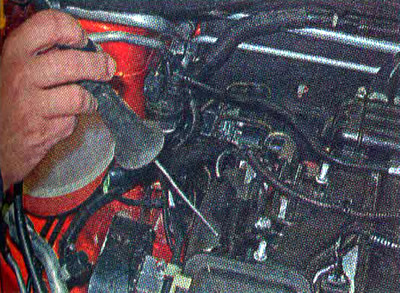
Based on the nature of the sound and the location of the sound emission, we determine the possible source of the sound and the possible malfunction.
Note: A clicking, ringing sound under the cylinder head cover usually indicates a faulty hydraulic compensator in the valve drive (see "Hydraulic tappets - removal and installation"), uniform noise in the timing belt area may indicate wear of the tension and guide roller bearings or the coolant pump bearing. Knocking noises in the lower part of the cylinder block and from the oil pan side, increasing with increasing crankshaft speed, are caused by faulty main bearings. In this case, as a rule, the oil pressure in the lubrication system is low. At idle, this sound is low-pitched, and as the revs increase, its pitch increases. When you press the gas pedal sharply, the engine makes something like a growl - like "gyr-r-r". The ringing knocks in the middle of the cylinder block are caused by a malfunction of the connecting rod bearings. A rhythmic metallic knock in the upper part of the cylinder block, audible in all engine operating modes and increasing under load, is caused by a malfunction of the piston pins. A muffled knocking sound from the top of the cylinder block on an unheated engine that subsides and disappears as it warms up can be caused by worn pistons and cylinders. Operating a vehicle with faulty bearings and pins will result in engine failure.
6. If oil consumption has increased and no signs of leakage are found:
- a) warm up the engine to operating temperature.
- b) disconnect the crankcase ventilation hose from the throttle valve.
- c) bring a sheet of paper to the hose. If oil stains appear on the paper, the cylinder-piston group is worn out. The degree of wear is determined by the compression in the cylinders (see "Compression in engine cylinders").
- d) if no oil mist comes from the ventilation system, then the reason for the increased oil consumption may be wear of the oil scraper caps (see "Valve stem seals - replacement"). In this case, the car will have smoky exhaust.
Warning! Running the engine with a worn cylinder-piston group, faulty oil seals or on low-quality fuel leads to failure of the catalytic converter and oxygen concentration sensor.
Recommendation. During vehicle operation, the engine compartment becomes heavily contaminated, but unlike the body and interior of the vehicle, it is usually neglected when visiting car washes. Therefore, it is necessary to periodically clean the engine and underhood space (see below).