



The cooling system is filled with ethylene glycol based coolant (antifreeze, antifreeze), non-freezing at ambient temperatures down to -40°C.
Water pump 10 (figure 4.8) centrifugal type provides forced circulation of coolant in the cooling system, is installed on the front plane of the cylinder block and is driven by a toothed belt of the camshaft drive. The water pump has sealed bearings that do not require relubrication. The water pump cannot be repaired if it fails (coolant leak or bearing damage) it is replaced as a whole.
Thermostat 5 with solid temperature-sensitive filler maintains normal operating temperature of the coolant and reduces engine warm-up time in a car. The thermostat has a main and additional (bypass) valves. At a coolant temperature of up to (85±2)°C, the thermostat is completely closed and the liquid circulates through a small circuit, bypassing the radiator, which accelerates engine warm-up. At a temperature of (85+2)°C the thermostat begins to open, and at 102°C it opens completely, ensuring circulation of the coolant through the radiator.
Electric fan engine cooling 9 (figure 4.9) with a plastic six-blade impeller provides air blowing through the radiator at low vehicle speeds, mainly in urban conditions or on mountain roads, when the oncoming air flow is insufficient to cool the radiator.
To improve the efficiency of operation, the electric engine cooling fan is installed in the casing 7 and attached to it at three points through rubber cushions. The casing, in turn, is attached to the radiator 3 at four points.
The electric cooling fan is controlled by the engine control unit, which receives information about the coolant temperature from sensor 6 (see figure 4.8), located in the thermostat socket 5.
Radiator 3 (see figure 4.9) tubular-plate, aluminum, with plastic tanks, two-way, with a partition in the left tank. At the bottom of the right tank there is a drain plug 5. The radiator tanks contain supply and outlet hose pipes to the engine water jacket and a hose pipe connecting the radiator to the expansion tank.
Expansion tank 12 serves to compensate for the changing volume of coolant depending on its temperature. The expansion tank is made of translucent plastic. The expansion tank walls are marked with "MAX" and "MIN" to control the coolant level, and the filler neck is located on top, hermetically sealed with a plastic plug 1 with two valves inside it (inlet and outlet), collected in a single block. The outlet valve opens at a pressure of 110 kPa (1.1 kgf/cm².), ensuring an increase in the boiling point of the coolant and preventing intensive vaporization. When the liquid cools, the volume of the coolant decreases and a vacuum is created in the engine cooling system. The inlet valve in the expansion tank cap opens at a vacuum of about 3 kPa (0.03 kgf/cm².) and the inlet valve in the plug allows air to pass into the expansion tank.
The interior heater radiator is connected to the engine cooling system via hoses.
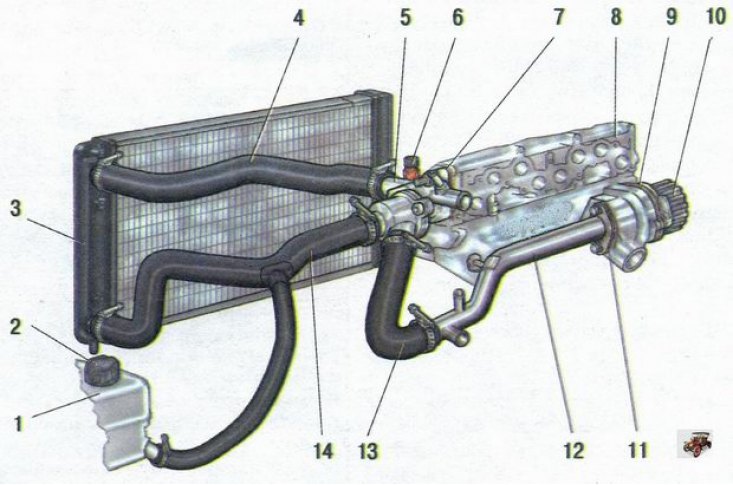
Figure 4.8. Engine cooling system: 1 - expansion tank; 2 - expansion tank cap; 3 - engine cooling system radiator; 4 - radiator supply hose; 5 - thermostat; 6 - Engine management system coolant temperature sensor; 7 - thermostat gasket; 8 - cylinder head; 9 - water pump gasket; 10 - water pump; 11 - laying the supply pipe; 12 - water pump inlet pipe; 13 - hose from thermostat to water pump inlet pipe; 14 - radiator drain hose assembly
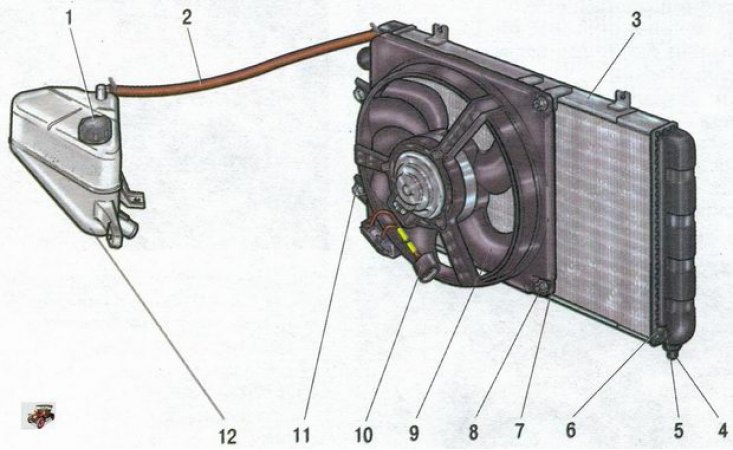
Figure 4.9. Radiator with electric fan and expansion tank: 1 - expansion tank cap; 2 - steam outlet hose; 3 - radiator; 4 - radiator support cushion; 5 - drain plug sealing ring; 6 - drain plug; 7 - Electric fan casing; 8 - nut; 9 - Electric fan; 10 - Electric fan wiring harness connector; 11 - bolt; 12 - expansion tank