



To replace the coolant in your car, you will need: a 13 mm open-end wrench, a screwdriver, coolant (antifreeze, antifreeze, etc.), and a clean rag.
Caution! Replace the coolant only when the engine is cold. Coolant is toxic, so be careful when handling it.
1. Place the vehicle on a level, horizontal surface. If the area is on a slope, park the car so that its front is higher than the rear.
2. Remove the engine splash guard from the vehicle (see "Removal and installation the engine mudguard").
Note: It is not necessary to remove the engine splash guard, but in this case you will have to take measures to prevent the coolant from spreading over the area under the car: if the coolant gets on the splash guard from the drain holes, it will splash heavily.
3. Disconnect the wire from the negative terminal of the battery.
4. To access the drain plug on the cylinder block, remove the ignition coil together with the bracket (see "Removal and installation the ignition coil").
5. Remove the expansion tank cap.
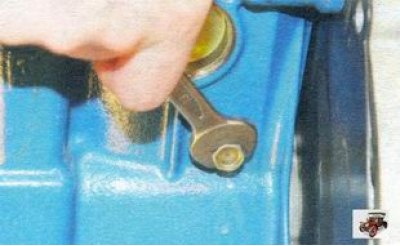
6. Place a container under the engine and remove the drain plug on the cylinder block. After draining the coolant, wipe any traces of it off the cylinder block.
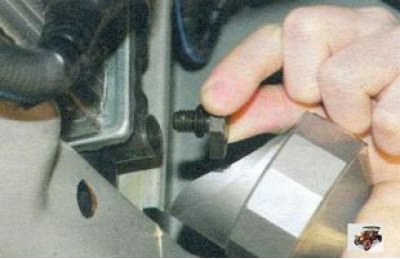
7. Place a container under the radiator, unscrew the drain plug on the radiator and wait until the coolant has completely drained from the cooling system.
8. Screw the plugs into the cylinder block and radiator.
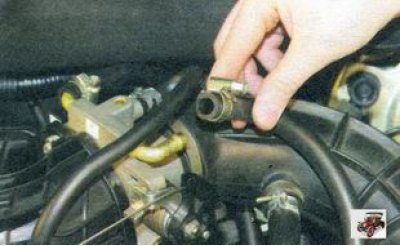
9. Loosen the clamp and disconnect the coolant drain hose from the throttle body heater fitting. This is necessary to ensure that air is released from the engine cooling system as it fills. If this is not done, then due to the formation of air locks, the coolant will not completely fill the system.
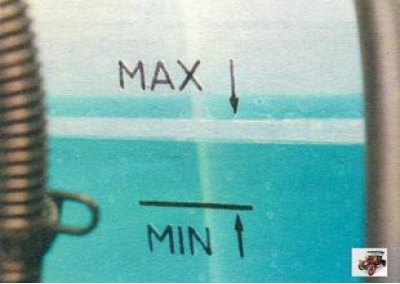
10. Fill the engine cooling system by pouring coolant into the expansion tank until it starts to flow out of the hose disconnected from the throttle body. At this point, put the hose back in place and tighten the clamp that secures it. Continue pouring in fluid until its level is 25-30 mm below the "MAX" mark on the wall of the expansion tank. Tighten the expansion tank cap.
Attention! Tighten the expansion tank cap tightly. When the engine is running, the expansion tank is under pressure, so coolant may leak from under a loosely tightened cap.
11. Install the ignition coil in place.
12. Connect the wire to the negative terminal of the battery.
13. Start the engine and let it warm up to operating temperature (before turning on the cooling fan). After this, turn off the engine, check the coolant level and, if necessary, add liquid up to the "MAX" mark on the wall of the expansion tank.