



To check the thermostat, start the engine of the car and touch the lower radiator hose with your hand - it should be cold. Once the coolant temperature reaches 85-92°C, the lower radiator hose should begin to heat up. If this does not happen, remove the thermostat and check its functionality.
To remove and install the thermostat on a car, you will need: a 5 mm Allen key and a Phillips-head screwdriver.
1. Remove the cap from the expansion tank. Unscrew the drain plug at the bottom of the right radiator tank and drain the coolant from it (see "Replacing the coolant"). Replace the drain plug on the radiator.
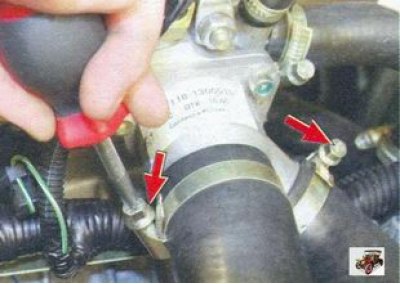
2. Loosen the two clamps securing the hoses to the thermostat cover and remove the hoses from the thermostat cover.
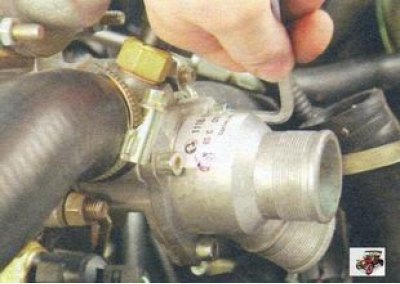
3. Unscrew the three bolts securing the thermostat cover and remove it together with the thermostat.
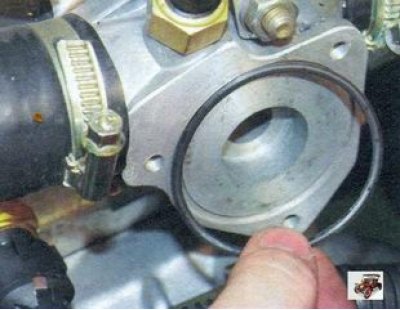
Note: Pay attention to the condition of the rubber sealing ring in the groove of the thermostat seat. Replace a sealing ring that is severely deformed, torn or has lost elasticity.
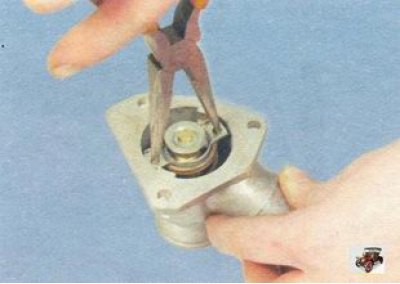
4. Overcoming the force of the spring, press the thermostat retaining plate down and, turning it in any direction, disengage it from the grooves.
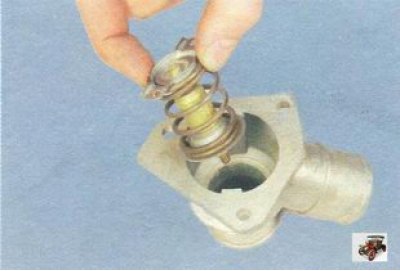
5. Remove the thermostat from the cover.
6. Before installing a new thermostat, test it by placing it in water heated to 78-80°C. Heat the water, stirring constantly, to a temperature of (87+2)°C.
Material was taken from the website: www.ladaman.ru
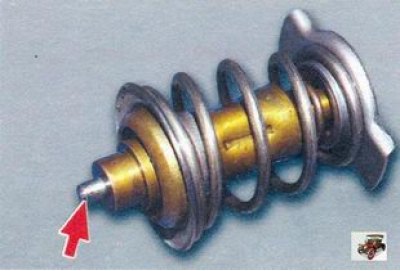
7. At a temperature of (87±2)°C the thermostat rod should begin to extend from the power element. If this does not happen, replace the thermostat.
8. Install the thermostat on the vehicle in the reverse order of removal.
9. Fill the engine cooling system with coolant (see "Replacing the coolant"). Tighten the expansion tank cap, start the car engine, check for coolant leaks through the thermostat hose connections and warm up the engine at idle speed to operating temperature to remove air locks from the system.