



The throttle position sensor is a potentiometer, one end of which is supplied with «plus» supply voltage (5 V), its other end is connected to «weight». From the third output of the potentiometer (from the slider) is an output signal to the controller. When the throttle is turned (from impact on the control pedal), the voltage at the output of the throttle position sensor changes. When the throttle is closed, it is lower than 0.7 V. When the throttle is opened, the voltage at the output of the TPS (throttle position sensor) increases and at full throttle should be more than 4 V. By monitoring the output voltage of the TPS (throttle position sensor), the controller adjusts the fuel supply depending on the throttle opening angle (those. at the request of the driver). Throttle position sensor does not require adjustment as the controller senses idling (those. full throttle closing) as a zero point.
In the event of a malfunction of the TPS (throttle position sensor) the controller memorizes the sensor fault code, turns on the engine control system warning lamp and calculates the estimated value of the throttle opening angle from the crankshaft speed and mass air flow.
For replacement on a TPS car (throttle position sensor) you need to do the following.
1. Disconnect the wire from the terminal «minus» battery.
2. Disconnect the wiring harness connector from the terminals of the TPS (throttle position sensor), by releasing the plastic latch.
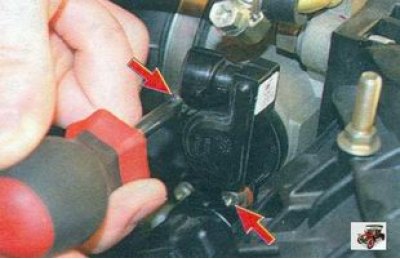
3. Remove the two mounting screws and remove the throttle position sensor from the throttle assembly (for clarity, the throttle assembly is removed).
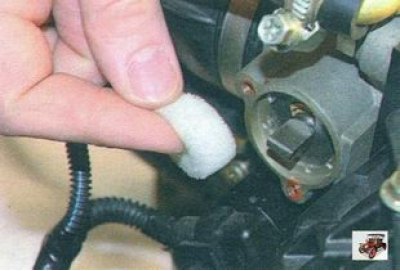
4. Install TPS on the car (throttle position sensor) in reverse order. Pay attention to the condition of the foam rubber sealing ring: if the ring is damaged, replace it with a new one.