
Car repair AvtoVAZ Car repair Renault Car repair Hyundai Car repair Ford Car repair Volkswagen Car repair Audi Car repair Chevrolet
English Русский
Български
Беларускі
Український
Српски
Hrvatski
Română
Polski
Slovenský
Magyar
articles sitemap contacts bookmark
LadaMan.ru


Kalina Granta Priora Vesta Largus XRAY
Kalina Sedan (2004-2013, VAZ-1118) Kalina Hatchback (2004-2013, VAZ-1119)

Problems with brakes on the car (Kalina 1118)

  • Main
  • Kalina
  • Kalina Sedan
  • General information
  • Faults en route
  • Problems with brakes on the car
0
Contents: Bleeding the brake system ⇣ Checking the brake system ⇣
The car's braking system is equipped with a vacuum booster and is quite effective. A decrease in braking efficiency and skidding of the car when braking should be a signal for an urgent brake check.

The car's braking system is equipped with a vacuum booster and is quite effective. A decrease in…


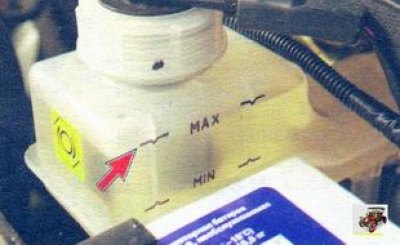
Caution: Check the brake fluid level in the master cylinder reservoir regularly. With the plug installed, the level should be at the lower edge of the brake reservoir neck, and with the plug removed, it should be near the "MAX" mark on the brake reservoir body.


Car manufacturers recommend changing all brake fluid in the brake system after 3 years or 45,000 km (whichever comes first).

Some drivers ignore this advice because the brake fluid in the brake reservoir seems clean enough to them, and this is completely in vain. The fact is that brake fluid is very hygroscopic: it absorbs moisture from the air, and this moisture over time not only destroys the surfaces of brake cylinders, pipelines and, as a result, leads to premature failure of brake system components, but also significantly reduces the boiling point of the brake fluid. Normal boiling point of brake fluid "Neva" - 190°C, "Tom" - 210°C, "Dew" - 260°C. During frequent heavy braking, the front wheel disc brakes get very hot, and if the water content is high, the brake fluid can boil, which usually leads to brake failure. If you experience problems with your brakes, bleed the brake system on your vehicle (see "Bleeding the brake system"). If bleeding the brakes on a vehicle does not produce the desired result, the entire brake system must be thoroughly checked as described below (see "Checking the brake system").


Bleeding the brake system


If the brake pedal has become "soft" and becomes "harder" after several consecutive presses, this means that air has entered the hydraulic brake drive.

To remove air from the brake system, it is necessary to bleed the brakes. The procedure for bleeding the brakes on a car is quite simple, but it is more convenient to do it with an assistant.

You will find a detailed description of bleeding the brake system in the section. "Brake system" (see "Bleeding the brake system").

Checking the brake system


1. The loss of braking efficiency may be caused by poor operation of the vacuum booster. To quickly check the vacuum booster, press the brake pedal several times with the engine off to relieve the vacuum in the vacuum booster, and then, while holding the brake pedal, start the engine. If the brake pedal drops slightly after starting the engine, the brake booster is working properly.
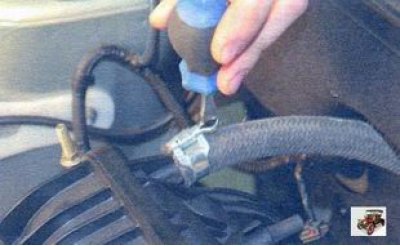
1. The loss of braking efficiency may be caused by poor operation of the vacuum booster. To quickly…


2. If the brake pedal remains motionless, check the integrity and reliability of the connection of the vacuum booster hose to the fitting on the engine intake pipe...
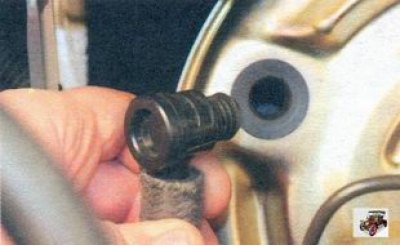
2. If the brake pedal remains motionless, check the integrity and reliability of the connection of…


3. ...and with a check valve. Replace or repair the faulty hose. If the hose is in good condition, the vacuum booster needs to be replaced (see "Removal and installation the brake booster").


If braking is accompanied by beating and pulsation of the brake pedal, you should first check the condition of the front brake discs.

4. After placing the car on a jack, remove the front wheel and inspect the brake disc. The thickness of the brake disc must be at least 17.8 mm, the surface of the disc must be even and smooth on both sides. If the disc surface is covered with rust in places, which usually happens after the car has been parked for a long time with the brakes not dried, try cleaning the working surface with a fine sandpaper. If this procedure does not help, you will have to send the brake discs for grinding or replace them with new ones.
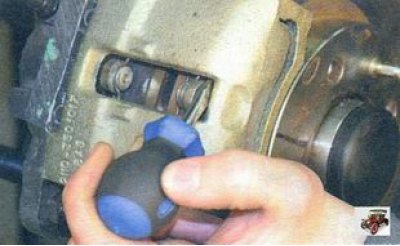
4. After placing the car on a jack, remove the front wheel and inspect the brake disc. The…


5. Check the mobility of the brake piston. To do this, use two screwdrivers to try to move the brake caliper from its place. If the brake caliper cannot be moved, it means that the piston in the brake cylinder is jammed.


This article is available at russian, bulgarian, belarusian, ukrainian, serbian, croatian, romanian, polish, slovak, hungarian
This article has been reviewed: Daniil Markelov
Share with friends:
◀ Previous
Lada Kalina Sedan: Faults en route
Next ▶

There are strange knocking sounds in the car
Starting the engine from external sources
Vehicle electrical equipment faults
The battery is not charging
Engine overheating and cooling system check
Puncture and replacement of a wheel
More articles with information from manuals for Lada:

• Brake problems Lada Priora 1 (2007-2018, VAZ-2170)
• Bleeding brakes Lada Largus 1 (2012-2023)
• Troubleshooting Clutch Problems Lada X-Ray 1 (2015-2022)
Link to this article in various formats
Reviews and comments of visitors
No comments yet


Add up two numbers: 46 + 48


Kalina Sedan (2004-2013) 
  • General information
  • Vehicle device
  • Operation and maintenance
  • Faults en route
  • Power unit
  • Engine repair
  • Cooling and lubrication system
  • Exhaust system
  • Supply system
  • Ignition and control
  • Transmission
  • Clutch and drive shafts
  • Car gearbox
  • Chassis (running gear)
  • Front suspension
  • Rear suspension
  • Steering
  • Brake system
  • Body and interior
  • Exterior (external elements)
  • Interior (internal elements)
  • Doors, locks and windows
  • Electrical equipment
  • Equipment and devices
  • Power devices
  • Lighting and signaling
  • Heating and ventilation
Kalina Hatchback (2004-2013) 
  • General information
  • Vehicle Details
  • Maintenance
  • Troubleshooting
  • Power unit
  • Engine repair
  • Cooling system
  • Supply system
  • Control system
  • Exhaust system
  • Transmission
  • Clutch
  • Car gearbox
  • Drive shafts
  • Chassis (running gear)
  • Wheels and tires
  • Front suspension
  • Rear suspension
  • Steering
  • Brake system
  • Body and interior
  • Exterior (external elements)
  • Interior (internal elements)
  • Doors, locks and windows
  • Electrical equipment
  • Equipment and devices
  • Power devices
  • Lighting and signaling
  • Electrical circuits
LadaMan.ru © 2018–2026 | Mobile version | About Lada | Sitemap: EN BG BY UA RS HR RO PL SK HU | Contacts with admin | | Add to bookmarks
Kalina Hatchback (2004-2013) | Kalina Sedan (2004-2013) | Granta 1 (2011-2023) | Priora 1 (2007-2018) | Vesta 1 (2015-2023) | Largus 1 (2012-2023) | X-Ray 1 (2015-2022) |
This site uses cookies to ensure everything runs smoothly.