



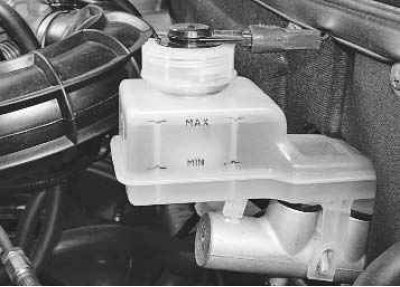
Caution: Check the brake fluid level in the master cylinder reservoir regularly. The level should be at the "MAX" mark or just below the master cylinder reservoir.
Caution! A drop in the fluid level indicates either a leak of brake fluid from the system or excessive wear of the brake pads. If the low brake fluid light comes on in the instrument cluster, do not rush to top it up immediately, first check the thickness of the brake pads: maybe it is time to replace the pads?
Car manufacturers recommend replacing all brake fluid in the system after a certain period. Some drivers ignore this advice because the fluid in the tank seems clean enough to them, and this is completely in vain. The fact is that brake fluid is very hygroscopic - it absorbs moisture from the air, and this moisture over time not only destroys the surfaces of brake cylinders, pipelines and, as a result, leads to premature failure of brake system components, but also significantly reduces the boiling point of the brake fluid. Normal boiling point of brake fluid "Neva" – 190°C, "Tom" – 210°C, "Dew" – 260°C. During frequent heavy braking, the front wheel disc brakes become very hot and if the water content is too high, the brake fluid can boil, which usually leads to brake failure.
Note: In order to avoid unexpected expenses in the future for repairs not only of the brake system, but of the entire car, it is better to replace the fluid in the brake system in a timely manner.
If the brake pedal becomes "soft" and becomes "harder" after several consecutive presses, this means that air has entered the hydraulic brake drive. It could have entered the system during repairs, replacement of brake fluid, depressurization of the system due to damage to tubes and hoses, or a drop in the brake fluid level in the master cylinder reservoir.
To remove air from the system, it is necessary to bleed the brakes according to the procedure described in section. "Brake system" (see "Bleeding the hydraulic brake system").
The reason for the loss of braking efficiency may be poor operation of the vacuum booster.
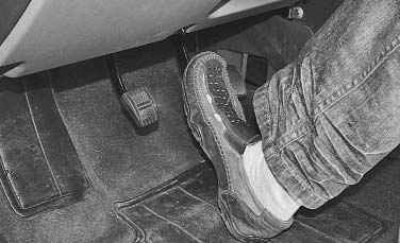
To quickly check it, press the brake pedal several times with the engine off to remove the vacuum in the booster, and then, holding the pedal, start the engine. If after starting the engine the pedal drops slightly, the vacuum booster is working properly.
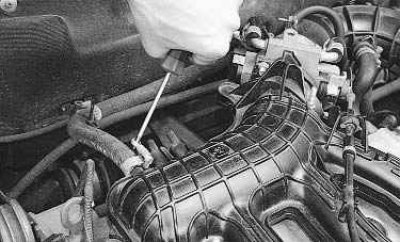
1. If the pedal remains motionless, check the integrity and reliability of the connection of the vacuum booster hose to the fitting on the engine intake pipe...
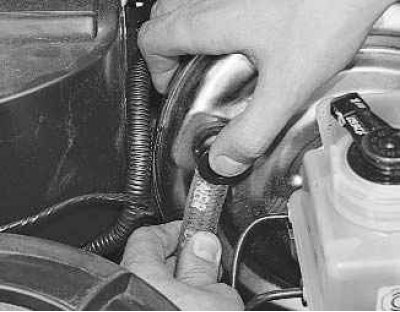
2. ...and with a check valve. Replace or repair the faulty hose. If the hose is in good condition, the vacuum booster needs to be replaced (see "Removing and installing the brake booster").
If braking is accompanied by beating and pulsation of the brake pedal, you should first check the condition of the front disc brakes.
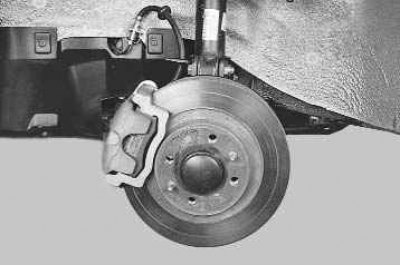
3. After placing the car on a jack, remove the front wheel and inspect the brake disc. The thickness of the brake disc must be at least 17.8 mm. The surface of the disc must be flat and smooth on both sides. If the disc surface is covered with rust in places, which usually happens after a long period of parking of the car with un-dried brakes, try cleaning the working surface with a fine sandpaper. If this procedure does not help, you will have to send the discs for grinding or replace them with new ones.
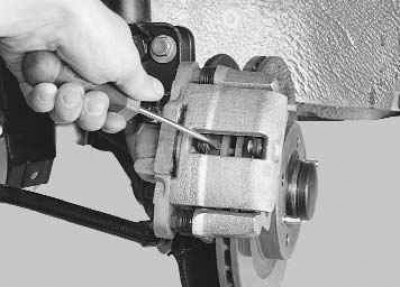
4. Check the mobility of the brake pads. To do this, use a screwdriver to try to move the pads away from the brake disc. If the pads cannot be separated, it means that the piston in the brake cylinder is jammed.
Attention! Jamming of the brake cylinder piston leads to constant braking of the corresponding wheel when the pedal is released and skidding of the car when braking.
Note: The parking brake applies the rear brakes via a cable that connects the parking brake lever and the brake shoe control mechanism. Many drivers try to use the parking brake as little as possible in order to extend its life, and achieve the opposite result. If you do not use the parking brake, dirt and moisture will accumulate in the cable sheaths, the cable will become covered with rust, stop moving and break. Therefore, use the parking brake whenever necessary, but do not forget to adjust its drive from time to time.
According to the manufacturer, the travel of the parking brake lever should be:
- when adjusted 2-4 clicks;
- in operation 2-8 clicks.
A properly adjusted parking brake should hold the vehicle on a 25% incline.
If the parking brake lever is raised more than 8 clicks when the vehicle is braked, the vehicle will not hold on the slope. If the lever travel is less than 2 clicks, partial wheel locking may occur while the vehicle is moving. In both cases, the parking brake must be adjusted according to the procedure described in section. "Maintenance" (see "Checking and adjusting the parking brake drive").