



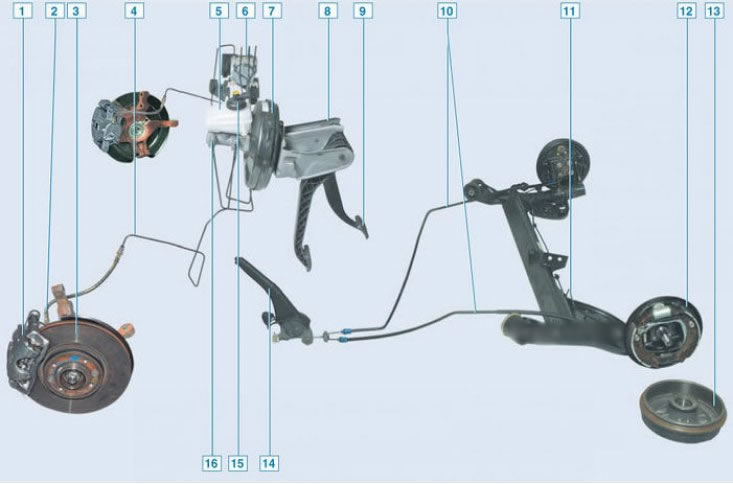
The structure of the braking system with ABS: 1 – front brake caliper; 2 – front wheel brake hose; 3 – front brake disc; 4 – front wheel brake pipe; 5 – brake fluid reservoir; 6 – ABS block; 7-vacuum booster brake system; 8 – pedal assembly; 9 – brake pedal; 10 – manual cable (parking) brakes; 11 – rear wheel brake pipe; 12 – rear wheel brake mechanism; 13 – rear wheel brake drum; 14 – manual lever (parking) brakes; 15 – sensor indicating low brake fluid level; 16 – master brake cylinder
The braking system consists of front and rear brake mechanisms, a brake drive and a parking brake drive.
The front brake mechanism is disc, with a movable caliper and automatic adjustment of the gap between the disc and the pads.
The rear brake mechanism is drum, with self-adjusting shoes and automatic adjustment of the gap between the shoes and the drum.
The brake drive is foot-operated, hydraulic, dual-circuit with diagonal separation of circuits, with a vacuum booster and pressure regulator.
The optional design includes an anti-lock braking system (ABS) with electronic distribution of braking forces along the vehicle axles.
The parking brake is manual, with a cable drive to the brake pads of the rear wheels.
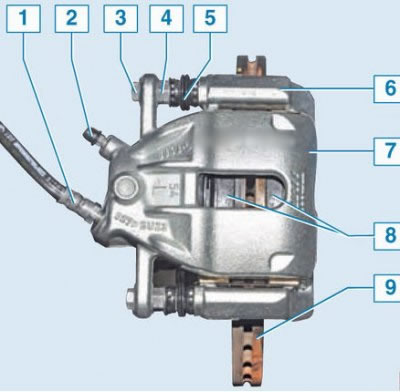
Front brake mechanism design: 1 – brake hose; 2 – Brake bleed nipple; 3 – bolt securing the bracket to the guide pin; 4 – guide pin; 5 – protective cover of the guide pin; 6 – brake shoe guide; 7 – front brake caliper; 8 – front brake pads; 9 – front brake disc
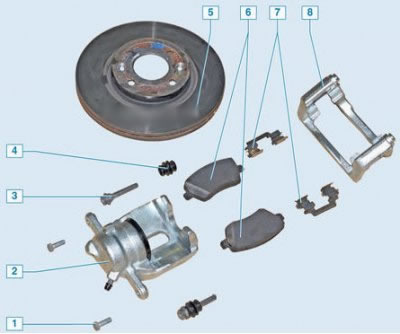
The same in disassembled form: 1 – bolt for fastening the bracket to the guide pin; 2 – front support; 3 – guide pin; 4 – protective cover of the guide pin; 5 – front brake disc; 6 – front brake pads; 7 – spring clamps of the pads; 8 – shoe guide
Replacing the front brake pads is described here
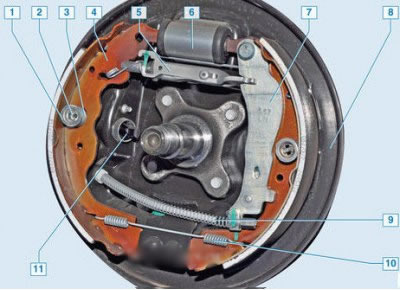
Rear brake mechanism device (brake drum removed): 1 – cup of the brake shoe pressure spring; 2 – support stand of the shoe; 3 – brake shoe pressure spring; 4 – front rear brake shoe; 5 – spacer bar with automatic gap adjuster; 6 – working brake cylinder; 7 – rear brake shoe with lever and mount for handbrake cable; 8 – brake shield; 9 – handbrake cable; 10 – lower tension spring; 11 – ABS sensor
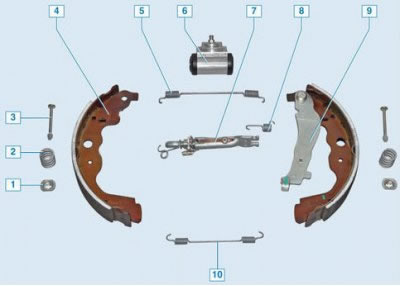
The same in disassembled form: 1 – cup of the brake shoe pressure spring; 2 – brake shoe pressure spring; 3 – support stand of the shoe; 4 – front rear brake shoe; 5 – upper tension spring; 6 – working brake (wheel) cylinder; 7 – spacer bar; 8 – clearance adjuster spring; 9 – rear shoe with handbrake cable mounting lever; 10 – lower tension spring
Replacing the rear brake pads is described here.
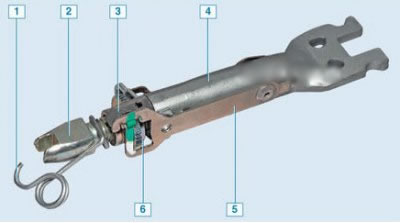
Automatic adjustment mechanism for the gap between the brake shoes and the brake drum: 1 – threaded tip coil spring; 2 – threaded end of the spacer bar; 3 – spring regulator lever; 4 – spacer bar; 5 – leaf spring; 6 – ratchet nut
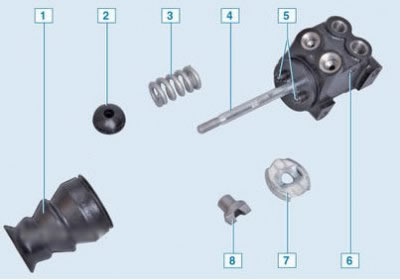
Rear brake pressure regulator (for cars with ABS): 1 – anther; 2 – support sleeve; 3 – spring; 4 – pressure regulator pin; 5 – pressure regulator pistons; 6 – body; 7 – thrust washer; 8 – guide bushing
The rear brake pressure regulator is located between the body and the rear suspension beam.
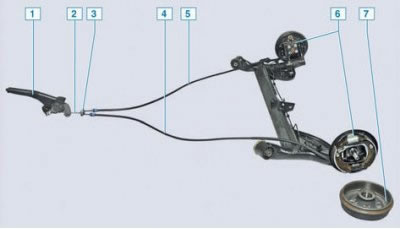
Handbrake device: 1 – handbrake lever; 2 – front (small) handbrake cable; 3 – cable equalizer; 4 – left rear cable; 5 – right rear cable; 6 – rear brake mechanism; 7 – rear brake drum
Replacing the handbrake cables is described here.
Recommendations for the brake system
- We recommend that you replace the brake fluid at least once every 1.5-2 years. During operation, the brake fluid inevitably absorbs moisture, and its boiling point decreases. During intensive braking, it can boil in the working cylinders, causing an air lock to appear in them, which will not allow the necessary pressure to be created, and the efficiency of the braking system will deteriorate sharply. Check the brake fluid level periodically. If it starts to decrease quickly, it means there is a leak – contact the service immediately. If the level is decreasing, but slowly (smoothly over a mileage of about 10-20 thousand kilometers) and has reached the minimum – check the condition of the brake pads.
- It is advisable to change the brake pads/discs if the wear percentage has reached 70% or more, since it is impossible to monitor their condition often, and in addition, the inner pad wears out more. Maintaining the braking system in good condition is the key to your and your loved ones' safety on the road.
- Use only original and high-quality spare parts in your vehicle's braking system. Brake pads of dubious quality may not withstand the heat during emergency braking and will not stop the car. They may have a shorter service life, squeal when braking, or wear out brake discs quickly. Non-original discs may be "slippery" and not provide effective braking, may wear out quickly, and may warp from slight heating.
- We recommend cleaning the brake calipers after each winter along with tire fitting. Under the influence of winter salts, corrosion and souring of the caliper parts occurs. As a result, the caliper loses its mobility, especially on the side of the inner pad. The caliper becomes "tight" and when the brake pedal is released, its moving part does not return back. The pads begin to wedge slightly and imperceptibly. This leads to premature wear of the brake pads and discs and can lead to failure of the braking system if overheated.
- In winter, do not leave the car on the parking brake for a long time, as the pads may freeze. It is better to put the car in gear or in "park" if you have an automatic transmission.
- When replacing brake pads, it is recommended to resurface the brake discs. During operation, not only the pads but also the discs wear out. Their surface becomes eroded, and grooves may form due to sand and dirt getting in. The surface of the old brake pads completely matched the surface relief of the disc. And if you install new pads on an old disk, they will not be able to contact the disk with their entire area and braking efficiency will decrease sharply. Some services have equipment that allows you to perform disc turning without removing them from the car.