



Amount of brake fluid: 0.5 liters.
Type of fluid used: DOT-4 (ELF 650).
We carry out the work on an inspection ditch or overpass.
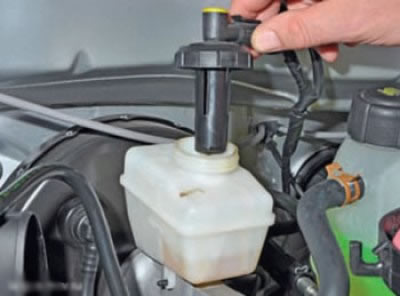
We unscrew and remove the cover with the sensor without disconnecting the wiring block from the sensor.
At this point, you can check the serviceability of the liquid level sensor. For this…
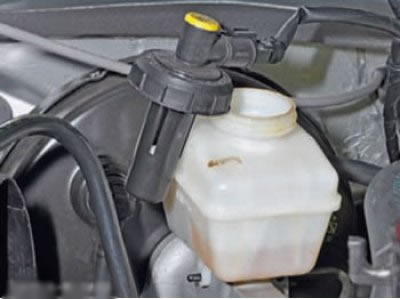
...we place the sensor in a vertical position on the tank and turn on the ignition.
If the sensor is working properly, the parking brake and brake system malfunction indicator in the instrument cluster should light up (the parking brake lever must be fully lowered when checking).
We pump out the old liquid from the tank using a rubber bulb or a regular syringe..
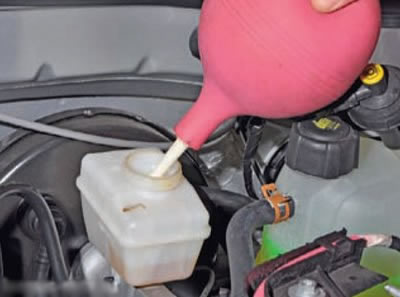
We replace it by topping up and pumping (see below).
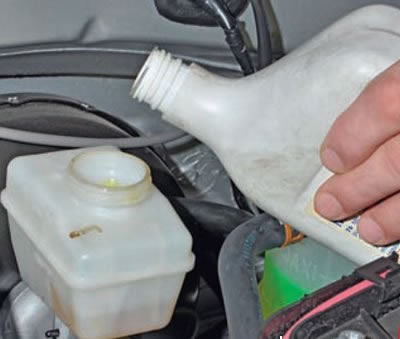
Bleed the brake system (see "Bleeding the brake system") and clutches (see "Clutch bleeding") until the new liquid (lighter than the old one) will not start to come out of the bleeding nipples of all working cylinders.
After bleeding the brake and clutch hydraulic drives, bring the fluid level in the reservoir to normal.
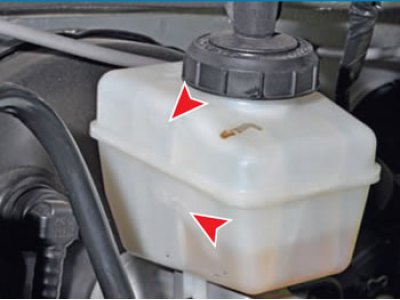
Min and Max marks on the brake fluid reservoir
Addition:
Everyone knows that brake fluid is hygroscopic and that it needs to be changed from time to time. By the word "change" car manufacturers mean a complete replacement of the fluid in the system, including the ABS and ESP units, if present. But in reality, it happens, especially when the repair area is inaccessible to the client, that the brake fluid is replaced using an extremely simplified scheme: the mechanic sucks out the old, cloudy and dirty brake fluid from the tank with an ordinary enema and pours in new, transparent and clean fluid. Even if the client looks under the hood after the replacement, he won't see anything criminal there - the fluid is clean, what's the question?
It is clear that no one cares about the client except for him, but in the brake circuits and electronic units there is brake fluid that has been absorbed by water, which is absolutely not what should actually be there. Even if you are lucky and after a series of intensive braking the circuits do not boil after such a "replacement" and the pedal does not become stuck, then you can not count on electronic assistants - ABS and ESP units are very sensitive to the moisture content in glycol - usually 0.4% of water is enough for the electronic unit to stop working adequately. By the way, depending on the car brand, the ABS and ESP systems are bled differently. The mechanic, of course, should know how exactly, otherwise it is worth looking for another place for maintenance. So, when replacing brake fluid, the main condition for replacement should be access to the repair area - it is not right to risk your safety for the sake of another hack.
We will not consider the agony of choosing brake fluid today, but it is worth remembering that the next product may turn out to be better, the main thing is not to confuse polyglycol with silicone. Fortunately, there are usually warnings on the packaging. Knowing about the problems with the integrity of servicemen and the careless attitude of consumers towards maintenance, Bosch recently released a liquid under the ENV brand, which lasts up to four years instead of the previous two, which is encouraging. Perhaps, of course, Bosch was more concerned about the performance of its new generation ESP, with serial number 9.3, and its reputation, but it did not forget about safety either.