



Attention. Replace brake pads as a set on wheels of one axle. Installation of brake pads from different manufacturers or different types on wheels of the same axle is not permitted.
You can check the thickness of the brake pads through the hole in the caliper. If it is less than that indicated in the table below, replace the pads.
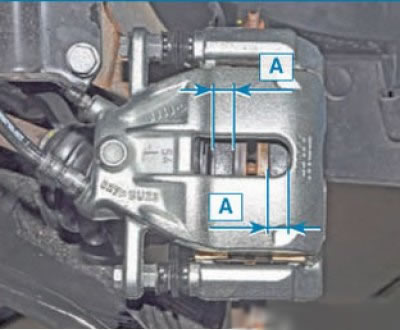
If dimension A is less than 6 mm, the pads must be replaced.
The brake pad parameters are shown in Table 8-1.
Table 8-1
| Parameter | R90 | F90 | |
| Engine model | K7M | K4M | K7M, K4M |
| Nominal thickness of brake pads (including backing), mm | 18,0 | 17,7 | 17,7 |
| Minimum permissible thickness of brake pads (including backing), mm | 6,0 | 6,0 | 6,0 |
For part numbers of brake pads and other front brake components, see here (depending on the presence of ABS).
Helpful tips:
- After replacing worn brake pads with new ones, do not rush to immediately drive onto busy highways. It is possible that during the first intensive braking you will be unpleasantly surprised by the low efficiency of the brakes, although the brake pads are original. Brake discs also wear out, and new pads only touch them with their edges, providing virtually no braking. Choose a quiet street or a driveway and brake gently several times to allow the pads to rub in and fit over their entire surface. At the same time, evaluate the effectiveness of the brakes.
- Try not to brake sharply for at least the first 100 km. If unburned pads become very hot, the top layer of their linings will burn and the brakes will not be maximally effective for a long time.
Removal
Place the vehicle on a two-post lift, apply the parking brake and turn off the ignition.
Remove the front wheels. Raise the vehicle to a height convenient for performing work. Clean the front brake parts (metal brush).
Spread the pads. To do this, you need to move the piston as far inside the wheel cylinder as possible. When performing this operation, unscrew the brake fluid reservoir cap and monitor the brake fluid level, remove excess fluid (flat screwdriver, syringe or rubber bulb, container).
Insert a screwdriver through the hole between the brake disc and the caliper and, using it as a support, move the bracket, pushing the piston into the cylinder.
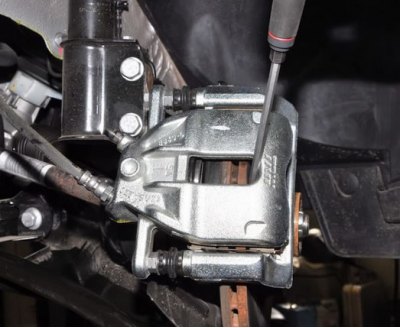
For LADA LARGUS R90 cars with K7M engine
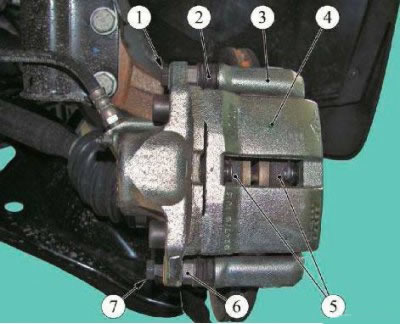
Figure 8-1 - Front Brake Caliper: 1.7 - guide pin mounting bolts; 2 - protective cover for the guide pin; 3 - front brake guide; 4 - support; 5 - brake pads; 6 - guide pin
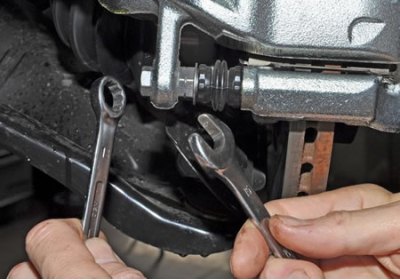
Loosen and remove the lower bolt 7, Figure 8-1, securing the guide pin, holding the guide pin 6 with a wrench (13 and 15 wrench).
Article based on data from the website: LADAMAN.RU
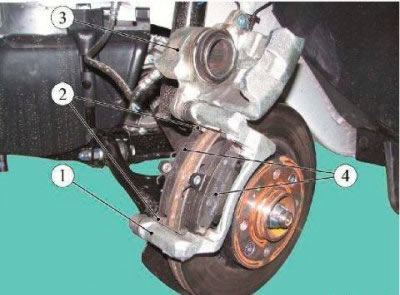
Turn the caliper bracket upward.
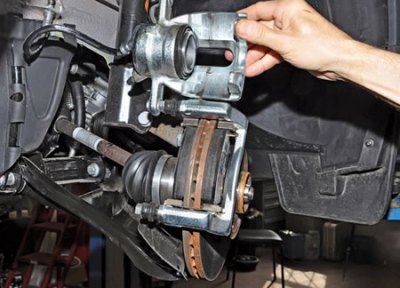
Figure 8-2 - Caliper Bracket Raised: 1 - front brake guide; 2 - noise-reducing plates; 3 - support; 4 - brake pads
Remove brake pads 4,
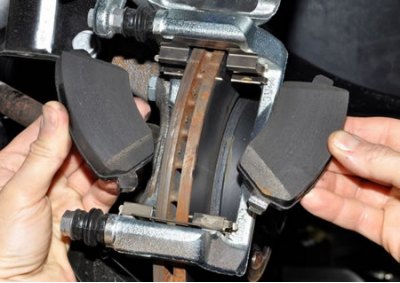
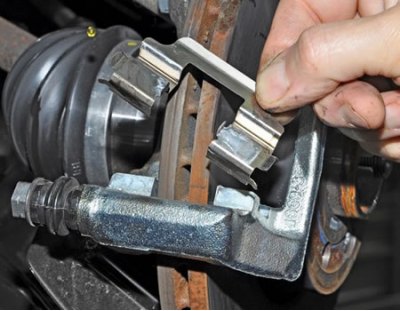
as well as two spring noise-cancelling plates 2.
For LADA LARGUS R90 cars with K4M engine and LADA LARGUS F90 cars
Remove spring 3, Figure 8-3 from the holes in front brake caliper 2 (flat head screwdriver, pliers).
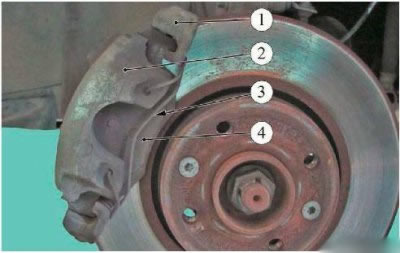
Figure 8-3: 1 - front brake guide; 2 - support; 3 - caliper spring; 4 - brake pads
Remove protective caps 4, Figure 8-4, from the guide pin wells (flat head screwdriver).
Unscrew and remove guide pins 5 (replaceable attachment with external hexagon 7 type "INHEX" 03 05 00 07 f. "Stahlwille", ratchet wrench).
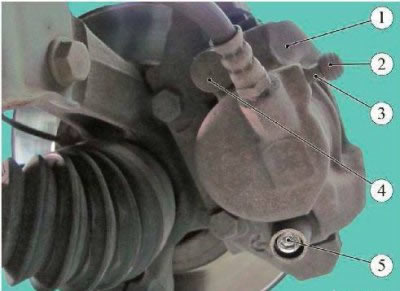
Figure 8-4: 1 - support; 2 - protective cap of the bleed nipple; 3 - bleed nipple; 4 - Protective cap of the guide pin; 5 - guide pin
Remove and hang the front brake caliper 1 to the suspension spring (technological hook).
Attention. To prevent damage to the brake hose, do not subject it to stretching or twisting loads, and also avoid contact of the hose with sharp edges of the vehicle suspension parts.
Remove the front brake pads.
Installation
Check the thickness of the brake pads according to Table 8-1 and replace if necessary.
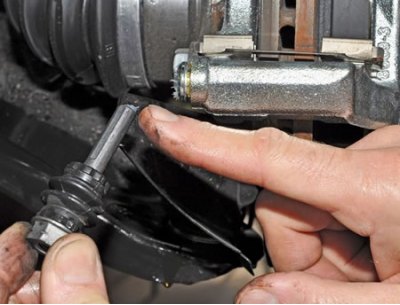
Check the condition of the working piston dust cap, the guide pin dust covers and replace if necessary. To do this, remove the guide pin from the hole in the guide shoe and replace the boot
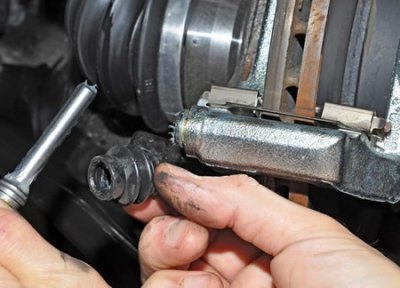
To replace the upper pin boot, you need to unscrew the bolt that secures the bracket to the pin and remove the bracket from the pad guide.
Before installing the pin, apply a little grease to it, as well as into the hole in the guide.
For LADA LARGUS R90 cars with K7M engine
Attention. (according to the company's technical instructions) After removal, bolts 1, 7, Figure 8-1, fastening the guide pins must be replaced, since the bolts are fixed with an adhesive compound applied to the threaded surface of the bolt. Reuse of bolts is not permitted.
Attention. (according to the company's technical instructions) When replacing the pads, replace the noise-suppressing plates 2, Figure 8-2, with new ones.
Install new noise-suppressing plates into the front brake guide and install the brake pads.
Turn the caliper down and secure it with the guide pin mounting bolt, having first applied adhesive to the threaded part of the bolt "FRENETANCHE" in the amount of 1 g. Bolt tightening torque 34 N·m (3,4 kgf·m) spare part number 77 11 236 471).
If it is not possible to lower the caliper bracket because the piston is protruding from the wheel cylinder, then we press it down using large pliers and lower the caliper bracket onto the pads.
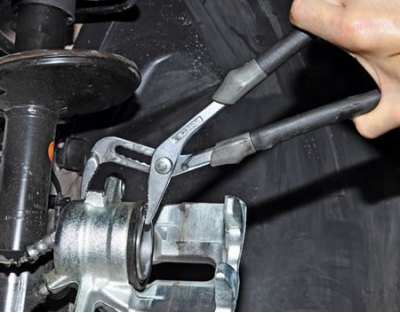
For LADA LARGUS R90 cars with K4M engine and LADA LARGUS F90 cars
Install the brake pads into the front brake guide.
Install the front brake caliper onto the guide and secure it with the guide pins. Tightening torque of guide pins 28 Nm (2.8 kgf·m) (replaceable nozzle with external hexagon 7 type "INHEX" 03 05 00 07 f. "Stahlwille", ratchet wrench, torque wrench).
Install protective caps into the guide pin wells.
Install the spring into the caliper holes (pliers, flat screwdriver).
For everyone
Install the front wheels.
Press the brake pedal 2-3 times, check and, if necessary, top up the brake fluid level in the brake hydraulic reservoir. Replace the brake fluid reservoir cap.
Check the efficiency of the service brake system.
About some features of replacing brake pads
Even a simple replacement of brake pads is fraught with unpleasant surprises, let alone more serious repairs, so it is advisable to monitor what is happening in the repair area if possible. All the bypass technologies that negligent servicemen use are well known to most people, so the customer's task is to prevent them from being used on his car.
So, replacing the brake pads. Let's go in order from the most egregious violations of technology to the less egregious.
1. Most vehicles are equipped with floating caliper calipers. There are exceptions, but monolithic multi-piston calipers are found mainly on powerful and premium equipment, however, this does not change the essence of the matter. By the time the pads wore out, the caliper piston had protruded quite a bit. To get the new pads into place, the piston needs to be pushed back in. How? If the mechanic grabbed two mounting blades and is going to do this operation with them, stop him - you will save on a new caliper, not right now, of course, but in six months or a year. The fact is that in nine cases out of ten one of the blades will slip and is guaranteed to pierce the piston dust cover, sand, water, dirt will start getting in there, the caliper will jam over time and will have to be replaced. This situation is one of the most common, one of my clients had his boots torn at every brake pad change, and at the company service.
2. "Fast is never good" is a well-known saying, but there is a great temptation to do everything quickly, get money from the client and work on another car. The approach is wrong, but quite common. When replacing the pads, it is necessary in any case to check the integrity of all the dust boots, pay attention to the condition of the bracket guides, the ease and smoothness of its movement. It would be desirable, of course, to disassemble and lubricate everything, but in our reality this is more of a fantasy. But if the pads wear unevenly, this must be done without fail. If the friction layer has become jammed, this means that one of the guide pins is jammed and you cannot put off checking the guides for later - this could result in failure during braking. It is absolutely not recommended to replace special lubricants that are placed in the moving parts of brake mechanisms with something "universal" that does not tolerate high temperatures.
Now a little about the timing of replacement of pads and discs, "non-original", turning and other elements of the system and related activities. Modern brake pads usually signal wear themselves - either with the help of built-in sensors, or with rather primitive but effective "squeakers" - metal plates that, when critically worn, reach the brake disc and begin to make an unpleasant loud squeal. Now you can't put off maintenance for long, even if you see that there still seems to be a friction layer left on the pads. There is almost none left, believe me, although visually it may not look that way. Why? The thing is that those 2-3 mm that you see not yet worn out are not actually a braking layer - this is a special glue that holds the friction base, and it will brake poorly. In general, this glue is quite powerful in its characteristics and is developed by each company according to its own recipes. Judge for yourself what serious loads the shoe experiences in terms of shear and pressure, but this glue is designed for anything but friction work.