



Note: Catalog numbers of the brake disc and related parts see here.
Removal
Loosen the wheel bolts, place chocks under the rear wheels. Engage the handbrake. Using a jack, lift the front of the car, place it on reliable supports, and remove the wheel.
If the work is carried out on a lift: place the vehicle on a two-post lift, apply the parking brake and turn off the ignition. Remove the front wheel. Raise the vehicle to a height convenient for performing work.
Clean the front brake parts (metal brush).
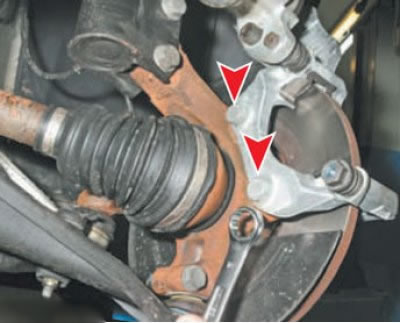
Loosen and remove the two bolts securing the front brake guide to the steering knuckle (replacement head 18, extension and ratchet) (for details see Removal the brake caliper),
[The text of the article was taken from the website www.LadaMan.ru]
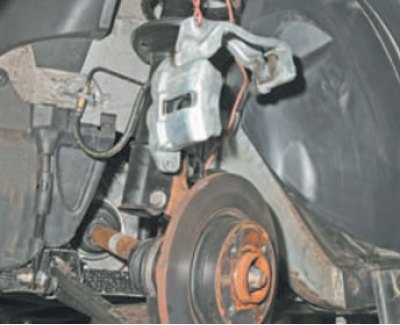
Remove the front brake (caliper) assembly and hang it on the suspension spring. There is no need to disconnect the brake hose, but make sure that it is not overtightened or kinked.
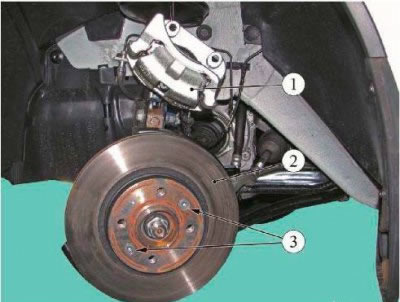
Figure 11-1 - Removing the brake disc: 1 - front brake mechanism; 2 - front brake disc; 3 - brake disc mounting screws
Loosen and remove the two screws 3, Figure 11-1, securing the brake disc to the front wheel hub (torx T40 replacement bit, extension, ratchet wrench).
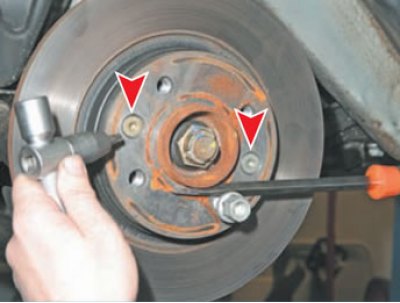
To prevent the disc from turning, you can screw a wheel mounting bolt into the threaded hole in the hub and insert a mounting blade between the bolt and the hub flange.
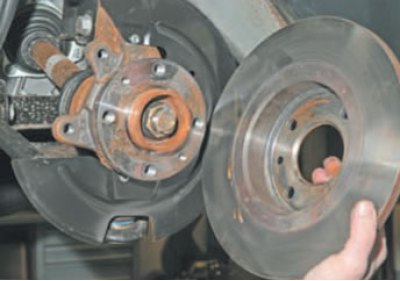
... and remove the brake disc.
Checking the technical condition
Look Complete inspection of brake discs.
Please note: Brake discs cannot be ground. If there is significant wear or deep scratches, the discs must be replaced.
Attention: When replacing the brake disc on one side, be sure to replace the brake disc on the opposite side.
Attention: When replacing brake discs, be sure to replace the brake pads.
Brake disc parameters
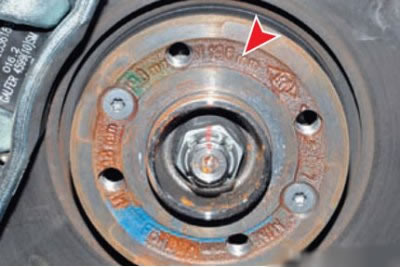
The marking indicating the minimum permissible thickness is indicated on the brake disc itself.
In this case it is 19.8 mm.
| Parameter | R90 | F90 | |
| Brake disc diameter, mm | 259 | 260 | 260 |
| Nominal thickness of brake disc, mm | 20,6 | 22 | 22 |
| Minimum brake disc thickness, mm | 17,7 | 19,8 | 19,8 |
Installation
Install the brake disc in place and secure it to the hub with two screws. The tightening torque of the screws is 14 Nm (1.4 kgf·m).
Attention. After removal, the bolts securing the guide to the steering knuckle must be replaced, since the bolts are fixed with an adhesive compound applied to the threaded surface of the bolts. Reuse of bolts is not permitted.
Install the front brake assembly onto the steering knuckle and secure it with new mounting bolts, having first applied "High-strength locking compound" to the threaded surface of the bolts in the amount of 1 g per bolt. Tightening torque of bolts 105 N·m (10.5 kgf·m) (replaceable head 18, extension, ratchet, torque wrench, "High-strength locking compound" spare parts number 77 11 230 112).
Install the front wheel.
Press the brake pedal 2-3 times, check and, if necessary, top up the brake fluid level in the brake hydraulic reservoir.
Check the efficiency of the service brake system.
Addition
Brake discs are a separate and important topic. The greatest danger is posed by disks that have already exhausted their resource, so it is advisable to check their thickness at each thematic maintenance. What is the threat of excessive wear? Cracks, for example, and, as a result, a jammed wheel at the most inopportune moment. In the case of non-ventilated discs, they can be worn to an absurd level - when the pad falls into the gap between the caliper and the disc, the pressure in the system drops, and with it the brakes as a whole fail, and such cases also happen. So it is vital to check the thickness of the disc from time to time.
Now about such a problem as "beating" of the disk. Of course, it is better to buy proven products, preferably with a certificate from TUV, otherwise the disk may start beating right from the first day of operation. But it can also be different when a branded product starts to bother you with vibrations over time. What's the matter? In the temperature difference - for example, I was driving at a good pace for a long time, accelerating and braking, and then suddenly drove through a deep puddle. There are many opinions on the topic of turning brake discs, however, based on experience and science, we can say that turning, if it helps, will only help for a very short time. In case of a serious temperature change during operation, the disk will "warp" - it will change its structure in accordance with the well-known iron-carbon diagram, not completely, but in places. So, no matter how you polish it, it will continue to lead him. By the way, the world leader in the production of braking systems, BREMBO, agrees with this widespread opinion, and it knows a lot about extreme braking.
Much has already been written about components for braking systems, including consumables - discs and pads, but it would be useful to recall a number of key points about where, how and what spare parts are best to purchase. Naturally, it is ridiculous to overpay 30-50, or even 100% for a cardboard box with the car manufacturer's logo, especially since they themselves do not produce brake systems, but use third-party services: BMW, for example, usually prefers Jurid, Mercedes-Benz - Textar, and so on. You can purchase consumables directly from the catalogs of the manufacturers themselves - suppliers to the conveyor, if you are such a perfectionist, but usually they do it easier, choosing a certified product of the appropriate quality. I would like to remind you that it is better to buy spare parts in well-tested places, since even the manufacturers themselves admit that in Russia the amount of counterfeit goods is simply off the charts, and from the point of view of appearance, they look impeccable. However, this problem is not new and is not limited to Russia.