



Note: To replace the pads with wear sensors, disconnect the sensor wire tip from the wiring harness block.
To complete the work you will need:
- reliable car stand;
- small metal brush.
Removal
1. Prepare the car for work (see "Preparing the car for maintenance and repair").
2. Remove the front wheels (see "Wheel - replacement").
3. Clean the master brake cylinder reservoir from dirt. We remove the tank lid.
4. Clean the brake mechanism from dirt.
5. Through the inspection hole in the floating bracket of the caliper, slightly move the brake pads apart so that they move away from the brake disc to the maximum possible distance.
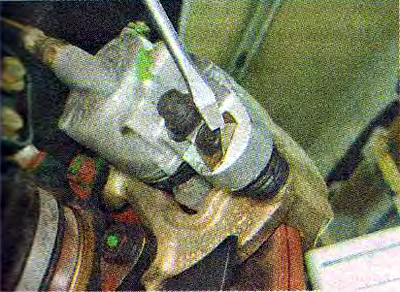
6. Using a slotted screwdriver, bend back the corner of the locking plate of the lower guide pin bolt.
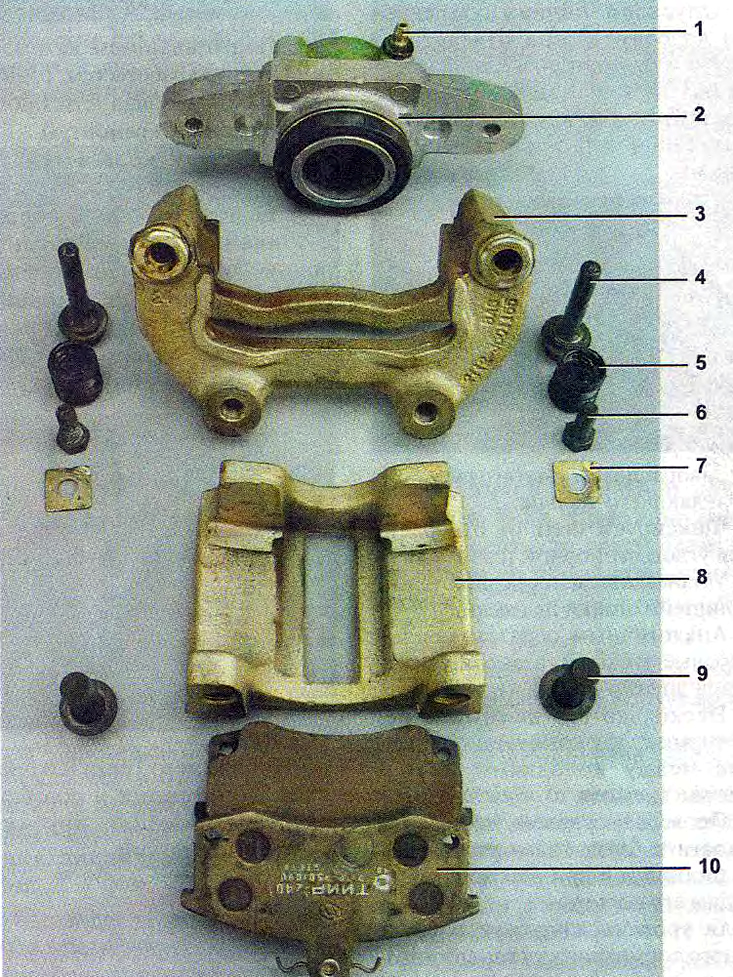
Front brake caliper parts:
1 - bleed nipple;
2 - working cylinder;
3 - fixed caliper bracket;
4 - guide pin of the sliding bracket;
5 - Protective cover of the guide pin;
6 - guide pin bolt;
7 - locking plate;
8 - movable bracket of the caliper;
9 - bolt for fastening the working cylinder to the sliding bracket;
10 - brake pads.
7. Remove the brake hose from the strut bracket (see "Front Brake Hose - Replacement").
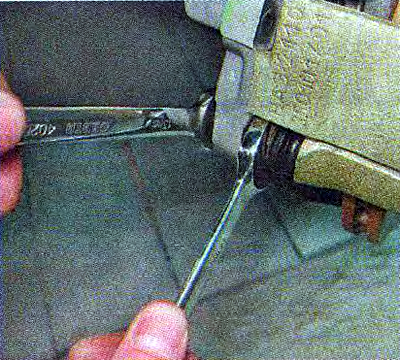
8. Holding the guide pin from turning with a 17 mm open-end wrench, unscrew its bolt with a 13 mm wrench.
9. Raise the movable bracket upwards, turning it on the upper guide pin.
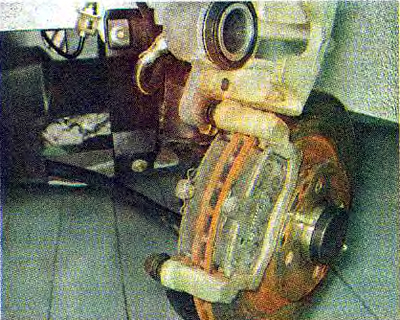
10. Remove the brake pads.
11. Using a small metal brush, clean the brake pad mounting surfaces from dirt and rust.
12. Make sure that there is no leakage of brake fluid from under the brake cylinder cuff.
Installation
1. Install new brake pads in place.
2. Lower the movable bracket down until the hole in the housing aligns with the hole in the guide pin (when lowering the bracket, make sure that the spring tabs of the pads do not become displaced or bent).
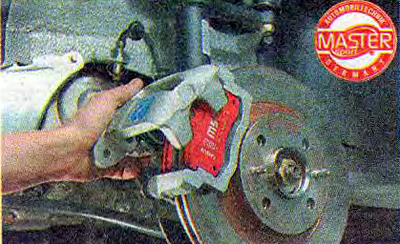
3. Screw in and tighten the guide pin bolt.
4. We fix the bolt from unscrewing with the corner of the locking plate.
5. Install the brake hose into the suspension strut bracket.
6. Similarly, we change the brake pads of the brake mechanism of the other front wheel.
7. Press the brake pedal several times to automatically adjust the gaps between the pads and brake discs.
8. Check the brake fluid level in the master cylinder reservoir and top it up to normal if necessary.
If the fluid level in the master brake cylinder reservoir is above the MAX mark, use a rubber bulb to remove some of the fluid from the reservoir.
Warning. After replacing the brake pads, braking efficiency will be reduced in the first 100-200 km of driving. Be careful!