



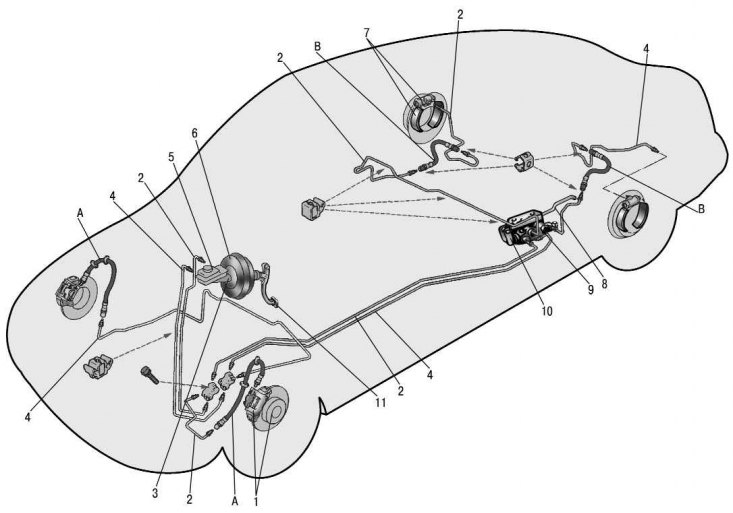
Figure 9.1. Hydraulic brake drive diagram: 1 – front wheel brake mechanism; 2 – flexible front brake hose; 3 – left front – right rear brake circuit pipeline; 4 – main cylinder of the brake hydraulic drive; 5 – right front – left rear brake circuit pipeline; 6 – master cylinder reservoir; 7 – vacuum booster; 8 – rear wheel brake mechanism; 9 – flexible rear brake hose; 10 – pressure regulator; 11 – brake pedal
The car is equipped with a dual-circuit service brake system with diagonal division of the circuits (figure 9.1), which significantly increases the safety of driving. One hydraulic drive circuit operates the right front and left rear brake mechanisms, the other operates the left front and right rear.
If one of the circuits of the service brake system fails, the second circuit is used, ensuring that the vehicle stops with sufficient efficiency.
The hydraulic drive includes a vacuum booster 7 and a dual-circuit regulator 10 of the rear brake pressure.
The parking brake system has a drive to the brake mechanisms of the rear wheels.
Vacuum booster (figure 9.2) the diaphragm type works on the principle of pressure difference in the vacuum and atmospheric chambers, as a result of which, when the brake pedal is pressed, additional force is created on the piston of the main brake cylinder. The rubber diaphragm 8 together with the valve body 17 divides the vacuum booster cavity into two chambers: vacuum A and atmospheric B. Chamber A is connected to the engine intake manifold through a check valve tip and a hose.
The body of valve 17 is plastic. At the outlet from the cover it is sealed with a corrugated protective cover 11. The valve body contains the main cylinder drive rod 2 with a support sleeve, piston 10, valve 15 in assembly, return springs 13 and 14 of the pusher and valve, respectively, and pusher 12.
When the pedal is pressed, pusher 12, piston 10, and then valve 15 move until they stop in the valve body seat. In this case, cameras A and B are separated. As the piston moves further, its seat moves away from the valve and through the resulting gap, chamber B connects to the atmosphere. The air entering through the gap between the piston and the valve, as well as through channel D, creates pressure on the diaphragm 8. Due to the difference in pressure in chambers A and B, the valve body moves together with rod 2, which acts on the piston of the main cylinder.
When the pedal is released, valve 15 moves away from the housing seat and through the resulting gap and channel C, chambers A and B communicate with each other.
The pressure regulator changes the pressure in the hydraulic drive of the rear wheel brake mechanisms depending on the load on the rear axle of the vehicle. It is included in both circuits of the brake system, through which brake fluid is supplied to both rear brake mechanisms.
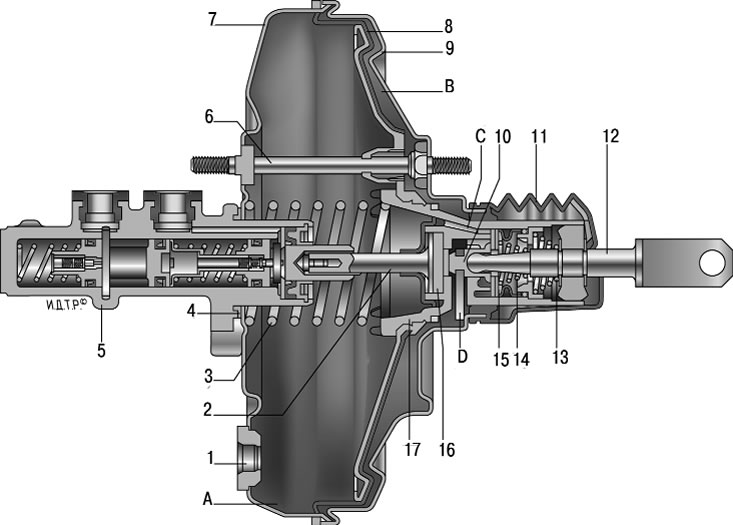
Figure 9.2. Vacuum amplifier: 1 – tip mounting flange; 2 – rod; 3 – diaphragm return spring; 4 – sealing ring of the master cylinder flange; 5 – master cylinder; 6 – amplifier pin; 7 – amplifier body; 8 – diaphragm; 9 – amplifier housing cover; 10 – piston; 11 – valve body protective cover; 12 – pusher; 13 – pusher return spring; 14 – valve spring; 15 – valve; 16 – rod buffer; 17 – valve body; A – vacuum chamber; B – atmospheric chamber; C, D – channels
Pressure regulator 1 (figure 9.3) attached to bracket 9 by two bolts 2 and 16. In this case, front bolt 2 simultaneously fastens fork bracket 3 of lever 5 of pressure regulator drive. On the finger of this bracket, a double-arm lever 5 is pivotally attached by pin 4. Its upper arm is connected to an elastic lever 10, the other end of which is pivotally connected to the bracket of the rear suspension lever via an earring 11.
Bracket 3 together with lever 5 can be moved relative to the pressure regulator due to the oval holes for the mounting bolt and thereby regulate the force with which lever 5 acts on the regulator piston.
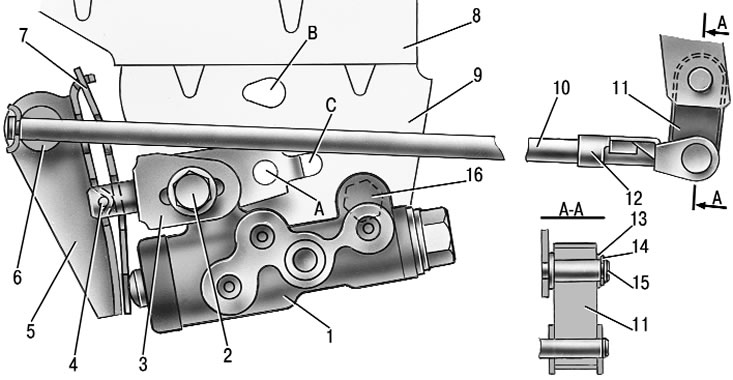
Figure 9.3. Pressure regulator drive: 1 – pressure regulator; 2, 16 – pressure regulator mounting bolts; 3 – pressure regulator drive lever bracket; 4 – pin; 5 – pressure regulator drive lever; 6 – axis of the pressure regulator drive lever; 7 – lever spring; 8 – body bracket; 9 – pressure regulator mounting bracket; 10 – elastic lever of pressure regulator drive; 11 – earring; 12 – earring bracket; 13 – washer; 14 – retaining ring; 15 – bracket pin; A, B, C – holes
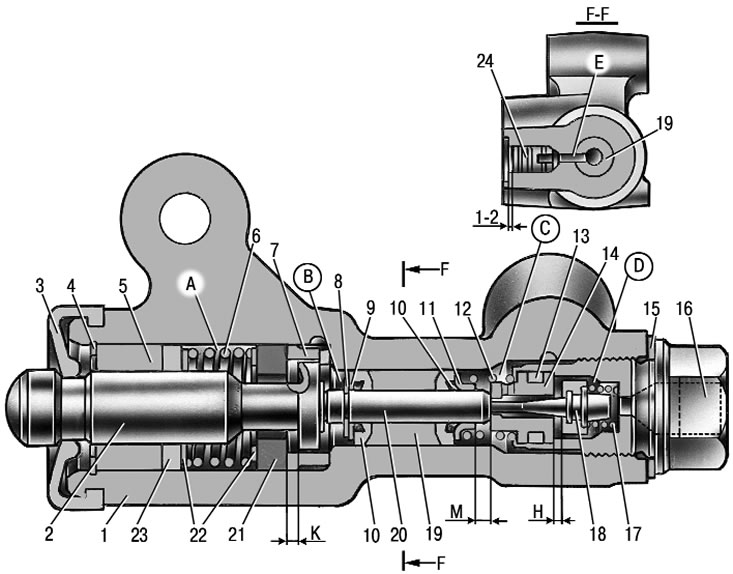
Figure 9.4. Pressure regulator: 1 – pressure regulator body; 2 – piston; 3 – protective cap; 4, 8 – retaining rings; 5 – piston bushing; 6 – piston spring; 7 – body bushing; 9, 22 – support washers; 10 – pusher sealing rings; 11 – support plate; 12 – pusher bushing spring; 13 – valve seat sealing ring; 14 – valve seat; 15 – sealing gasket; 16 – cork; 17 – valve spring; 18 – valve; 19 – pusher bushing; 20 – pusher; 21 – piston head seal; 23 – piston rod seal; 24 – plug; A, D – chambers connected to the master cylinder; B, C – chambers connected to the wheel cylinders of the rear brakes; E – brake fluid supply channel; K, M, H – gaps
The regulator has four chambers: A and D (figure 9.4) connected to the master cylinder, B - to the left wheel cylinder of the rear brakes, C - to the right.
In the initial position of the brake pedal, piston 2 is pressed by lever 5 (see figure 9.3) through the leaf spring 7 to the pusher 20 (see figure 9.4), which, under the action of this force, is pressed against the seat 14 of valve 18. Valve 18 is pressed away from the seat, resulting in gaps K (between the piston head and the seal 21) and H. Through these gaps, chambers A and D communicate with chambers B and C.
When the brake pedal is pressed, fluid flows through gaps K and H and chambers B and C into the wheel cylinders of the brake mechanisms. As the liquid pressure increases, the force on the piston increases, tending to push it out of the housing. When the force from the liquid pressure exceeds the force from the elastic lever, the piston will begin to move out of the housing, and after it, under the action of springs 12 and 17, the pusher 20 will begin to move together with the sleeve 19 and rings 10. In this case, the gap M increases, and the gaps H and K decrease. When the gap H is completely selected and valve 18 isolates chamber D from chamber C, pusher 20 together with the parts located on it stops moving after the piston. Now the pressure in chamber C will change depending on the pressure in chamber B. With a further increase in the force on the brake pedal, the pressure in chambers D, B and A increases, piston 2 continues to move out of the housing, and sleeve 19 together with sealing rings 10 and plate 11 under increasing pressure in chamber B moves towards plug 16. In this case, gap M will begin to decrease. Due to the decrease in the volume of chamber C, the pressure in it, and therefore in the brake drive, increases and will be practically equal to the pressure in chamber B. When the gap K becomes equal to zero, the pressure in chamber B, and therefore in chamber C, will increase to a lesser extent than the pressure in chamber A due to the throttling of the liquid between the piston head and seal 21. The relationship between the pressure values in chambers B and A is determined by the ratio of the difference in the areas of the piston head and rod to the area of the head.
As the vehicle load increases, the elastic lever 10 (see figure 9.3) is loaded more and the force from lever 5 on the piston increases, i.e. the moment of contact between the piston head and seal 21 (see figure 9.4) achieved with higher pressure in the master brake cylinder. Thus, the effectiveness of the rear brakes increases with increasing load.
In case of failure of the brake circuit, the left front - right rear sealing rings 10 and bushing 19, under the influence of the fluid pressure in chamber B, will shift towards plug 16 until plate 11 stops in seat 14. The pressure in the rear brake will be regulated by the part of the regulator, which includes piston 2 with seal 21 and bushing 7. The operation of this part of the regulator, in case of failure of the named circuit, is similar to the operation with a serviceable system. The nature of the pressure change at the regulator outlet is the same as with a functioning system.
If the brake circuit fails, the right front - left rear pusher 20 with bushing 19, sealing rings 10, under the influence of brake fluid pressure, shifts towards the piston, pushing it out of the housing. The gap M increases and the gap H decreases. When valve 18 touches seat 14, the pressure increase in chamber C stops, that is, the regulator in this case operates as a pressure limiter. However, the achieved pressure value is sufficient for reliable operation of the rear brake.
In the body 1 of the pressure regulator there is an opening closed by a plug 24. A leak of liquid from under the plug when it is squeezed out indicates a leak in the rings 10.
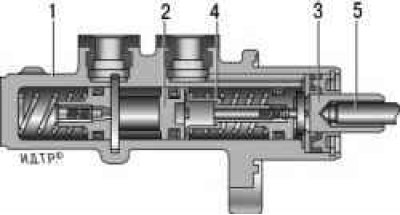
Figure 9.5. Master cylinder: 1 – cylinder body; 2, 3 – pistons of brake circuit drive; 4 – spacer washer; 5 – pusher
The main cylinder is two-section, with sequential arrangement of pistons (figure 9.5). A tank 6 is fixed to the body of the main cylinder (see figure 9.1), in the filler neck of which a brake fluid emergency level sensor is installed. High pressure sealing rings and rear wheel cylinder rings are interchangeable.
Front wheel brakes
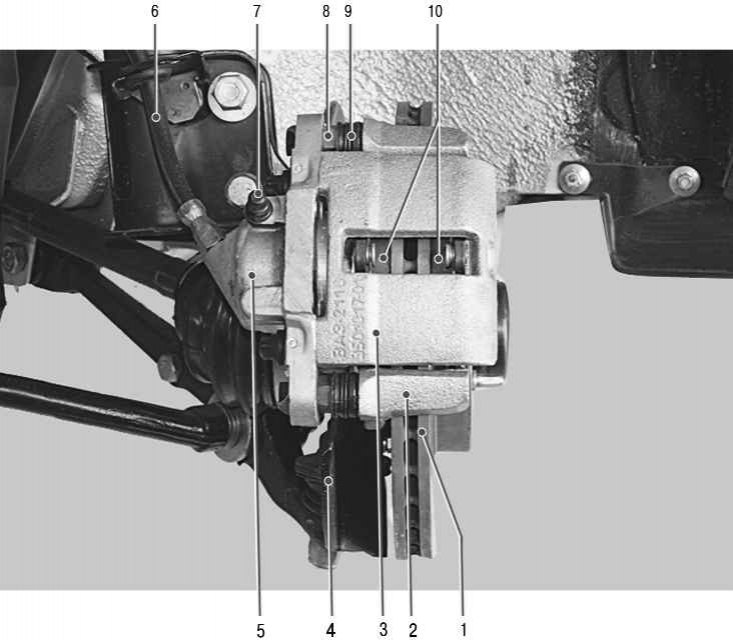
Figure 9.6. Front wheel brake mechanism: 1 – brake disc; 2 – shoe guide; 3 – support; 4 – protective cover; 5 – working cylinder; 6 – brake hose; 7 – air release valve; 8 – guide pin; 9 – Protective cover of the guide pin; 10 – brake pads
disc, with automatic adjustment of the gap between the pads and the disc, with a floating bracket. The bracket is formed by the support 3 (figure 9.6) and wheel cylinder 5, which are tightened with bolts. The movable bracket is attached with bolts to the pins 8, which are installed in the holes of the guide 2 of the shoes. Grease is placed in these holes, and rubber covers 9 are installed between the pins and the guide of the shoes. Brake shoes 10 are pressed against the grooves of the guide by springs.
A piston with a sealing ring is installed in the cavity of cylinder 5. Due to the elasticity of this ring, an optimal gap is maintained between the pads and the disc.
Rear wheel brake mechanism (figure 9.7) drum, with automatic adjustment of the gap between the pads and the drum. Brake shoes 1 and 6 are actuated by one hydraulic working cylinder 9 with two pistons.
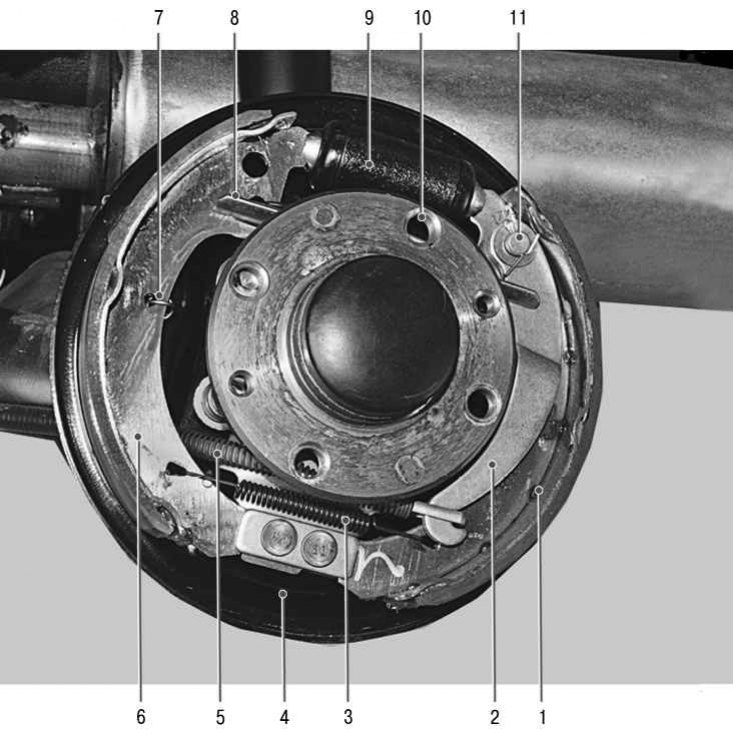
Figure 9.7. Rear wheel brake mechanism: 1 – rear brake shoe; 2 – parking brake drive lever; 3 – lower brake shoe tension spring; 4 – brake mechanism shield; 5 – parking brake drive cable; 6 – front brake shoe; 7 – guide spring; 8 – expansion bar; 9 – working cylinder; 10 – upper brake shoe tension spring; 11 – parking brake lever pin
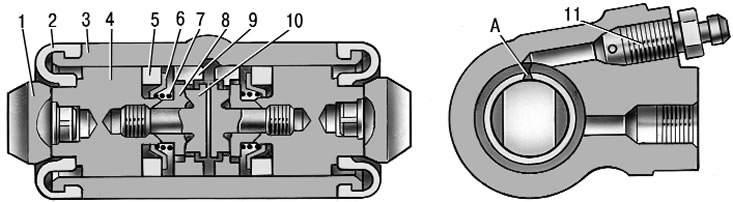
Figure 9.8. Working cylinder: 1 – brake shoe stop; 2 – protective cap; 3 – cylinder body; 4 – piston; 5 – seal; 6 – support plate; 7 – spring; 8 – crackers; 9 – thrust ring; 10 – stop screw; 11 – nipple; A - slot on the thrust ring
The automatic clearance adjustment device is located in the working cylinder. Its main element is a split thrust ring 9 (figure 9.8), installed on piston 4 between the flange of stop screw 10 and two crackers 8 with a gap of 1.25–1.65 mm.
The thrust rings 9 are inserted into the cylinder with tension, ensuring a force of movement of the ring along the cylinder mirror of at least 343 N (35 kgf), which exceeds the force on the piston from the tension springs 3 and 10 (see figure 9.7) brake pads.
When the gap of 1.25–1.65 mm is completely selected due to wear of the linings, the flange on the stop screw 10 (see figure 9.8) is pressed against the flange of ring 9, as a result of which the thrust ring shifts after the piston by the amount of wear. When braking stops, the pistons are moved by the force of the tension springs until the crackers stop against the flange of the thrust ring. This automatically maintains the optimum clearance between the pads and the drum.
Parking brake system with mechanical drive acts on the brake mechanisms of the rear wheels. The parking brake drive consists of a lever 2 (figure 9.9), adjusting rod 4, equalizer 5, cable 8, lever 2 of manual drive of shoes and expansion bar 8 (see figure 9.7).
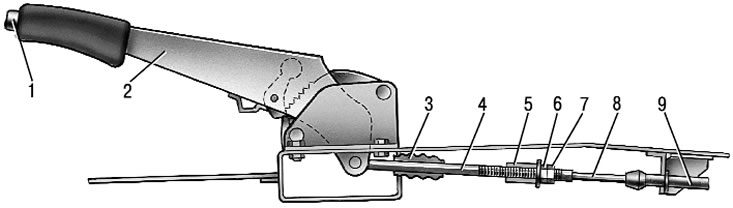
Figure 9.9. Parking brake system drive: 1 – lever lock button; 2 – parking brake drive lever; 3 – protective cover; 4 – traction; 5 – cable equalizer; 6 – adjusting nut; 7 – lock nut; 8 – cable; 9 – cable sheath
Brake fluid emergency level sensor mechanical type. Building 2 (figure 9.10) the sensor with seal 4 and base 3 with reflector 6 are pressed by clamping ring 5 to the end of the tank neck.
A pusher 7 passes through the opening of the base, connected to a float 9 by means of a sleeve 8. A movable contact 11 is located on the pusher, and fixed contacts 10 are located on the sensor body. The cavity of the contacts is sealed with a protective cap 1.
When the brake fluid level in the reservoir drops to the maximum permissible level, the moving contact drops onto the fixed contacts and closes the circuit of the hazard warning lamp in the instrument cluster.
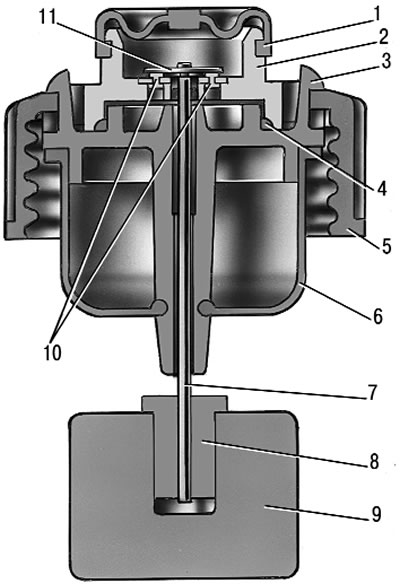
Figure 9.10. Brake fluid emergency level sensor: 1 – protective cap; 2 – sensor body; 3 – sensor base; 4 – sealing ring; 5 – clamping ring; 6 – reflector; 7 – pusher; 8 – bushing; 9 – float; 10 – fixed contacts; 11 – movable contact
27.03.2026 16:45