



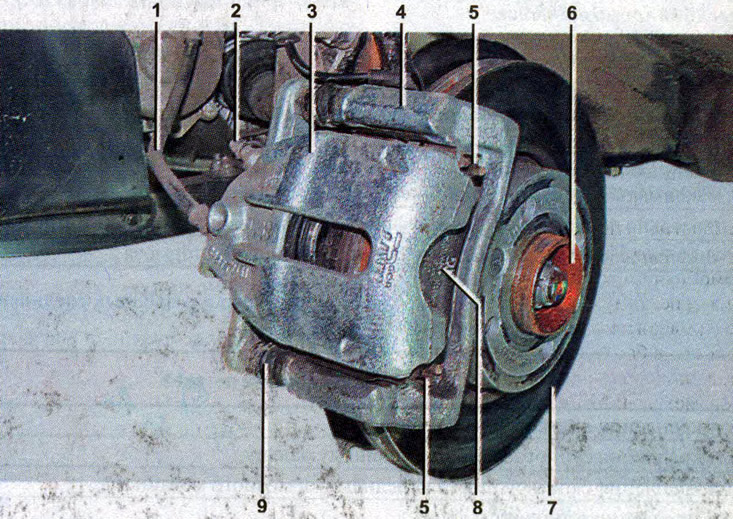
Front brake mechanism: 1 - brake hose; 2 - bleed nipple; 3 - support; 4 - brake shoe guide; 5 - spring stops of brake shoes; 6 - hub; 7 - brake disc; 8 - brake shoe; 9 - Protective cover of the guide pin
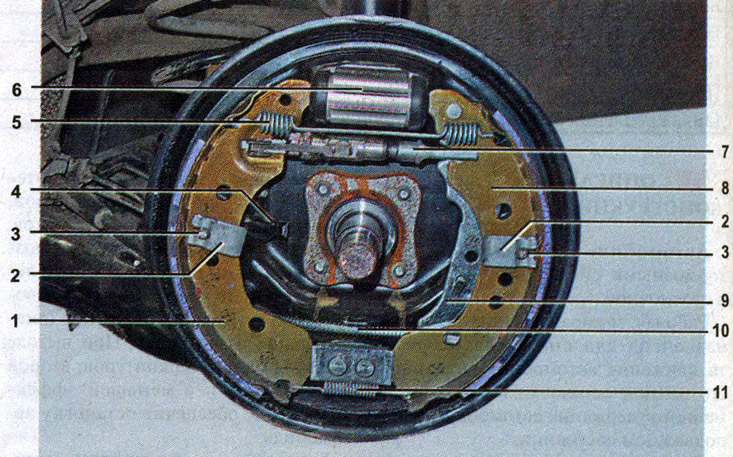
Rear brake assembly: 1 - brake shoe (front); 2 - spring bracket for mounting the support stand; 3 - support stand for mounting the brake shoe; 4 - wheel speed sensor; 5 - tension spring (upper); 6 - brake cylinder; 7 - adjustment mechanism; 8 - brake shoe (rear); 9 - parking brake lever; 10 - Parking brake cable; 11 - tension spring (lower)
The car is equipped with two braking systems - service and parking.
The service brake system is designed to reduce the speed of the vehicle until it comes to a complete stop and to hold the vehicle stationary for a short time.
The parking brake system is designed to prevent spontaneous movement of the vehicle while parked.
The service brake system is a dual-circuit system with a hydraulic drive, consisting of a master brake cylinder with a vacuum booster, four brake mechanisms, brake lines and hoses. One circuit includes the brake mechanisms of the right rear and left front wheels, the second - the left rear and right front (diagonal split). If one of the circuits fails, the second circuit, although less efficient, will ensure that the vehicle stops.
The car is equipped with an anti-lock braking system (ABS), which prevents the wheels from locking during sudden braking and braking on slippery surfaces. The ABS system uses four wheel speed sensors.
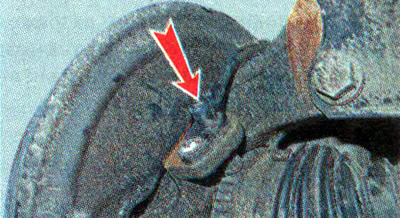
Front wheel speed sensor |
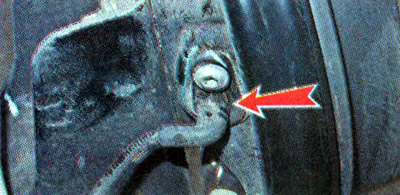
Rear wheel speed sensor |
The setting rings of the front wheel speed sensors are made integral with the outer joints of the wheel drives; the rear wheel speed sensors are installed on the brake drums.
The ABS actuator is a hydraulic unit, which is installed in the hydraulic drive of the service brake system between the main and service brake cylinders.
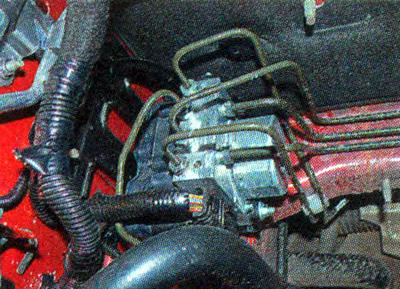
ABS hydraulic unit
Note: The hydraulic unit is a complex unit that contains a hydraulic pump with an electric drive and electromagnetic valves. The operation of the hydraulic unit is controlled by an electronic control unit, which is combined with it into a single unit. The control unit also monitors the serviceability of all elements of the ABS system. Pulse signals from the wheel speed sensors are sent to the control unit. When the wheels begin to lock, the hydraulic unit, on command from the control unit, limits the pressure in the hydraulic drive, reducing the braking force.
The front wheel brakes are disc brakes, the rear wheel brakes are drum brakes.
To reduce the force applied by the driver to the brake pedal, a vacuum booster is installed in the brake system drive, which operates due to the vacuum created in the intake manifold of the running engine.
Warning! Do not turn off the engine until the car has come to a complete stop, as this will greatly increase the force required to apply to the brake pedal to stop the car.
A reservoir with brake fluid is installed on the body of the main brake cylinder. There is a brake fluid level sensor in the tank. When the fluid level in the tank drops dangerously, the sensor sends a signal to turn on the low brake fluid level indicator lamp on the instrument panel.
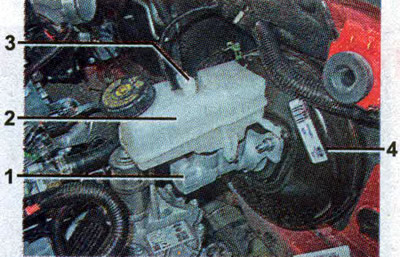
Master Brake Cylinder: I - master brake cylinder; 2 - tank; 3 - brake fluid emergency level sensor; 4 - brake booster
The parking brake system is driven by cables to the brake mechanisms of the rear wheels. When used correctly, the parking brake system does not require maintenance. However, sometimes it may be necessary to adjust the drive (see "Parking brake - adjustment").
We check the technical condition of the brake system in accordance with the maintenance regulations (see "Maintenance plan").