



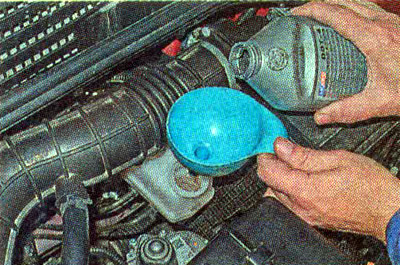
Warning! If the work requires adding brake fluid, use only new fluid recommended by the manufacturer. Avoid spilling brake fluid or allowing it to come into contact with vehicle parts, especially the paintwork. To avoid accidentally spilling liquid, add it through a clean funnel.
Sequence of execution
1. Prepare the car for work (see "Preparing the car for maintenance and repair").
2. Check the brake fluid level in the brake hydraulic reservoir, which should be between the MAX and MIN marks.
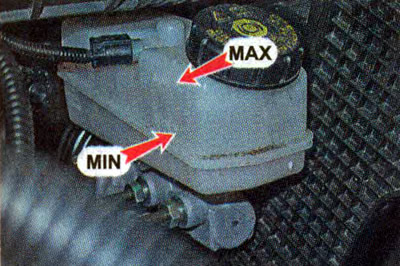
Comment:
- The car must be parked on a level, horizontal surface.
- With new brake pads and discs, the brake fluid level should be at the MAX mark. If the fluid level in the reservoir has dropped, it is necessary to check the tightness of the brake system (see below, "Checking the service brake system drive").
- You should also check the condition of the brake pads and brake discs, as their wear leads to a decrease in the brake fluid level.
3. If the level is below the MIN mark, you need to add brake fluid.
Note: The brake fluid level sensor built into the reservoir will signal an insufficient brake fluid level - the low brake fluid level indicator lamp on the instrument panel will light up (see "Instrument panel").
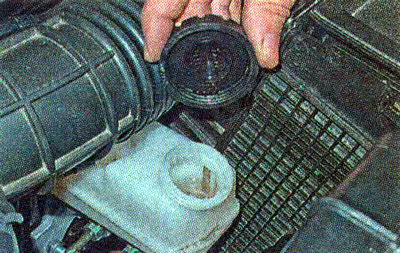
4. Carefully wipe the tank lid with a clean cloth to prevent dust and dirt from getting into the hydraulic drive. We unscrew and remove the lid.
5. Using a funnel, add brake fluid into the reservoir up to the MAX mark.
Warning! It is essential to determine the cause of the drop in brake fluid level and eliminate the malfunction.
6. Screw the cap onto the neck of the tank and tighten it by hand.