



Sequence of execution
1. Remove the brake drum (see "Rear brake drums - replacement").
Warning: To avoid the pistons falling out of the wheel cylinder, do not press the brake pedal with the brake drum removed.
2. Inspect the working surface of the drum and make sure there are no cracks or deep grooves on it.
3. Using a caliper, measure the inner diameter of the drum, which should be no more than 204.45 mm.
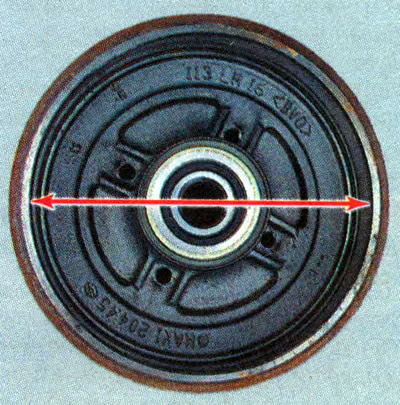
Note: If the drum is significantly worn, a ridge will form on the outer edge of its working surface, which may interfere with accurate measurements. In this case, to take the measurement, use a round file to reduce the flange.
Warning! Damaged drum or worn to the maximum permissible diameter (see "Reference data", table 13.1) must be replaced. In this case, both brake drums should be replaced.
4. Visually determine the condition of the friction linings of the brake pads and measure their thickness at the point of greatest wear.
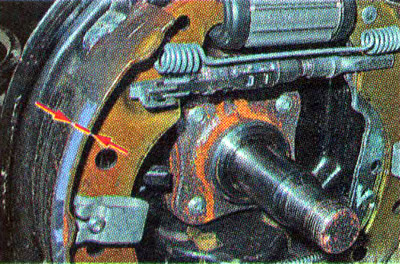
Note: When taking measurements with a caliper, take into account the thickness of the base of the pad (measure the thickness of the base and subtract this value from the obtained value).
Warning! If the thickness of one of the linings is less than the permissible value, replace all four brake pads of the right and left wheels (see "Rear brake pads - replacement").
Note: Before installing the brake drum, treat its working surface and the pad linings with a special brake cleaner.
5. Install the brake drum in the reverse order.
6. We check the rear brake mechanism of the other wheel in the same way.
7. Check the condition of the rear brake hoses (see above, "Checking the service brake system drive").
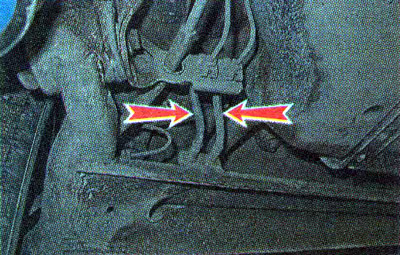
Warning! Damaged hoses may burst and must be replaced (see "Brake hoses - replacement").
8. After checking, press the brake pedal several times to bring the pads to the brake drum.
9. Adjust the parking brake (see "Parking brake - adjustment").