
Car repair AvtoVAZ Car repair Renault Car repair Hyundai Car repair Ford Car repair Volkswagen Car repair Audi Car repair Chevrolet
English Русский
Български
Беларускі
Український
Српски
Hrvatski
Română
Polski
Slovenský
Magyar
articles sitemap contacts bookmark
LadaMan.ru


Kalina Granta Priora Vesta Largus XRAY
Kalina Sedan (2004-2013, VAZ-1118) Kalina Hatchback (2004-2013, VAZ-1119)

Bleeding the brake system (Kalina 1118)

  • Main
  • Kalina
  • Kalina Sedan
  • Chassis (running gear)
  • Brake system
  • Bleeding the brake system
0
Bleeding the brakes on a car is necessary to remove air from the brake system, which may get into the system during repairs, replacement of brake fluid, depressurization of the brake system due to damage to brake pipes and hoses, or a drop in the brake fluid level in the master cylinder reservoir. An indication of the presence of air in the brake system is an increased travel and "softness" of the brake pedal.

The procedure for bleeding the brakes on a car:
  • rear right;
  • front left;
  • rear left;
  • front right.

To bleed the brakes on a car, you will need: an 8 mm wrench, a flexible tube, and a container to collect the brake fluid.

1. Check the level and, if necessary, add brake fluid to the brake reservoir up to the "MAX" mark.
1. Check the level and, if necessary, add brake fluid to the brake reservoir up to the «MAX» mark.


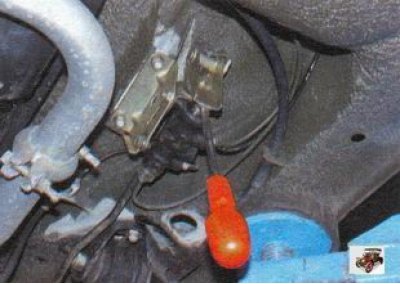
2. If the rear wheels of the vehicle are suspended, first unlock the rear brake pressure regulator by inserting a screwdriver between the plate and the piston. Don't forget to remove it after you've bled the brakes.

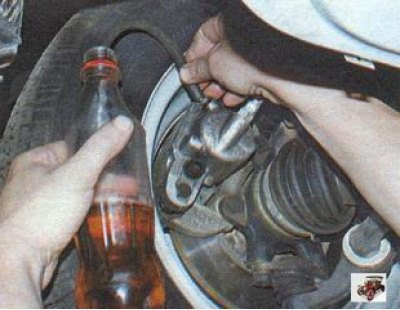
3. Clean the air bleed nipple on the brake mechanism from dirt and dust.
3. Clean the air bleed nipple on the brake mechanism from dirt and dust.


4. Remove the protective cap from the air bleed nipple. Place a rubber hose over the head of the fitting and immerse the end of the hose in a clean, clear container partially filled with brake fluid (the end of the hose must be immersed in brake fluid).


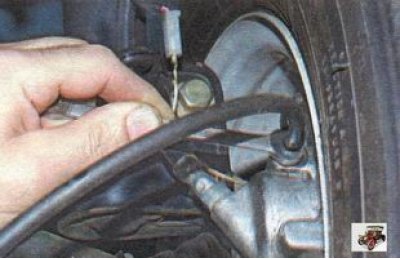
5. The assistant should sharply press the brake pedal 4-5 times (with an interval between presses of 1-2 s), then keep the brake pedal pressed.
5. The assistant should sharply press the brake pedal 4-5 times (with an interval between presses…


6. Loosen the brake bleeder nipple by 1/2-3/4 of a turn. Air bubbles will be visible in the brake fluid flowing out of the hose. When the brake fluid stops flowing from the hose, completely tighten the brake bleeder screw, after which the assistant should release the brake pedal.

7. Repeat bleeding the brakes 5 and 6 until the escaping brake fluid stops bubbling.

8. Remove the hose, wipe the brake bleed nipple dry and put the protective cap on it. Bleed the brakes on the remaining wheels of the vehicle if necessary.


This article is available at russian, bulgarian, belarusian, ukrainian, serbian, croatian, romanian, polish, slovak, hungarian
This article has been reviewed: Daniil Markelov
Share with friends:
◀ Previous
Lada Kalina Sedan: Brake system
Next ▶

Checking the operation of the brake booster
Checking the tightness of the hydraulic drive of the brake system
Brake system malfunctions, their causes and solutions
Design features of the brake system
Replacing brake fluid
Removal and installation the brake booster
Removal and installation the brake master cylinder reservoir
Removal and installation the master brake cylinder
Replacing the front brake pads
More articles with information from manuals for Lada:

• Brake system Lada Granta 1 (2011-2023, VAZ-2190)
• Bleeding the hydraulic brake system Lada Priora 1 (2007-2018, VAZ-2170)
• Description of the brake system design Lada Vesta 1 (2015-2023, VAZ-2180)
• Brake system — description of the design Lada Largus 1 (2012-2023)
• Bleeding the hydraulic brake system, replacing the fluid Lada X-Ray 1 (2015-2022)
Link to this article in various formats
Reviews and comments of visitors
No comments yet


Add up two numbers: 21 + 12


Kalina Sedan (2004-2013) 
  • General information
  • Vehicle device
  • Operation and maintenance
  • Faults en route
  • Power unit
  • Engine repair
  • Cooling and lubrication system
  • Exhaust system
  • Supply system
  • Ignition and control
  • Transmission
  • Clutch and drive shafts
  • Car gearbox
  • Chassis (running gear)
  • Front suspension
  • Rear suspension
  • Steering
  • Brake system
  • Body and interior
  • Exterior (external elements)
  • Interior (internal elements)
  • Doors, locks and windows
  • Electrical equipment
  • Equipment and devices
  • Power devices
  • Lighting and signaling
  • Heating and ventilation
Kalina Hatchback (2004-2013) 
  • General information
  • Vehicle Details
  • Maintenance
  • Troubleshooting
  • Power unit
  • Engine repair
  • Cooling system
  • Supply system
  • Control system
  • Exhaust system
  • Transmission
  • Clutch
  • Car gearbox
  • Drive shafts
  • Chassis (running gear)
  • Wheels and tires
  • Front suspension
  • Rear suspension
  • Steering
  • Brake system
  • Body and interior
  • Exterior (external elements)
  • Interior (internal elements)
  • Doors, locks and windows
  • Electrical equipment
  • Equipment and devices
  • Power devices
  • Lighting and signaling
  • Electrical circuits
LadaMan.ru © 2018–2026 | Mobile version | About Lada | Sitemap: EN BG BY UA RS HR RO PL SK HU | Contacts with admin | | Add to bookmarks
Kalina Hatchback (2004-2013) | Kalina Sedan (2004-2013) | Granta 1 (2011-2023) | Priora 1 (2007-2018) | Vesta 1 (2015-2023) | Largus 1 (2012-2023) | X-Ray 1 (2015-2022) |
This site uses cookies to ensure everything runs smoothly.