



1. Unscrew the master cylinder reservoir cap and place it on a clean cloth. Be careful: brake fluid may drip from the float.
2. If the rear wheels of the car are suspended, first unlock the rear brake pressure regulator by inserting a screwdriver between the plate and the piston. Don't forget to remove it after you've bled the brakes.
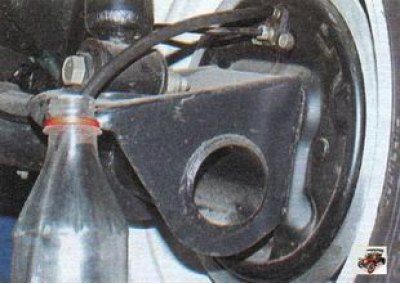
3. Clean the brake bleed nipple of the right rear brake mechanism from dirt. Remove the rubber protective cap from the brake bleeder nipple. Put a rubber hose on the nipple (it is recommended to use a transparent hose to see the state of the flowing liquid) and dip its end into a clean transparent container.
4. The assistant should press the brake pedal sharply 4-5 times (with an interval between presses of 1-2 s), then keep the brake pedal pressed.
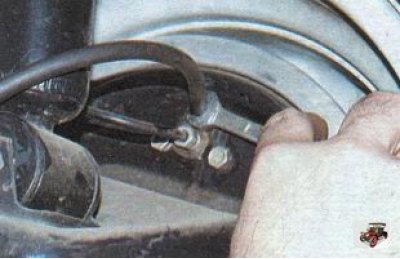
5. Loosen the brake bleeder screw by 1/2-3/4 turn. Old (dirty) brake fluid will start to flow out of the hose. In this case, the brake pedal should smoothly reach the stop. Once the brake fluid stops leaking, close the brake bleed screw.
6. Constantly monitor the brake fluid level in the brake reservoir, not allowing the brake fluid to drop below the "MIN" mark, and add new brake fluid if necessary. Repeat bleeding the brakes 4 and 5 until new (clean) brake fluid starts to flow out of the hose.
7. In the same way, replace the brake fluid in the left front brake mechanism, and then in the second circuit (first in the left rear brake mechanism, then in the right front).
8. Press the brake pedal several times. The brake pedal travel and resistance should be constant each time you press it. If these conditions are not met, then air has entered the brake system and the brakes on the car need to be bled (see "Bleeding the brake system").
9. After replacing the brake fluid, be sure to put the protective caps on the brake bleed nipples.
10. Add brake fluid to the brake reservoir up to the "MAX" mark and tighten the cap.