



The extreme case of a jerk is a failure - a noticeable delay in the engine's response to pressing the accelerator (gas) pedal.
Conventionally, we can distinguish three types of car jerks:
- at the moment the car starts moving;
- when accelerating the car;
- when the vehicle is in steady motion, i.e. when the accelerator pedal (gas) is in a constant position.
To determine the causes of jerks when driving a car with an injection engine, special diagnostic equipment is required, so in this case we recommend contacting a car service that specializes in repairing fuel injection systems. However, as practice shows, in most cases jerks are caused by insufficient fuel pressure in the fuel line (ramp) of the engine or a malfunction of the throttle position sensor.
If you have some skills, you can determine the cause of the jerks yourself.
A jerk at the start of movement
At the moment the car starts moving, the most common extreme case of jerking is a failure. The most unpleasant sensations are associated with the delay in the engine's response to pressing the gas pedal. Sometimes the engine even stalls.
The jerk occurs at the moment the throttle valve begins to open, when, based on the signal from the throttle position sensor, the electronic control unit determines the moment of transition from idle mode to load mode and must increase the amount of fuel supplied through the injectors. If there is insufficient pressure in the fuel line (even with increasing injection duration) there is not enough fuel to smoothly move the car from a standstill. For fuel pressure testing method, see. in the subsection "Checking the fuel pressure in the engine fuel system".
Jerks when accelerating the car
The reason for jerks when accelerating the car may be, as in the previous case, insufficient fuel pressure in the fuel line. The electronic engine control unit, having received a signal from the throttle position sensor about intensive opening of the valve at a large angle, tries to increase the fuel supply as much as possible, but due to the low fuel pressure it is not able to do this. For reasons for this phenomenon and how to check it, see. above "Jerk at the moment of the start of movement".
Jerks during steady motion
Such jerks are most often caused by a malfunction of the ignition system. Diagnostics and repair are required (see "Electrical equipment"). On the way, you can try to do the following yourself:
- carefully inspect the underhood space. Turn off the ignition and check the reliability of the fastening and seating of all wires and connectors at the ignition coil and high-voltage wires. Start the engine and listen to its operation: the crackling sound when the high voltage breaks down "to ground" is weak but distinct. In complete darkness, the spark during breakdown is clearly visible;
- replace spark plugs regardless of their condition and mileage. Pay attention to the condition of the spark plugs: if it is not in good condition, you may have to repair the engine or its systems.
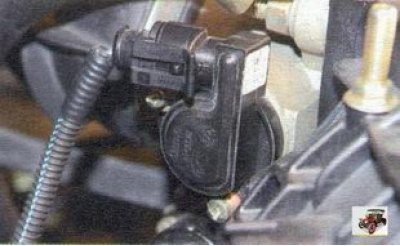
A specific cause of jerks during steady movement of a car with an injection engine may be a failure of the throttle position sensor (TPS). Additional symptoms confirming a malfunction of the TPS sensor:
- uneven engine operation at idle;
- reduction in maximum engine power.
The throttle position sensor is non-disassemblable and therefore cannot be repaired. If a fault is detected in the throttle position sensor (see "TPS (throttle position sensor)"), replace the sensor assembly.