



Recommendation. If the lever travel is six or more clicks, adjust the parking brake drive.
To carry out the work you will need an inspection pit or overpass.
Sequence of execution
1. Prepare the car for work (see "Preparing the car for maintenance and repair").
2. Raise the parking brake lever all the way up, determining the length of its travel. If it is less than 2 clicks, the drive must be lengthened, and if it is more than 6, it must be shortened.
3. Fully lower the parking brake lever.
4. Remove the cushions from the brackets of the additional muffler 1 (see "Exhaust System Suspension - Replacement of Cushions"). Using a socket wrench, unscrew the four nuts 2 securing the protective screen.
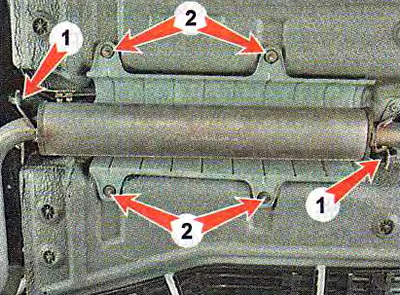
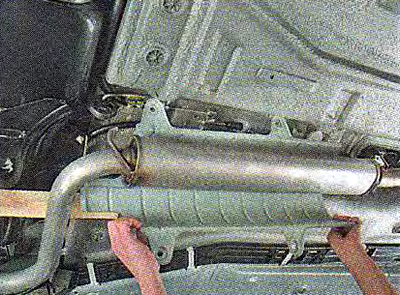
5. Having pulled the additional muffler away from the bottom of the car, we place a wooden block under the muffler pipe. We remove the protective screen.
(Material was taken from the website www.Ladaman.ru)
6. Using a 13 mm open-end wrench to hold the adjusting nut from turning, loosen the lock nut with a 13 mm open-end wrench.
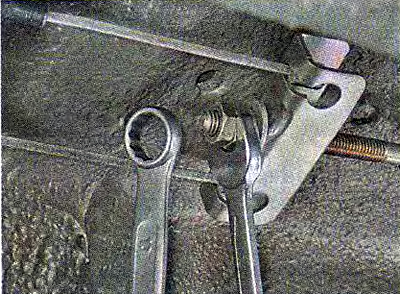
7. When the adjusting nut is loosened, the drive is lengthened; when tightened, it is shortened.
8. Periodically during the adjustment process, check the lever travel.
Note: If the length of the threaded part of the rod is not enough to adjust the lever stroke, it is necessary to replace the drive cables, and if the linings are heavily worn, the brake pads as well.
9. Having adjusted the stroke of the parking brake lever, we lift the rear of the car. We check the ease of rotation of the rear wheels and the reliability of their fixation with the parking brake.
10. If the brake pads do not interfere with the rotation of the wheels, secure the adjusting nut with a lock nut. We install the protective screen in place.
11. We check the functionality of the parking brake system: on an incline with a slope of 23%, it should reliably hold the car in a stationary position. If necessary, check the condition of the parking brake drive parts, the condition of the rear brake pads and brake drums. We replace faulty and worn parts. After which we repeat the adjustment.