



To complete the work you will need an assistant, as well as:
- inspection ditch or overpass;
- drill or piece of wire with a diameter of 2 mm;
- a level section of road free of traffic.
Adjustment
1. Place the unloaded vehicle on an inspection ditch or overpass (see "Preparing the car for maintenance and repair").
2. Press the rear of the car several times to adjust the suspension.
3. Using a piece of wire or a 2 mm drill bit as a feeler gauge, measure the gap "A" between the plate and the lever (see photo below p. 6), which should be 2.0-2.1 mm. If the gap size does not correspond to the required size, adjust the regulator drive.
4. Using a 13 mm open-end wrench, loosen the bolt securing the front pressure regulator to the bracket.
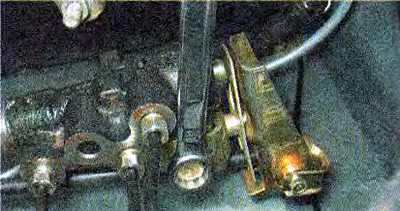
5. Using large sliding pliers, move the adjusting bracket, setting the gap between the plate and the lever to 2 mm.
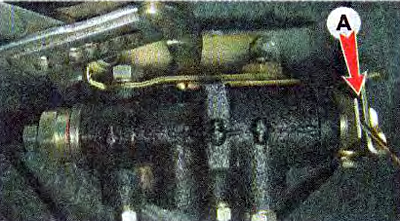
6. Tighten the bolt of the front mounting of the pressure regulator to the bracket.
Examination
1. We drive the car to a level section of the road, free of traffic and other obstacles. The assistant steps aside and watches the car's wheels lock.
During sudden braking, the rear wheels should lock with a slight delay (1-2 s) relative to the front wheels locking.
2. At a speed of about 40 km/h, sharply press the brake pedal with sufficient force to lock the wheels.
a) If the rear wheels lock up before the front ones, then the gap "A" must be increased.
b) If the rear wheels do not lock or lock too late, then the gap "A" must be reduced.