



- difficult engine starting;
- unstable engine operation;
- engine stalls at idle;
- increased crankshaft speed at idle;
- engine does not develop full power, insufficient engine response;
- jerks and dips in engine operation when the car is moving;
- increased fuel consumption;
- increased CO and CH content in exhaust gases;
- pre-ignition due to leaky injectors.
To check and replace the injectors on your car, you will need: a 5 mm Allen key, a screwdriver, a 17 mm key (two), and an autotester.
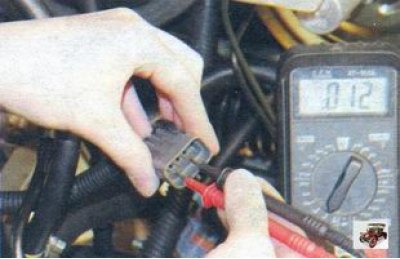
1. Disconnect the connecting connector of the injector wire harness and the engine harness (see "Removal and installation the fuel rail"), perform an initial check of the injector windings. To do this, connect the ohmmeter to the injector connector contacts one by one. The connector has five contacts: four for sending a control signal to the injectors and one for general "mass" (a raspberry wire with a black stripe is connected to it). Connect each of the four injector control contacts to the common contact in turn and measure the resistance in each case. It should be equal to 0.011_0.015 kOhm. If the resistance differs from the specified value in one or more measurements, some of the injectors are faulty.
2. For a more accurate check and replacement of injectors, remove the fuel rail from the vehicle (see "Removal and installation the fuel rail").
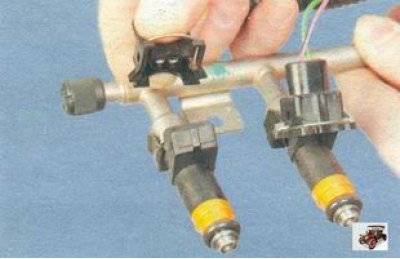
3. Press the lock and disconnect the wiring harness connector from the injector.
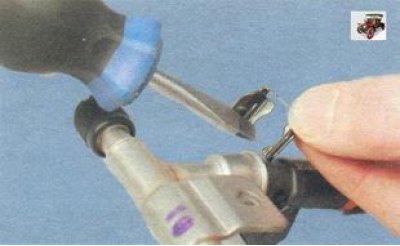
4. Using a screwdriver, remove the spring retainer of the injector...
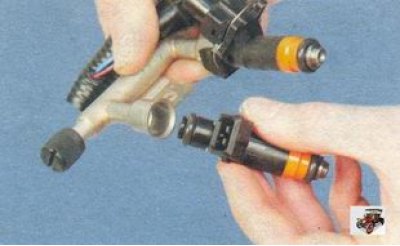
5. ...and remove the injector from the fuel rail. Remove the remaining injectors from the fuel rail in the same manner.
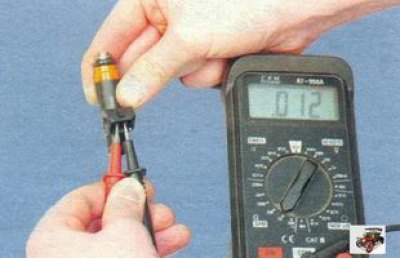
6. To identify a faulty injector, connect an ohmmeter to the injector contacts. It should show a resistance of 0.011-0.015 kOhm. If the winding resistance is not normal, replace the injector, as it is not repairable.
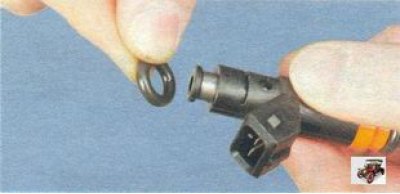
7. Each time you remove the injectors, be sure to replace the sealing rings on all injectors on the fuel rail side...
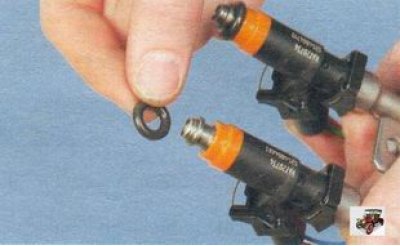
8. ...and sealing rings on the intake pipe side.
9. If you are installing the old injectors, carefully wash their nozzles with solvent or carburetor cleaner.
10. Install the injectors on the vehicle in the reverse order of removal. Before installing the injectors, lubricate the sealing rings with engine oil.
11. After installing the injectors in the fuel rail, the fuel rail on the intake pipe and connecting the pipeline to the fuel rail, start the engine and check the tightness of the pipeline connection and the injector seals.