



Recommendation.
- If the oil pressure warning light comes on while the engine is idling and warmed up to operating temperature, you must make sure that:
- a) the oil level in the engine oil pan is within the norm (see "Oil level - check");
- b) the engine is filled with oil in accordance with the manufacturer's operating instructions;
- c) the oil pressure sensor is in good condition and its wire is not shorted to ground. The integrity of the sensor wire insulation is checked visually. To check the sensor itself, replace it with a known good one and start the engine. If the indicator light remains on, the sensor is working properly;
- d) no extraneous sounds are heard from the engine (knocking, grinding), indicating that the connecting rod or main bearings are turning or that the oil pump is faulty.
To perform the work you will need a pressure gauge.
Sequence of execution
1. Prepare the car for work (see "Preparing the car for maintenance and repair").
2. Start the engine and warm it up to operating temperature.
3. After turning off the engine, remove the emergency oil pressure sensor (see "Oil Pressure Sensor - Replacement").
4. Screw the pressure gauge tip into the sensor mounting hole.
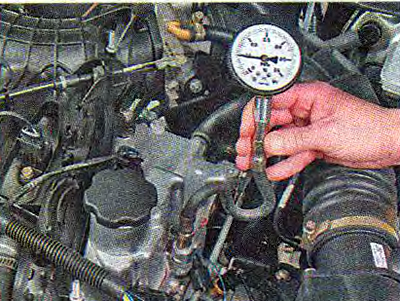
5. Start the engine and check the oil pressure at idle and at a crankshaft speed of about 5400 rpm.
Note: For a serviceable engine warmed up to operating temperature, the oil pressure at idle speed should be at least 196.2 kPa (2 bar), and the oil pressure at high crankshaft speed should be 441.3-637.4 kPa (4.5-6.5 bar). If the pressure is below normal, the engine needs major repairs. If the oil pressure at high crankshaft speed is higher than normal, then the safety valve is probably faulty (reduction) oil pump valve.
6. After completing the check, install the sensor in place (see "Oil Pressure Sensor - Replacement").