



Comment. Work can be done without this device if you can unscrew the bolts securing the camshaft pulleys.
Execution sequence
1. Remove the upper front timing belt cover (see «Timing Belt - Checking Condition»).
2. Using a 17 mm socket wrench, turn the crankshaft until the marks on the camshaft pulleys match the marks on the rear cover of the timing belt (see «Timing belt - replacement»).
3. Alternately holding the camshaft pulleys with a special tool, loosen the pulley mounting bolts with a 17 mm wrench.
Advice. If there is no tool to hold the camshaft pulleys, turn on the fifth gear, fix the car with a parking brake and a 17 mm socket wrench, loosen the pulley mounting bolts.
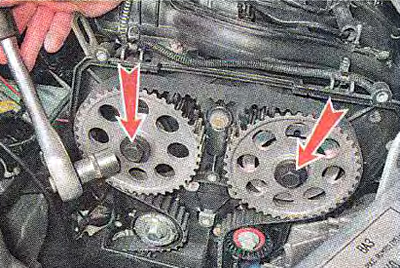
4. Loosen the tension of the timing belt (see «Timing belt tensioner and guide roller - check and replace»).
5. Remove the belt from the exhaust valve shaft pulley and, having unscrewed the bolt, remove the pulley.
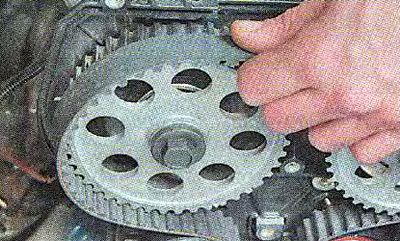
6. Remove the key from the groove of the camshaft.
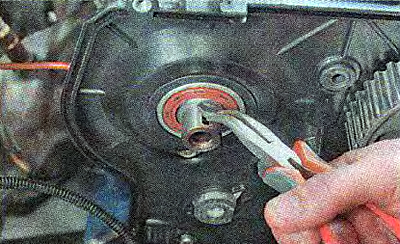
Warning! When performing the following operation, do not scratch the working surface of the camshaft and do not damage the oil seal seat.
7. Using a drill with a diameter of 2.5 mm, carefully drill a hole in the stuffing box and screw a self-tapping screw into the stuffing box.
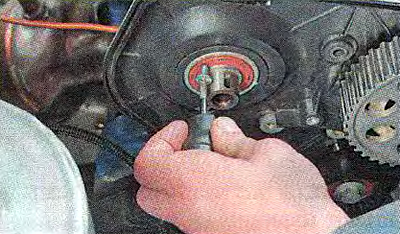
8. With pliers, pulling on the screw, we remove the camshaft oil seal from the mounting hole.
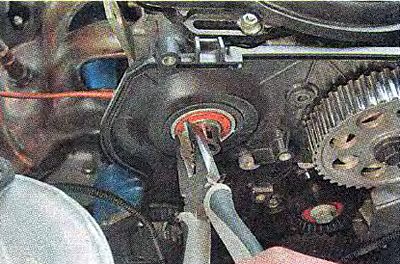
9. We apply clean engine oil to the working edge of the new oil seal and press it in with a hammer through a 32 mm deep head (or through a piece of pipe with a diameter of 40 mm) so that the outer edge of the gland is flush with the edge of its mounting hole.
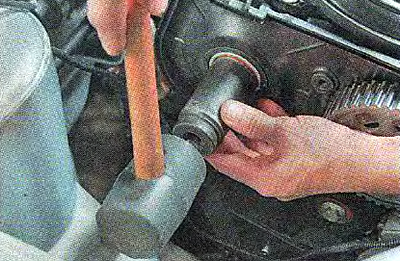
10. Install the key in the groove of the camshaft.
11. We put the pulley on the camshaft and wrap the pulley mounting bolt.
12. Similarly, we replace the seal of the second camshaft.
13. We make sure that the relative position of the marks on the pulleys and the rear cover of the timing belt is not broken. We put the timing belt on the pulleys and pull it (see «Timing belt - replacement»).
14. Install the timing belt top cover and other parts in the reverse order of removal.