



Note: The engine management system fuses and relays are located in the center console of the instrument panel (for details, see. "Engine Management System Fuses and Relays - Replacement").
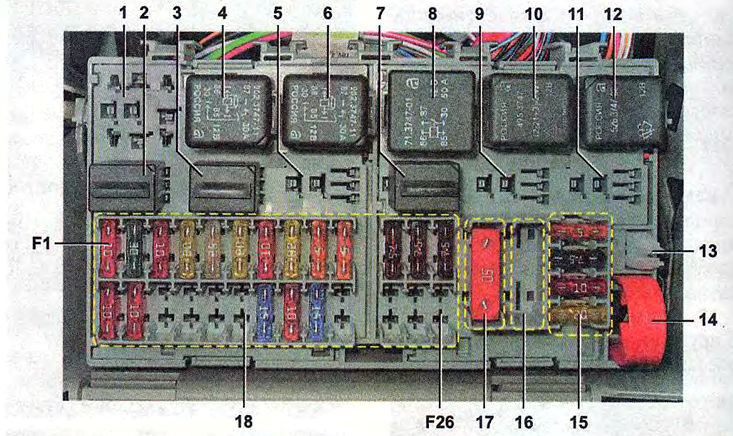
Fuse and relay mounting block:
1 - location of installation of the headlight wiper relay, K1;
2 - high beam headlight relay, K7;
3 - relay for switching on the sound signal K8;
4 - door window lifter relay, K2;
5 - location of the fog light relay, K9;
6 - starter relay;
7 - rear window heating relay, K10;
8 - additional relay, K4;
9 - seat heating relay, K11;
10 - relay for switching on direction indicators and hazard warning lights, K5;
11 - location of installation of backup relay, K12;
12 - windshield wiper and washer relay, K6;
13 - tweezers for extracting fuses and relays with a small case;
14 - tweezers for extracting relay;
15 - spare fuses;
16 - location of ABS fuse, F28;
17 - Electric power steering fuse, F27;
18 - fuses F1-F26.
Note 1. The serial numbers of the fuses and relays are indicated on the body of the mounting block. The purpose of the relay and the circuits protected by the fuses are indicated by conventional symbols on the inside of the cover of the mounting block. The current strength for the fuses is also indicated there.
Note 2: Mounting blocks from different manufacturers may differ slightly in the number and location of fuses.
Table 13.6.1. Fuses and protected circuits
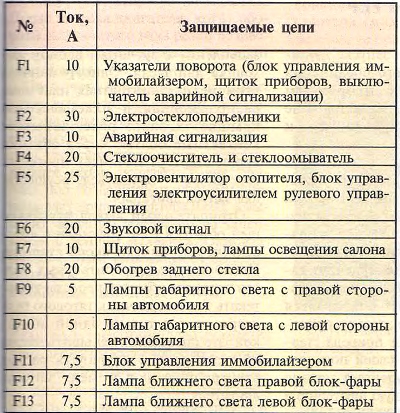
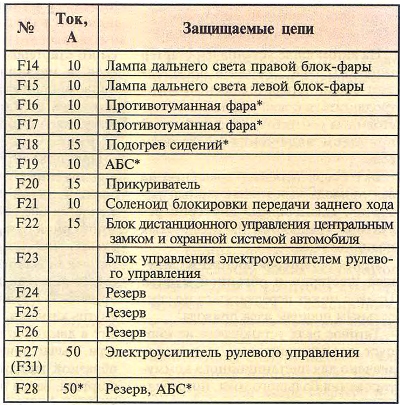
Note: The differences for the mounting block numbered for 31 fuses are given in brackets. When replacing fuses, follow the symbols on the cover of the mounting block.
* Installed on some vehicles.
Warning! Before replacing a fuse, you must determine and eliminate the cause of its blown fuse. To avoid failure of electrical equipment, fuses with increased ratings or homemade ones must not be installed.
Sequence of execution
1. Prepare the vehicle for work and disconnect the wire terminal from the negative terminal of the battery (see "Preparing the car for maintenance and repair").
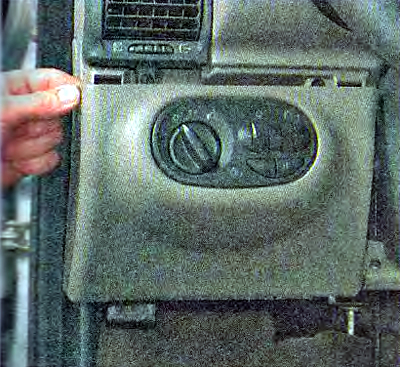
2. Pull the tab on the left side of the instrument panel to open the cover of the mounting block.
3. Using the serial number on the body of the mounting block, we find the fuse of the faulty circuit.
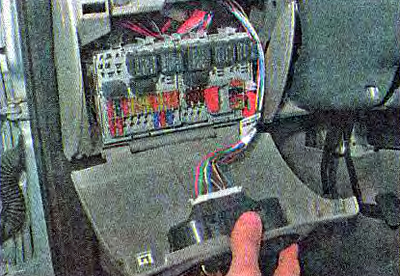
4. There are fuse extractor tweezers in the fuse and relay mounting block.
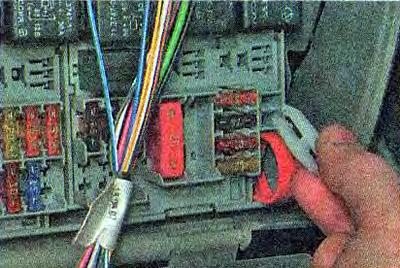
5. Squeeze the fuse housing with tweezers and remove the fuse from the block. A faulty fuse can be identified by a burnt-out filament.
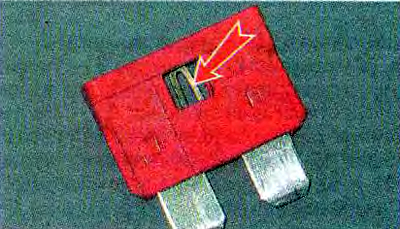
Recommendation. Sometimes the fuse thread remains intact while its connection inside the fuse is broken. It is impossible to visually identify such a malfunction. In this case, you can assess the condition of the fuse using an ohmmeter or a test lamp.
6. Install a new fuse of the appropriate rating.
7. If it is necessary to replace the relay, remove it using the puller located in the mounting block.
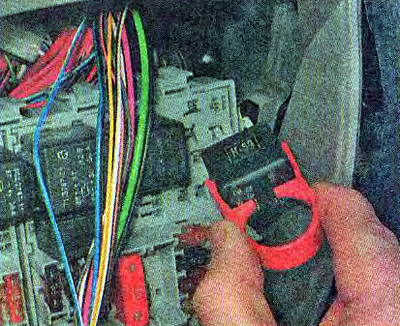
8. Install a new relay of a similar type.
9. Close the cover of the mounting block and connect the battery.