



body frame (pic. 10.1) includes base, sidewalls, roof and frame parts connected by electric welding (point, seam and arc), and is a non-separable structure with sufficient rigidity and capable of carrying all vehicle components, attachments of the body, components and interior parts, etc.
Attachments include side doors, hood, trunk lid, front fenders, bumpers and grille. Doors, hood and trunk lid are attached to the body with hinges.
Front fenders, front and rear bumpers are bolted to the body. The radiator cover is attached with plastic clips and three screws.
The windshield is three-layer type triplex. Glasses of doors, back and lateral glasses tempered. wind, rear (with heating element) and side windows are glued to the body and are part of its power circuit.
The front seats are separate, with adjustable backrests and mechanisms for moving in the longitudinal direction, with easily removable head restraints, adjustable in height. The back of the front seats can be adjusted to a comfortable resting position.
To increase the volume of the luggage compartment, the rear seat of the car is folded in parts: the seat cushion leans forward and the backrest folds down. All car seat belts are inertial type. The interior of the car is equipped with a cigarette lighter, an ashtray, sun visors, a heater, a rear-view mirror and handrails. Under the driver's seat, there is a mount for a fire extinguisher, and under the passenger seat - for a first aid kit. The vehicle is equipped with front and rear towing eyelets.
In a variant version, the car is equipped with an air conditioning system, an electric trunk lock, and electrically heated front seats.
Depending on the configuration, the car is equipped with a heating and ventilation or air conditioning unit. If the car is equipped with an air conditioner, then the microclimate in the cabin is controlled by the controller in automatic mode.
Exhaust ventilation is provided in the body through deflectors with valves installed on the sides of the body behind the rear bumper.
Helpful Hints
Do not cover the body with a cover made of dense material during a long-term parking of the car. A rain-soaked cover creates steam when heated in the sun «bath», and the body paint underneath may peel off and swell. In addition, under gusts of wind, the cover moves and erases the paint on the protruding parts of the body.
Do not place rubber objects on the body. After a while, the rubber leaves on the surface (especially light) indelible stains.
Regularly lubricate the door hinge axles with any liquid lubricant. There were cases when, due to rusted axles, door hinges came off from the body pillars.
If, over time, the rubber products on the body of your car have lost their presentation, wipe them with a hand cream containing glycerin or silicone grease, which is sold in auto parts stores.
From time to time, pass a thin metal plate between the side glass and the rubber lining on the door - this way you will remove dust and sand, protect the glass from scratches.
After washing, be sure to remove the rubber mats and dry the interior. Moisture under rugs is the main cause of floor corrosion.
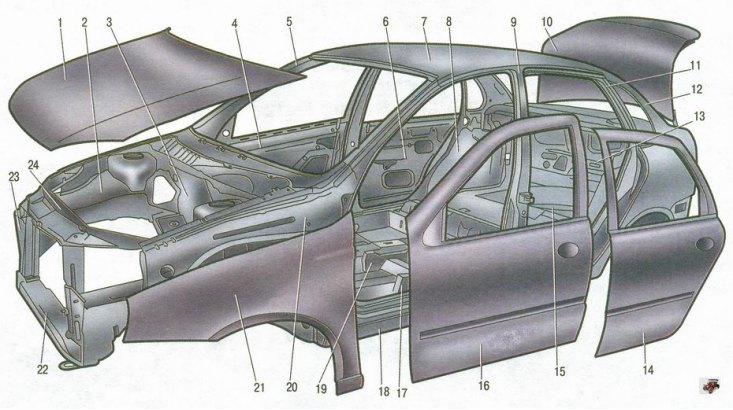
10.1. Body frame details: 1 - hood; 2 - right front spar; 3 - front panel; 4 - right front door; 5 - a rack of a wind window; 6 - right rear door; 7 - roof panel; 8 - rear wheel arch with rear suspension spring support; 9 - central pillar; 10 - trunk lid; 11 - rear pillar; 12 - sidewall window frame; 13 - back panel; 14 - left rear door; 15 - spare wheel niche; 16 - left front door; 17 - front seat mounting bracket; 18 - side panel; 19 - floor cross member; 20 - mudguard of the left front wing; 21 - left front fender; 22 - lower cross member of the radiator frame; 23 - radiator frame rack; 24 - the upper cross member of the radiator frame