



Sequence of execution
1. Prepare the car for work (see "Preparing the car for maintenance and repair").
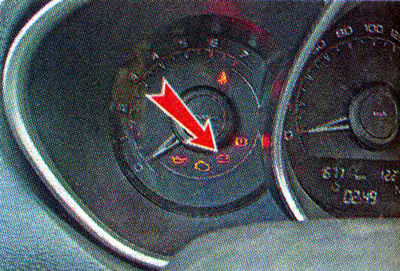
2. Start the engine. If the battery charge indicator light on the instrument panel lights up, check the tension of the auxiliary drive belt.
Recommendation. Weak tension of the alternator drive belt (see "Accessory Drive Belt - Check") causes it to slip along the pulleys, which prevents the generator from developing the required power and leads to rapid wear of the belt. Belt slippage can be indirectly determined by the dim glow of the headlights at night and by a whistling sound in the front of the engine when the crankshaft speed increases.
3. Warm up the engine to operating temperature (at least 80°C).
4. Turn on all powerful consumers of electrical energy in the car (heated rear window, electric heater fan, high beam headlights, heated seats).
Note: We will do the rest of the work with an assistant.
5. Pressing the gas pedal and monitoring the engine operation using the tachometer, we maintain the engine crankshaft speed within 3000–3500 min⁻¹.
6. Using a voltmeter, measure the voltage at the battery terminals. If the generator is in good working order, the voltmeter should show a voltage of at least 14 V.
Remark. If the voltage is lower, the generator drive belt may be loosely stretched (see above), the generator circuit is faulty, the generator voltage regulator is faulty, the brushes in the generator are greasy or worn out, or the generator itself is faulty (for troubleshooting the voltage regulator and other generator parts, see. below in the relevant sections).
7. Turn off all electrical consumers, while the voltmeter should show a voltage no higher than 15.1 V.
Note: If the voltage is higher, the voltage regulator is most likely faulty.
8. Using a stethoscope, we evaluate the condition of the generator bearings based on the noise. A loud hum indicates wear of the bearing or bearings (the front bearing fails most often).