



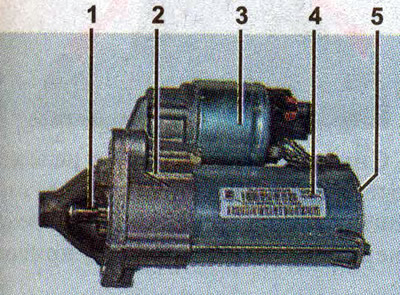
Starter details: 1 - drive; 2 - front cover; 3 - pull-in (traction) relay; 4 - Electric motor; 5 - back cover
The armature shaft transmits rotation to the drive shaft through a planetary gearbox. The planetary gears of the gearbox rotate on needle bearings.
The starter drive consists of a pinion gear and an overrunning clutch. The drive can move along the spiral splines of the drive shaft.
The retractor relay is installed on the electric motor housing and is designed for remote switching of the large current consumed by the starter when starting the engine, and mechanical connection of the starter drive with the toothed ring of the engine flywheel. The relay coil has two windings, pull-in and holding.
When the ignition key is turned to position II ("starter"), voltage is supplied from the battery to the control terminal of the solenoid relay "50", and from it to both relay windings. Under the influence of a magnetic field, the metal core of the traction relay, overcoming the force of the return spring, is drawn into the coil. At the same time, it sets the starter drive lever in motion. The drive lever with its horseshoe-shaped fork extends the starter drive, bringing the drive pinion into engagement with the toothed ring of the engine flywheel. At the same time, the copper contact plate located in the plastic cover of the traction relay closes the contact bolts. Current begins to flow through the starter armature windings, the armature begins to rotate, starting the engine.
The negative terminal of the relay pull-in winding is connected to ground through the starter armature windings. After the contact bolts are closed, the current stops flowing through this winding and the core of the pull-in relay is held by only one winding, which reduces the heating of the relay windings and reduces energy consumption at the moment of engine start.
The overrunning roller clutch of the drive transmits rotation in only one direction - from the starter to the flywheel. After starting the engine, when the crankshaft speed increases sharply, the clutch protects the starter from destruction.
Information taken from the website LadaMan.ru
After the driver releases the ignition switch (lock), the control voltage stops flowing to the output of the retractor relay; the electromagnetic field holding the anchor disappears. The drive lever, under the action of the spring, moves the starter drive back and disengages the drive pinion from the flywheel ring gear. At the same time, the power contacts that supply current to the starter motor windings open.
Warning! The starter is the most powerful consumer of electrical energy in a car. When starting the engine, the current consumed by the starter can reach more than 400 A. Therefore, all electrical connections between the battery and the starter must have reliable contact.