
Car repair AvtoVAZ Car repair Renault Car repair Hyundai Car repair Ford Car repair Volkswagen Car repair Audi Car repair Chevrolet
English Русский
Български
Беларускі
Український
Српски
Hrvatski
Română
Polski
Slovenský
Magyar
articles sitemap contacts bookmark
LadaMan.ru


Kalina Granta Priora Vesta Largus XRAY
Vesta 1 (2015-2023, VAZ-2180)

Checking and repairing the starter (Vesta 2180)

  • Main
  • Vesta
  • Vesta 1
  • Electrical equipment
  • Power devices
  • Checking and repairing the starter
0
Contents: Examination ⇣ Replacing the solenoid relay ⇣
Note: Depending on the malfunction that has occurred, the sequence and scope of repair work may be changed.


The most common starter faults:

1. The winding burns out or the contact bolts and contact plate in the traction relay burn out. To eliminate these faults, it is necessary to replace the traction relay. This can be done on a car without removing the starter.

2. The overrunning clutch of the drive is faulty. To eliminate this malfunction, it is necessary to disassemble the starter and replace the drive.

3. The starter brushes are worn out. The starter should be removed, the brush assembly replaced and the commutator cleaned. When replacing the brush assembly, there is no need to remove the starter drive and traction relay.

To complete the work you will need: two power cables (with clamps on the ends) to start the engine from the battery of another car; external snap ring pliers; ohmmeter.

Examination


Note: You can check the electrical part of the starter without disassembling it.


1. Remove the starter (see above, "Starter - removal and installation").

Warning: When performing the test, do not short-circuit the positive battery terminal wire clamp to the starter housing. To do this, the clamp should be extended, for example by inserting a steel punch into it.


2. Using one wire, connect the negative terminal of the battery to the starter housing. The second wire, connected to the positive terminal of the battery, is connected to the contact bolt 3 of the retractor relay, to which the starter wire is connected. If the starter armature starts to rotate, the starter motor is good.
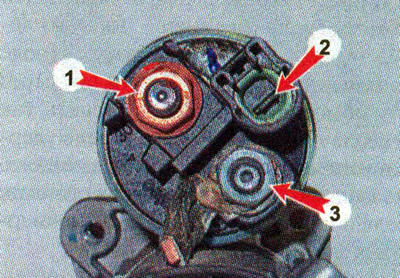


2. Using one wire, connect the negative terminal of the battery to the starter housing. The second…


3. Connect the second wire to contact bolt 1 of the pull-in relay. Using a screwdriver or other suitable metal object, we short-circuit terminal 2 and contact bolt 1 of the pull-in relay. If you hear a loud click and the starter armature starts to rotate, then the traction relay is working properly.

To further check the starter, as well as to determine the cause of the malfunction, it is necessary to disassemble the starter.

Replacing the solenoid relay


1. Using a 13 mm socket wrench, unscrew the nut securing the wire tip to the terminal (contact bolt) pull-in relay.
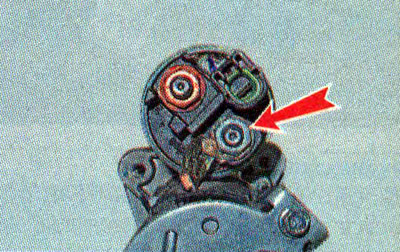
1. Using a 13 mm socket wrench, unscrew the nut securing the wire tip to the terminal (contact…


2. Remove the wire tip from the contact bolt of the starter relay.

3. Using a TORX T20 key, unscrew the two bolts securing the starter relay.
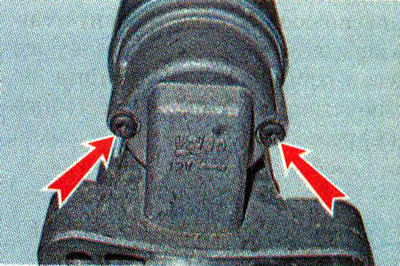


3. Using a TORX T20 key, unscrew the two bolts securing the starter relay.


4. Remove the starter solenoid relay (in this case it is necessary to disconnect the relay core earring from the upper end of the drive lever).
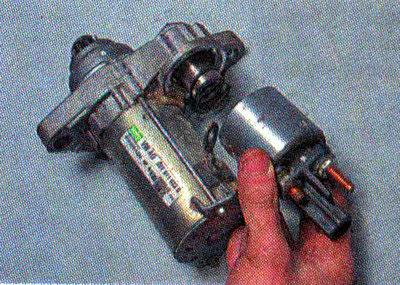
4. Remove the starter solenoid relay (in this case it is necessary to disconnect the relay core…


Recommendation. Check the ease of movement of the retractor relay core. Connect an ohmmeter to the terminals of the pull-in relay and, by pressing the anchor all the way in, make sure that the contact bolts close (electrical resistance is close to zero). A faulty solenoid relay must be replaced.


5. Install the pull-in relay in the reverse order.


This article is available at russian, bulgarian, belarusian, ukrainian, serbian, croatian, romanian, polish, slovak, hungarian
This article has been reviewed: Kirill Dementyev
Share with friends:
◀ Previous
Lada Vesta 1: Power devices
 

Starter — removal and installation
Description of the starter design
Generator — removal and installation
Checking the generator
Description of the generator design
 
More articles with information from manuals for Lada:

• Safety precautions when servicing and repairing a car Lada Kalina Hatchback (2004-2013, VAZ-1119)
• Checking the technical condition of the engine Lada Granta 1 (2011-2023, VAZ-2190)
• Checking the engine ignition system Lada Priora 1 (2007-2018, VAZ-2170)
• Precautions when repairing a car Lada Largus 1 (2012-2023)
• Checking the oil level in the engine oil pan Lada X-Ray 1 (2015-2022)
Link to this article in various formats
Reviews and comments of visitors
No comments yet


Add up two numbers: 11 + 34


Vesta 1 (2015-2023) 
  • General information
  • Governing bodies
  • User manual
  • Maintenance
  • Troubleshooting
  • Power unit
  • Engine repair
  • Control system
  • Supply system
  • Cooling system
  • Exhaust system
  • Transmission
  • Clutch
  • Mechanical gearbox
  • Automatic gearbox
  • Drive shafts
  • Chassis (running gear)
  • Wheels, tires and hubs
  • Front suspension
  • Rear suspension
  • Steering
  • Brake system
  • Body and interior
  • Exterior (external elements)
  • Doors, locks and windows
  • Heating and ventilation
  • Electrical equipment
  • Equipment and devices
  • Power devices
  • Breakers and switches
  • Lighting and signaling
  • Electrical circuits
LadaMan.ru © 2018–2026 | Mobile version | About Lada | Sitemap: EN BG BY UA RS HR RO PL SK HU | Contacts with admin | | Add to bookmarks
Kalina Hatchback (2004-2013) | Kalina Sedan (2004-2013) | Granta 1 (2011-2023) | Priora 1 (2007-2018) | Vesta 1 (2015-2023) | Largus 1 (2012-2023) | X-Ray 1 (2015-2022) |
This site uses cookies to ensure everything runs smoothly.