



The discrepancy between the actual values measured on the vehicle and the control values specified below is due to wear and deformation of suspension parts and deformation of the body.
Attention! Replacement or repair of suspension parts may result in changes in wheel alignment angles, so checking the wheel alignment angles after these works is mandatory.
Note: Check wheel alignment with the vehicle half full of fuel and 70 kg of ballast on each front seat.
Wheel alignment angles of the vehicle in running order:
- camber — 0°±30'
- toe-in — (0±1.0) mm
- longitudinal tilt angle of the rotation axis — 1°30'±30'
Attention! The difference in the longitudinal tilt angles of the steering axis between the right and left wheels must not exceed 1°.
Before adjusting the wheel alignment angles, check:
- tire pressure;
- radial and axial runout of wheel disks, which should not exceed 0.7 and 1 mm, respectively;
- free play (play) of the steering wheel;
- free play (play) in the front wheel hub bearings;
- technical condition of suspension parts and units (absence of deformation, destruction and wear of rubber-metal hinges, unacceptable settlement of the upper support of the suspension strut).
Correct any detected faults.
After installing the car on the stand (immediately before corner control) "Squeeze" the car's suspension, applying a force of 392–490 N (40–50 kgf) two or three times, directed from top to bottom, first on the rear bumper, and then on the front one. In this case, the car wheels must be positioned parallel to the longitudinal axis of the car.
Note: When adjusting the wheel alignment angles, first adjust the caster angle, then the camber and toe angles.
Angle of longitudinal inclination of the axis of rotation
If the angle does not correspond to the data given above, change the number of adjusting washers installed at both ends of the suspension struts. To increase the longitudinal tilt angle of the steering axis, reduce the number of washers on the tension rod in its front or rear part. Conversely, to reduce the angle, add a number of washers, but only at the rear of the brace, as this is not always possible at the front due to the short threaded part of the brace.
When changing the number of washers on the tension rod, ensure that the chamfers on the washers are facing the thrust end of the tension rod. Follow this rule when installing the inner thrust washer of the rubber-metal hinge, when the adjusting washers are completely removed. If the specified requirements are not met, the tightening of the nuts securing the braces may become loose.
The number of adjusting washers on the strut should not be more than two in front and four in the back.
[Taken from the website: LadaMan.ru]
In order to prevent the position of the strut relative to the suspension arm from changing when adjusting the longitudinal tilt of the pivot axis, use a special device that fixes the strut relative to the arm, thereby preventing the strut from turning under the effect of forces when tightening the nut securing the strut to the arm. This requirement must be observed in order to prevent premature wear of the rubber-metal hinge and the rubber cushion on which the ends of the stretch rest.
When one adjusting washer is installed or removed, the longitudinal tilt angle of the steering axis changes by approximately 19'.
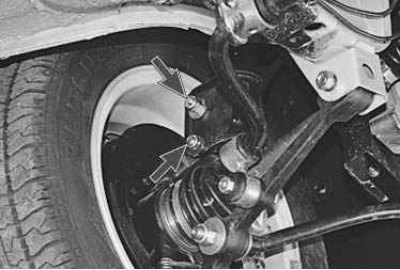
Front wheel camber angle
If the camber angle is different from the norm, adjust it.
To do this, loosen the nuts of the upper and lower bolts and, by turning the upper adjusting bolt, set the required camber angle. After completing the adjustment, tighten the nuts to a torque of 88.2 N·m (9 kgf·m).
Front wheel alignment
If the alignment is not within the norm…
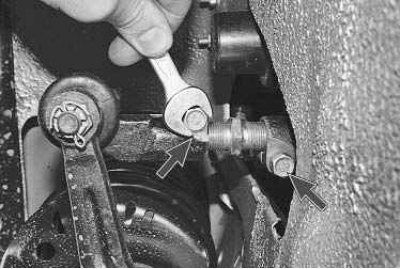
…use a 13 mm wrench to loosen the tie rod end clamp bolts…
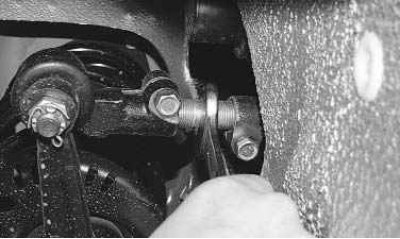
…and, using a 22 mm wrench to turn the adjusting rods, set the required toe-in. Then make sure that the plane of the ball joint is parallel to the plane of the bearing surface of the steering arm, and then tighten the tie rod end pinch bolts to a torque of 19.1–30.9 N·m (1.95–3.15 kgf·m).