



Check the steering wheel play with the vehicle parked on a level, non-slip surface. The clearance should not exceed 5°. The clearance can be determined in linear units (mm) using the formula
L = (5°/360°)pD, where
L — steering wheel play, mm;
p=3,14;
D — outer diameter of the steering wheel, mm.
For a steering wheel with an outer diameter of 400 mm, the play should be no more than 18–20 mm.
You will need: a ruler, chalk (or wire) for applying marks.
1. Set the front wheels to the straight-ahead position.
Note: If the front wheels are in a straight-ahead position and the steering wheel spokes are not horizontal, this indicates a wheel alignment issue, or a steering or suspension defect.
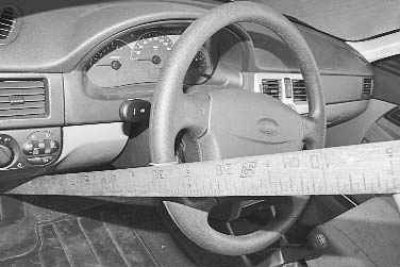
2. Position the ruler so that its end rests against the instrument panel and the edge of the ruler touches the outer surface of the steering wheel rim. Without changing the position of the ruler, turn the steering wheel in any direction until the front wheels begin to turn. In this position, apply a mark to the steering wheel rim (secure the wire).
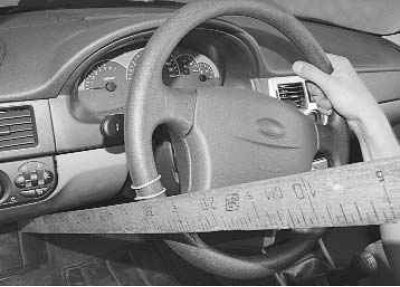
3. Without changing the position of the ruler, turn the steering wheel in the other direction until the front wheels begin to turn. In this position, apply a second mark to the steering wheel rim (secure the wire).
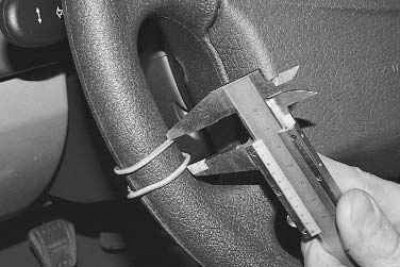
4. Measure the distance between the marks on the rim. It should not be more than the calculated value. If the distance (steering wheel free play) more and it is not possible to bring it up to standard by adjustment (see "Steering gear"), continue checking the steering to determine the cause of the increased free play.