Car repair AvtoVAZ Car repair Renault Car repair Hyundai Car repair Ford Car repair Volkswagen Car repair Audi Car repair Chevrolet
English Русский
Български
Беларускі
Український
Српски
Hrvatski
Română
Polski
Slovenský
Magyar
articles sitemap contacts bookmark
LadaMan.ru


Kalina Granta Priora Vesta Largus XRAY
Kalina Sedan (2004-2013, VAZ-1118) Kalina Hatchback (2004-2013, VAZ-1119)

Wheels, Tires and Hubs: Design Description (Kalina 1119)

  • Main
  • Kalina
  • Kalina Hatchback
  • Chassis (running gear)
  • Wheels and tires
  • Wheels, Tires and Hubs: Design Description
0
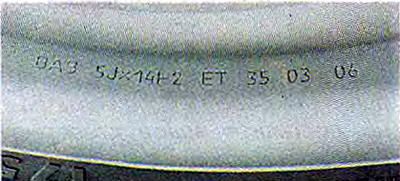
For a car with a 16-valve engine, the manufacturer installs wheels (disks) for tubeless tires 5Jxl3H2 ET 35, 5JX14H2 ET 35 or 5½Jxl4H2 ET 35, where:
  • 5 (51 /2) - rim width in inches;
  • J - conventional designation of the rim profile;
  • 13 (14) - rim seat diameter for tire in inches;
  • H2 - conventional designation of the shape of the rim landing shelves;
  • ET - conventional designation of rim offset;
  • 35 - rim offset in millimeters.

35 - rim offset in millimeters.


Note: Rim offset (ET) is the distance between the plane that divides the wheel rim in half (plane equidistant from the sides of the rim), and the mounting (fastening) plane of the wheel.


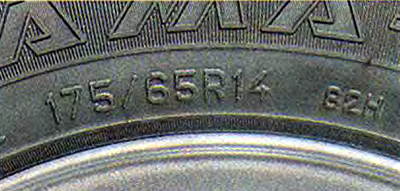
The car is equipped with tubeless tires 175/70R13 82T (or H), 175/65R14 82H or 185/60R14 82H, where:
  • 175 (185) - profile width in millimeters;
  • 65 (60) - the ratio of the profile height to its width in percent;
  • R - designation of radial tire;
  • 14 - tire seat diameter in inches;
  • 82 - load index (maximum permissible load on the tire is 475 kgf);
  • T (H) - speed index (maximum permissible speed 190 and 210 km/h respectively).
T (H) - speed index (maximum permissible speed 190 and 210 km/h respectively).


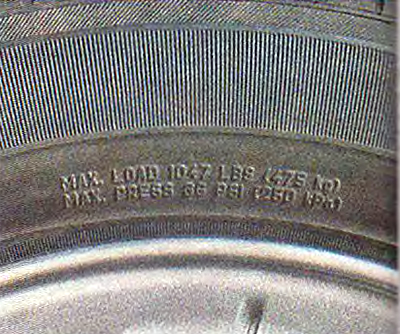
The maximum load on the tire (MAX LOAD) is duplicated in a deciphered form together with the indication of the maximum permissible pressure (MAX AT) of air in the tire.


The maximum load on the tire (MAX LOAD) is duplicated in a deciphered form together with the…


It is also permissible to install tires with a 14-inch rim diameter and speed index T on the vehicle.

When giving recommendations on the selection of certain tires, the manufacturer takes into account the conditions for ensuring maximum stability, controllability, cross-country ability and safety of the vehicle. Thus, wheels with a large offset can touch the brake mechanism parts, and those with a smaller offset increase the load on the hub bearings and can lead to unpredictable behavior of the car during emergency braking or in the event of failure of one of the brake system circuits. High-profile tires can touch body parts at maximum suspension travel, while wide tires can rub against the car's side members or fenders at large turning angles. A tire with a lower load index may burst under a fully loaded vehicle, while a lower speed index may result in tire failure when driving at high speed.

Tires that can be installed on a car are divided into three types: summer, winter and all-season. If the car is used all year round and the winter is snowy, it is better to have two sets of wheels: with winter and summer tires. Winter tires are made of softer rubber, which allows them not to "harden" at subzero temperatures, and the tread has narrow wavy slits - lamellas. This allows the tire to better cling to the roughness of the surface. The sidewalls of winter tires may be marked M+S or MS. The possibility of using studded tires in winter depends on the specific operating conditions of the vehicle. It should be noted that studs are designed to improve traction and are only needed on slippery hard surfaces such as ice or packed snow. In other cases, studs are useless, and on asphalt they even slightly worsen the tire's grip on the road.


Using a winter tire in summer results in intensive wear.

All-season tires can be used all year round. They are distinguished from other tires by the inscription ALL SEASON or TOURS TERRAIN on the sidewall. According to their performance, they behave satisfactorily in various weather conditions, but in summer they are inferior in technical performance to summer tires, and in winter to winter tires.

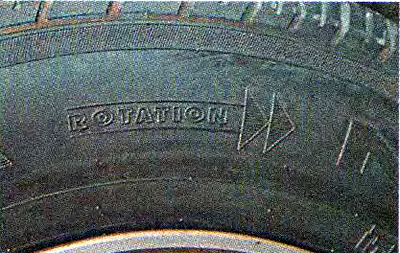
The tread pattern can be universal or directional and is not regulated by the requirements of the manufacturer. With a directional tread pattern, the word ROTATION and an arrow indicating the direction of rotation of the wheel when the vehicle is moving forward are applied to the sidewall of the tire. A special case of a directional pattern is an asymmetrical one. In this case, the inscription OUTSIDE is applied to the side, which must be on the outside during installation.
The tread pattern can be universal or directional and is not regulated by the requirements of the…


This article is available at russian, bulgarian, belarusian, ukrainian, serbian, croatian, romanian, polish, slovak, hungarian
This article has been reviewed: Polina Kudryashova
Share with friends:
◀ Previous
Lada Kalina Hatchback: Wheels and tires
Next ▶

Wheels, Tires and Hubs: Reference Data
Checking the technical condition of wheels, tires and hubs
Tires — Checking Pressure
Front Wheel Hub Bearing — Replacement
Rear Wheel Hub Bearing — Replacement
More articles with information from manuals for Lada:

• Description of the design of wheels and tires Lada Granta 1 (2011-2023, VAZ-2190)
• Checking the wheels Lada Priora 1 (2007-2018, VAZ-2170)
• General information about wheels and tires Lada Vesta 1 (2015-2023, VAZ-2180)
• Wheels, tires and disks — characteristics, features, replacement Lada Largus 1 (2012-2023)
• Tires and wheels Lada X-Ray 1 (2015-2022)
Link to this article in various formats
Reviews and comments of visitors
No comments yet


Add up two numbers: 40 + 44


Kalina Sedan (2004-2013) 
  • General information
  • Vehicle device
  • Operation and maintenance
  • Faults en route
  • Power unit
  • Engine repair
  • Cooling and lubrication system
  • Exhaust system
  • Supply system
  • Ignition and control
  • Transmission
  • Clutch and drive shafts
  • Car gearbox
  • Chassis (running gear)
  • Front suspension
  • Rear suspension
  • Steering
  • Brake system
  • Body and interior
  • Exterior (external elements)
  • Interior (internal elements)
  • Doors, locks and windows
  • Electrical equipment
  • Equipment and devices
  • Power devices
  • Lighting and signaling
  • Heating and ventilation
Kalina Hatchback (2004-2013) 
  • General information
  • Vehicle Details
  • Maintenance
  • Troubleshooting
  • Power unit
  • Engine repair
  • Cooling system
  • Supply system
  • Control system
  • Exhaust system
  • Transmission
  • Clutch
  • Car gearbox
  • Drive shafts
  • Chassis (running gear)
  • Wheels and tires
  • Front suspension
  • Rear suspension
  • Steering
  • Brake system
  • Body and interior
  • Exterior (external elements)
  • Interior (internal elements)
  • Doors, locks and windows
  • Electrical equipment
  • Equipment and devices
  • Power devices
  • Lighting and signaling
  • Electrical circuits
LadaMan.ru © 2018–2026 | Mobile version | About Lada | Sitemap: EN BG BY UA RS HR RO PL SK HU | Contacts with admin | | Add to bookmarks
Kalina Hatchback (2004-2013) | Kalina Sedan (2004-2013) | Granta 1 (2011-2023) | Priora 1 (2007-2018) | Vesta 1 (2015-2023) | Largus 1 (2012-2023) | X-Ray 1 (2015-2022) |
This site uses cookies to ensure everything runs smoothly.