



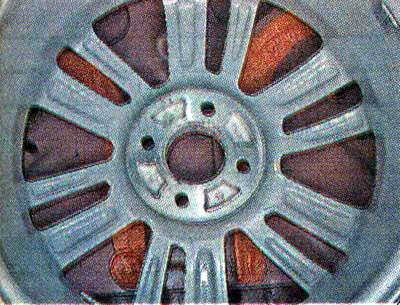
The manufacturer installs steel or alloy wheels for tubeless tires on the vehicle (see above, "Reference data"). The alloy wheel markings are cast on the inside of the spokes.
The steel wheel markings may be stamped on the rim.
The wheel disk designation is deciphered as follows:
- 6 - rim width in inches;
- J — conventional designation of the rim profile;
- 15 — rim seat diameter for tire in inches;
- 4x100 - the number of holes for wheel bolts and the diameter on which they are located;
- DIA60,1 — diameter of the mounting hole;
- ET — conventional designation of rim offset;
- 50 — rim offset in millimeters;
- 2013 10 7 — date of manufacture.
Note: Rim offset (ET) is the distance between the plane that divides the wheel rim in half (plane equidistant from the sides of the rim) and the mounting (fastening) plane of the wheel.
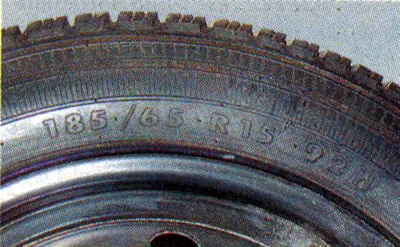
The wheels are fitted with tubeless tyres. The European tire designation, for example 185/65R15 92H, is deciphered as follows:
- 185 — profile width in millimeters;
- 65 — the ratio of the profile height to its width in percent;
- R — designation of radial tire;
- 15 — tire rim diameter in inches;
- 92 — load index (table 11.1.3);
- H — speed index (table 11.1.4).
Note: Load index is an index indicating the maximum permissible load on a tire, exceeding which may lead to tire failure. Speed index - an index indicating the maximum permissible speed for a given tire. Exceeding this speed may result in tire failure.
The American tire designation, for example P 185/65R15 84T, is deciphered similarly. An additional letter before the designation indicates the purpose of the tire: P (Passenger) - tire for a passenger car, LT (Light Truck) - light truck tire.
A tire may also have a DOT certification number if the tire has been tested to meet U.S. Department of Transportation standards.
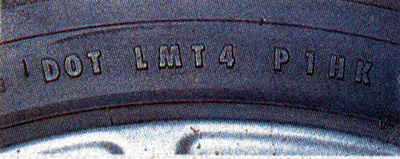
In this case, markings are applied to the sidewall of the tire, informing about the relative qualities of the rubber:
TREADWEAR — characterizes the wear resistance of the tire: the higher the index value, the higher the wear resistance of the tire (for example, a tire with index 300 has a resource three times greater than a tire with index 100).
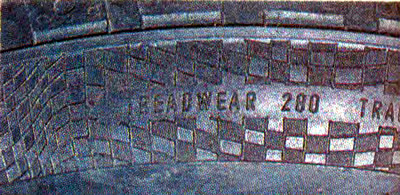
TRACTION — characterizes the ability of the tire to brake on wet asphalt without slipping. Measurements are carried out using a special technique with the vehicle moving in a straight line.
Warning! This measurement method does not take into account the tire's behavior when braking in a corner or on other road surfaces.
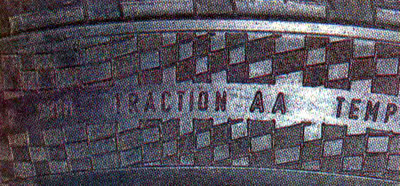
The letters next to the word TRACTION indicate the relative value of this tire parameter. The following options are possible (in order of deterioration): AA, A, B, C.
TEMPERATURE — characterizes the tire's resistance to heat generation and its ability to dissipate thermal energy. Measurements are carried out using a special technique.
Warning! Excessive load, excessive speed, and underinflation may cause the tire to overheat and fail.
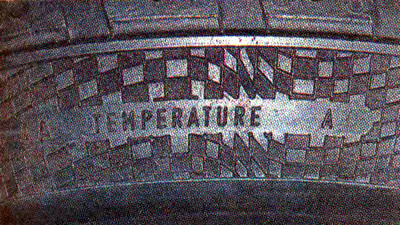
The C index indicates that the tire meets the minimum safety standard requirements. The indices B and A show the excess of these minimum requirements in ascending order. The following markings may also be applied to the sidewall of the tire: RADIAL — designation of a radial tire; TUBELESS - this inscription means that the tire is tubeless.
When giving recommendations on the selection of certain tires, the manufacturer takes into account the conditions for ensuring maximum stability, controllability, cross-country ability and safety of the vehicle. Thus, wheels with a large offset can touch parts of the brake mechanisms and suspension, and those with a smaller offset increase the load on the hub bearings and can lead to unpredictable behavior of the car during emergency braking or in the event of failure of one of the brake system circuits. High-profile tires can touch body parts at maximum suspension travel, while wide tires can rub against the car's side member or its wing at large turning angles. A tire with a lower load index may burst under a fully loaded vehicle, and using a tire with a low speed index is fraught with its destruction when driving at high speed.
Tires that can be installed on a car, depending on the temperature and weather conditions for which they are designed, are divided into three types: summer, winter and all-season. If the car is used all year round and the winter is snowy, it is better to have two sets of wheels: with winter and summer tires. Summer tires are specially designed to operate at high temperatures. In winter, summer tires will be too hard, which will negatively affect their grip on the road. Winter tires provide adequate traction in cold temperatures and on icy or snowy road surfaces. These tires are made from softer rubber. They are marked with a sign 1 in the form of a mountain peak with three peaks and a snowflake inside it, as well as signs 2 "M+S", "M&S", or "M S" (letters from the English words mud and snow, indicating that the tire has increased distances between the tread protrusions, which helps resist slipping on an unstable supporting surface).
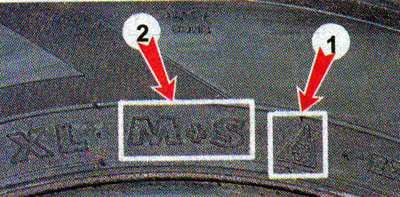
The inscription STUD indicates the presence of spikes. The possibility of using studded tires in winter depends on the specific operating conditions of the vehicle. It should be noted that studs are designed to improve the tire's grip only on slippery hard surfaces such as ice or packed snow. In other cases, studs are useless, and on asphalt they can even slightly worsen the tire's grip on the road.
Using a winter tire in summer results in intensive wear.
All-season tires can be used all year round. They are distinguished from other tires by the inscription: ALL SEASON or TOUS TERRAIN on the sidewall. According to their performance, they behave satisfactorily in various weather conditions, but at the same time, they lose to summer tires in terms of technical performance in summer, and to winter tires in winter. All-season tires are best suited for the off-season.
Depending on the profile height, tires are divided into low-profile (the ratio of the profile height to its width is equal to or less than 55) and high-profile (the ratio of the profile height to its width is greater than 55). The smaller the tire profile, the stiffer its sidewall and, accordingly, the tire absorbs road irregularities less, however, as the profile decreases, the control precision increases.
The tread pattern can be universal or directional and is not regulated by the requirements of the vehicle manufacturer. With a directional tread pattern, the sidewall of the tire has the inscription ROTATION and an arrow indicating the direction of rotation of the wheel when the vehicle is moving forward.
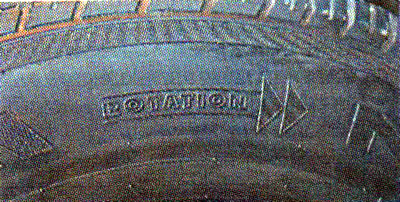
A special case of a directional pattern is an asymmetrical one. In this case, the inscription OUTSIDE is applied to the side, which must be on the outside during installation.
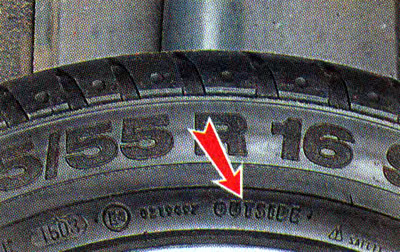
The tread of some types of tires may have narrow wavy cuts called sipes.
Table 11.1.3. Tire load indices
| Index | Load, kg | Index | Load, kg | Index | Load, kg | Index | Load, kg |
| 51 | 195 | 71 | 345 | 91 | 615 | 111 | 1090 |
| 52 | 200 | 72 | 355 | 92 | 630 | 112 | 1120 |
| 53 | 206 | 73 | 365 | 93 | 650 | 113 | 1150 |
| 54 | 212 | 74 | 375 | 94 | 670 | 114 | 1180 |
| 55 | 218 | 75 | 387 | 95 | 690 | 115 | 1215 |
| 56 | 224 | 76 | 400 | 96 | 710 | 116 | 1250 |
| 57 | 230 | 77 | 412 | 97 | 730 | 117 | 1285 |
| 58 | 236 | 78 | 425 | 98 | 750 | 118 | 1320 |
| 59 | 243 | 79 | 437 | 99 | 775 | 119 | 1360 |
| 60 | 250 | 80 | 450 | 100 | 800 | 120 | 1400 |
| 61 | 257 | 81 | 462 | 101 | 825 | 121 | 1450 |
| 62 | 265 | 82 | 475 | 102 | 850 | 122 | 1500 |
| 63 | 272 | 83 | 487 | 103 | 875 | 123 | 1550 |
| 64 | 280 | 84 | 500 | 104 | 900 | 124 | 1600 |
| 65 | 290 | 85 | 515 | 105 | 925 | 125 | 1650 |
| 66 | 300 | 86 | 530 | 106 | 950 | 126 | 1700 |
| 67 | 307 | 87 | 545 | 107 | 975 | 127 | 1750 |
| 68 | 315 | 88 | 560 | 108 | 1000 | 128 | 1800 |
| 69 | 325 | 89 | 580 | 109 | 1030 | 129 | 1850 |
| 70 | 335 | 90 | 600 | BY | 1060 | 130 | 1900 |
Table 11.1.4. Tyre speed indices
| Index | Speed, km/h | Index | Speed, km/h |
| TO | 110 | T | 190 |
| L | 120 | and | 200 |
| M | 130 | N | 210 |
| N | 140 | V | 240 |
| R | 150 | VR | more than 210 |
| Q | 160 | W | 270 |
| R | 170 | Y | 300 |
| S | 180 | ZR | more than 240 |