



Table 3. Permissible sizes of tires, wheels and air pressure in tires
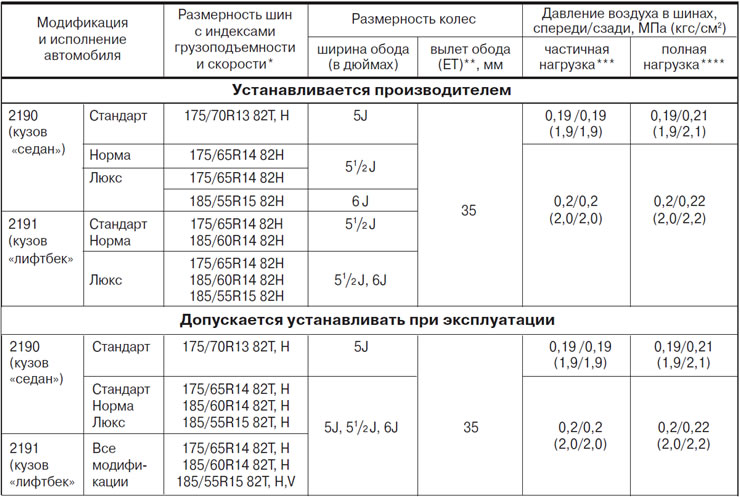
* Speed indices: T - up to 190 km/h, H - up to 210 km/h, V - up to 240 km/h. Load capacity indices: 82 - 475 kg.
** Rim offset (ET) is the distance from the mating plane of the disc to the center of the rim.
*** Partial load - no more than 3 adults in a car without cargo in the trunk.
**** Full load - more than 3 adults or 3 adults and 50 kg load in the trunk. It is allowed to use winter tires (M+S) of the above dimensions and index Q with the corresponding limitation of the maximum speed of the vehicle (up to 160 km/h).
If the pressure drops even though the valve is working properly, the tire needs to be repaired.
To avoid damaging the sealing layer of the tire, dismount and mount it using a special device or on the manufacturer-certified BSSS. To avoid disturbing the wheel balance, before dismounting, make a mark with chalk on the tire opposite the valve, and when mounting, install the tire according to this mark.
After installing new tires, be sure to balance the wheels on the manufacturer's approved wheel balance system.
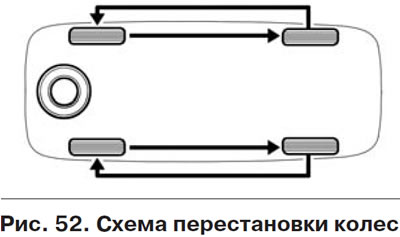
To ensure even tire wear, rotate the wheels as shown in the illustration 52 according to the service book instructions.
When operating your vehicle, avoid rubbing the wheels against road curbs and driving fast on roads with damaged surfaces (potholes, bumps, etc.), since damage to the wheel rim can cause not only its imbalance, but also loss of tightness of tubeless tires. If vibrations occur while driving, check the wheel balancing on the wheel balance system certified by the manufacturer.
Warning! It is prohibited to lift the vehicle with a jack when the wheels are not braked and to be under the vehicle raised with a jack.
The jack base is designed for use on hard surfaces and soils. To prevent the jack from falling through on washed-out, loose soil, snow, loose sand, etc., it is recommended to place a piece of board, plywood or other hard material measuring at least 250x250 mm underneath.
Tire pressure monitoring system
The vehicle is equipped with a tire pressure monitoring system (TPMS).
The system consists of four sensors installed in the tires, a control unit that is a signal receiver, and a warning light located in the instrument cluster. Replacement of sensors and system training is carried out only at authorized PSSS.
Yellow indicator light comes on (!) the tire pressure monitoring system indicates that pressure in one or more tires is low. Continuing to drive with low tire pressure may result in overheating and mechanical failure of the tires. Operating tires with underinflated tires also increases fuel consumption, reduces tire life, and may affect vehicle handling and braking distances.
If the indicator lights up, you must stop the car as soon as possible, check the condition of the tires and bring the pressure in them to normal.
Please note that using a TPMS does not mean that you do not need to properly maintain your tires or keep them at the correct pressure, even if the pressure level does not drop enough to trigger the TPMS low tire pressure warning light.
A warning light is also used to notify about a malfunction of the TPMS system (!).
When the system detects a fault, the indicator flashes 5 times at 1Hz and then remains on continuously.
The TPMS malfunction alarm is reset each time the ignition is turned on as long as the malfunction exists. When the malfunction indicator is illuminated, the system may not be able to detect or signal low tire pressure as intended. A TPMS system malfunction can be caused by a variety of reasons, including installing or replacing tires or wheels.
Always check the TPMS malfunction indicator after replacing or swapping one or more tires or wheels to ensure the TPMS is working properly.