



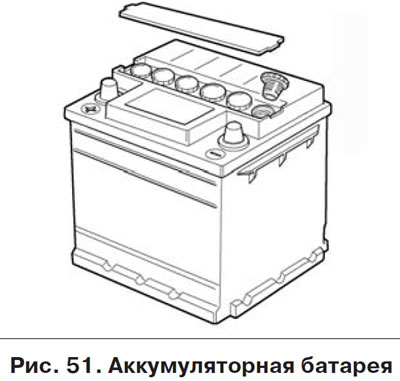
If there are no MIN and MAX marks on the battery case or the case is opaque, the electrolyte level should be 10-15 mm above the upper edge of the separators.
Warning! Due to the fact that electrolyte is an aggressive liquid, the impact of which is dangerous for your health and for the car parts, we recommend that the battery be serviced at certified car service stations.
Avoid deep discharge of the battery and recharge it if necessary.
If the battery has an indicator of the density and level of electrolyte ("eye"), then the battery condition can be determined by its color:
- green "eye" - electrolyte level and density are normal;
- "eye" of black color - the battery needs to be charged;
- "eye" white - electrolyte level below normal.
In the variant version, in the absence of a "peephole", the battery charge level can be determined by the voltage at the battery terminals: battery voltage (no load) must be no lower than 12.6 V (at a temperature of 25°C this corresponds to a 75% charge level).
Check the battery charge level regularly if:
- You use your car mainly for short city trips.
- You operate your vehicle at sub-zero ambient temperatures. As the temperature drops, the battery capacity decreases. During the winter, try to turn on only those electrical appliances that are really necessary.
- You have connected a number of additional permanent consumers to the vehicle's electrical system, such as clocks and other aftermarket accessories.
- Your car has been parked for a long time; in this case, for better safety, we recommend disconnecting the battery from the vehicle's electrical system by removing the terminal. At very low negative temperatures, below -30°C, we recommend removing the battery from the car and storing it in a warm room.
Warning! Do not remove the terminals from the battery terminals when the ignition is on, as this may cause errors in the operation of the ECM or lead to failures of electrical equipment.
Make sure the battery terminals and clamps are clean and securely connected. Remember that oxidation of terminals and clamps, as well as careless connections, cause sparking at the point of unreliable contact, which can lead to failure of the vehicle's electronic equipment. It is also not allowed to check the generator's performance with the engine running by removing the clamps from the battery.
When installing the battery on the vehicle, connect the wire harness terminals to the battery terminals in accordance with the specified polarity (the positive terminals of the harness and the battery terminal are larger in size than the negative ones).
When charging the battery from an external charger directly on the vehicle, be sure to disconnect the battery from the vehicle's electrical system.