
Car repair AvtoVAZ Car repair Renault Car repair Hyundai Car repair Ford Car repair Volkswagen Car repair Audi Car repair Chevrolet
English Русский
Български
Беларускі
Український
Српски
Hrvatski
Română
Polski
Slovenský
Magyar
articles sitemap contacts bookmark
LadaMan.ru


Kalina Granta Priora Vesta Largus XRAY
Kalina Sedan (2004-2013, VAZ-1118) Kalina Hatchback (2004-2013, VAZ-1119)

Brake system: design description (Kalina 1119)

  • Main
  • Kalina
  • Kalina Hatchback
  • Chassis (running gear)
  • Brake system
  • Brake system: design description
0
The car is equipped with two braking systems - service and parking.

The service brake system is designed to reduce the speed of the vehicle, up to its complete stop and to hold the vehicle stationary for a short time.

The working brake system is dual-circuit, diagonal, with hydraulic drive, consists of a smooth brake cylinder with a vacuum booster, four wheel brake mechanisms and a fluid pressure regulator in the rear brake mechanisms. The front wheel brakes are disc brakes, non-ventilated, and the rear wheel brakes are drum brakes.

Each of the vehicle's contours includes brake mechanisms for two wheels: one front and one rear, located diagonally on the vehicle. One circuit includes the brake mechanisms of the front right and rear left wheels, and the second circuit includes the brake mechanisms of the front left and rear right wheels. If one of the circuits fails, the second circuit, although less efficient, will ensure that the vehicle stops.

The fluid pressure regulator limits the flow of fluid to the rear brakes when the load on the rear axle is insufficient, thereby preventing the rear wheels from locking and the rear axle of the car from skidding during sudden braking. The regulator body has a control hole, closed with a plastic plug. If fluid leaks from this hole, it indicates that the regulator rings are not tight.

To reduce the force applied by the driver to the brake pedal, a vacuum booster is installed in the brake system drive, which operates due to the vacuum created in the intake manifold of the running engine.


Warning! Do not turn off the engine until the vehicle has come to a complete stop.


A reservoir with brake fluid is installed on the body of the main brake cylinder. The reservoir cap has a built-in brake fluid level sensor. When the fluid level in the tank drops dangerously, the sensor turns on the control lamp on the instrument panel.

Note: Some vehicles are equipped with ABS braking system (anti-lock braking system).
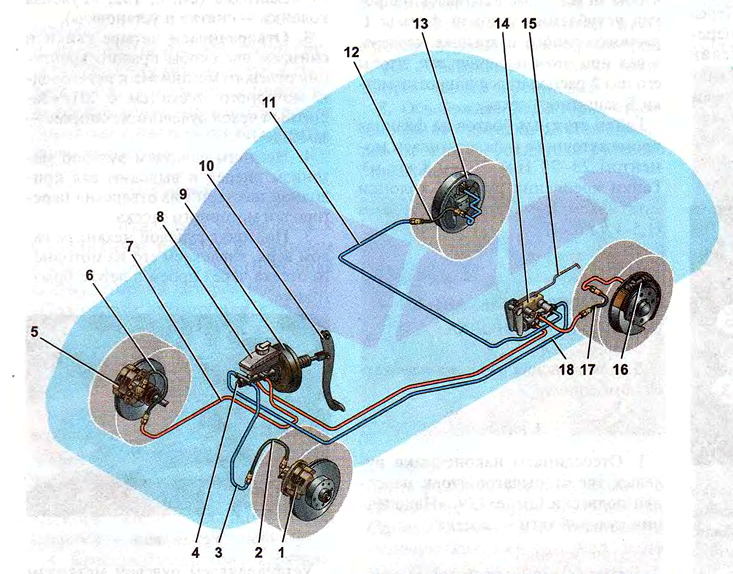

Service brake system:

Service brake system:
1 - front left wheel brake mechanism;
2, 6, 12, 17 - brake hoses;
3, 7, 11, 18 - brake pipes;
4 - master brake cylinder;
5 - front right wheel brake mechanism;
8 - master brake cylinder reservoir;
9 - vacuum booster;
10 - brake pedal;
13 - rear right wheel brake mechanism;
14 - fluid pressure regulator in the rear wheel brake mechanisms;
15 - lever of the fluid pressure regulator in the brake mechanisms of the rear wheels;
16 - rear left wheel brake mechanism.


Note: Some vehicles are equipped with ABS braking system (anti-lock braking system).


This article is available at russian, bulgarian, belarusian, ukrainian, serbian, croatian, romanian, polish, slovak, hungarian
This article has been reviewed: Polina Kudryashova
Share with friends:
◀ Previous
Lada Kalina Hatchback: Brake system
Next ▶

Brake system: reference data
Brake fluid level in the master cylinder reservoir — checking
Brake pads — checking for wear
Vacuum brake booster — check
Brake pedal — checking free play
Parking brake — checking the lever travel
More articles with information from manuals for Lada:

• Description of the brake system design Lada Granta 1 (2011-2023, VAZ-2190)
• Design features of the brake system Lada Priora 1 (2007-2018, VAZ-2170)
• Description of the brake system design Lada Vesta 1 (2015-2023, VAZ-2180)
• Brake system — description of the design Lada Largus 1 (2012-2023)
• Troubleshooting the brake system Lada X-Ray 1 (2015-2022)
Link to this article in various formats
Reviews and comments of visitors
No comments yet


Add up two numbers: 18 + 45


Kalina Sedan (2004-2013) 
  • General information
  • Vehicle device
  • Operation and maintenance
  • Faults en route
  • Power unit
  • Engine repair
  • Cooling and lubrication system
  • Exhaust system
  • Supply system
  • Ignition and control
  • Transmission
  • Clutch and drive shafts
  • Car gearbox
  • Chassis (running gear)
  • Front suspension
  • Rear suspension
  • Steering
  • Brake system
  • Body and interior
  • Exterior (external elements)
  • Interior (internal elements)
  • Doors, locks and windows
  • Electrical equipment
  • Equipment and devices
  • Power devices
  • Lighting and signaling
  • Heating and ventilation
Kalina Hatchback (2004-2013) 
  • General information
  • Vehicle Details
  • Maintenance
  • Troubleshooting
  • Power unit
  • Engine repair
  • Cooling system
  • Supply system
  • Control system
  • Exhaust system
  • Transmission
  • Clutch
  • Car gearbox
  • Drive shafts
  • Chassis (running gear)
  • Wheels and tires
  • Front suspension
  • Rear suspension
  • Steering
  • Brake system
  • Body and interior
  • Exterior (external elements)
  • Interior (internal elements)
  • Doors, locks and windows
  • Electrical equipment
  • Equipment and devices
  • Power devices
  • Lighting and signaling
  • Electrical circuits
LadaMan.ru © 2018–2026 | Mobile version | About Lada | Sitemap: EN BG BY UA RS HR RO PL SK HU | Contacts with admin | | Add to bookmarks
Kalina Hatchback (2004-2013) | Kalina Sedan (2004-2013) | Granta 1 (2011-2023) | Priora 1 (2007-2018) | Vesta 1 (2015-2023) | Largus 1 (2012-2023) | X-Ray 1 (2015-2022) |
This site uses cookies to ensure everything runs smoothly.