



The following information is received by the ECU:
- crankshaft position and speed;
- camshaft position;
- engine mass air flow;
- coolant temperature;
- intake air temperature;
- throttle position;
- oxygen content in exhaust gases;
- presence of detonation in the engine;
- amplitude of vibrations of the car body;
- car speed;
- voltage in the vehicle's on-board network;
- request to turn on the air conditioner (on cars in a variant design).
Based on the information received, the ECU controls the following systems and devices:
- fuel supply (injectors and electric fuel pump);
- ignition system;
- idle speed control;
- adsorber of the gasoline vapor recovery system;
- engine cooling system fan;
- air conditioning compressor clutch (on cars in a variant design);
- diagnostic system.
The ECU turns on the output circuits (injectors, various relays, etc.) by shorting them to ground through its output transistors. The only exception is the electric fuel pump relay circuit, which is powered through a power relay. In turn, the relay winding is controlled by the ECU by shorting one of the terminals to ground.
The ECU is equipped with a built-in diagnostic system. It can detect malfunctions in the ECM, warning the driver about them through the "CHECK ENGINE" warning light. In addition, the ECU stores diagnostic codes indicating the malfunction of a specific element of the system and the nature of this malfunction to help specialists in diagnosis and repair.
The following types of memory are included in the ECU:
- programmable read-only memory (EPROM);
- random access memory (RAM);
- electrically reprogrammable memory (ERPROM).
Programmable Read Only Memory (PROM)
It contains a general program that contains a sequence of working commands (control algorithms) and various calibration information. This information represents the control data for injection, ignition, idle speed, etc., which depend on the weight of the vehicle, the type and power of the engine, the gear ratio of the transmission and other factors. EPROM is also called a calibration memory device. The contents of the EPROM cannot be changed after programming. This memory does not require power to save the information recorded in it, which is not erased when the power is turned off, i.e. this memory is non-volatile.
Random Access Memory (RAM)
This is the ECU's "notebook". The controller's microprocessor uses it to temporarily store measured parameters that it uses for calculations, and intermediate information. The microprocessor can input or read data into it as needed.
The RAM chip is mounted on the controller's printed circuit board. This memory is volatile and requires an uninterruptible power supply to be saved. When the power supply is interrupted, the diagnostic trouble codes and calculated data contained in the RAM are erased.
Electrically reprogrammable memory (ERPROM)
Used for temporary storage of codes and passwords for the vehicle's anti-theft system (immobilizer). The password codes received by the ECU from the immobilizer control unit are compared with the codes stored in the EEPROM, as a result of which the engine starting is permitted or prohibited.
The EEPROM records such vehicle operating parameters as the vehicle's total mileage, total fuel consumption, and engine operating time.
The ERPZU also registers some malfunctions of the engine and the vehicle:
- engine overheating time;
- engine operating time on low octane fuel;
- engine operating time above maximum permissible speed;
- the time the engine is running with misfires of the fuel-air mixture, the presence of which is indicated by the engine management system warning lamp;
- engine operating time with a faulty knock sensor;
- engine operating time with a faulty oxygen concentration sensor;
- time of driving the vehicle at a speed exceeding the maximum permitted speed during the running-in period;
- the time the vehicle is moving with a faulty speed sensor;
- number of times the battery is disconnected with the ignition switch on.
The EEPROM is non-volatile, it can store information without supplying power to the controller.
The ECU is located under the instrument panel console.
To replace the electronic control unit, you will need a Phillips-head screwdriver.
1. Disconnect the wire from the negative terminal of the battery.
2. Remove the right floor tunnel trim (see "Removal and installation of floor tunnel linings").
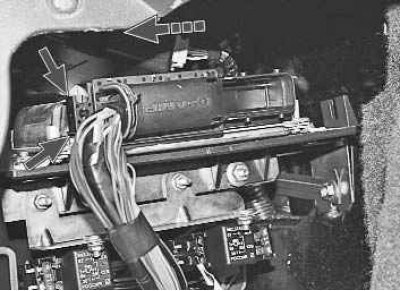
3. Grasp the two protrusions and pull the retaining clip along the plane of the connector until it stops.
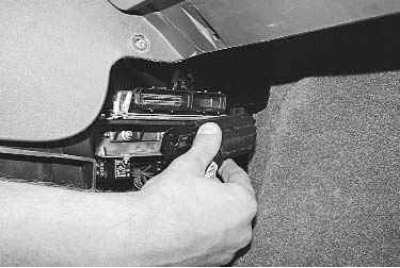
4. Disconnect the wiring harness from the ECU.
Original text can be found on the website: www.ladaman.ru
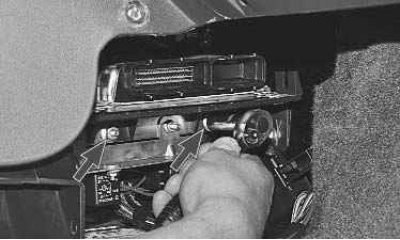
5. Turn away (not completely) two nuts securing the ECU bracket.
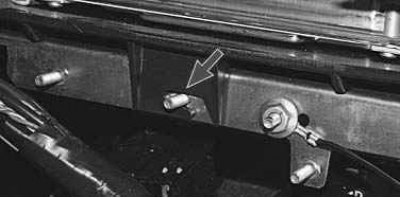
Note: On the opposite side, the ECU bracket is not secured with a nut.
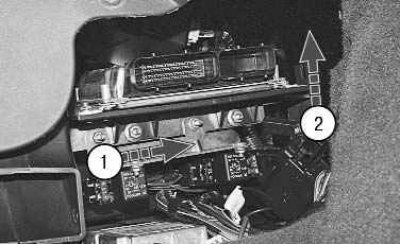
6. Move the bracket with the ECU to the right and, lifting it up a little, remove the ECU from the car.
7. Install the ECU in the reverse order of removal.
Attention! A faulty electronic unit can only be replaced with a new unit in which the anti-theft function is not activated. With this replacement, the ECU will allow the engine to start regardless of the immobilizer. To activate the anti-theft function, perform the immobilizer training procedure.
To activate the anti-theft function of the new controller, it is necessary to perform the learning procedure (see "Immobilizer Key Training"), using the available training and working keys.