



In the event of a frontal impact, these devices can be activated either simultaneously or separately from each other.
The principle of operation of the passive safety system is that in the event of a frontal collision, provided that the ignition is on, the front seat belts with a pre-tensioner are retracted in a very short period of time to securely fasten the driver and front passenger (depending on the severity of the collision), and the airbags are filled with gas. After an impact, the airbags deflate, which may allow you to escape the vehicle. Seat belts with pre-tensioners and load limiters, as well as airbags, reduce the risk of injury to the upper body and head of the driver and front passenger.
The airbags are triggered by a pyrotechnic system, which explains the popping sound and the heat and smoke that they produce when they deploy (which does not mean a fire has started). When airbags deploy, there is a risk of skin damage or other injuries.
Airbags are marked with the inscription AIRBAG or SRS AIRBAG.
The passive safety system for the driver and front passenger, depending on the version, includes:
- driver airbag module mounted in the steering wheel;
- front passenger airbag module located in the instrument panel;
- driver and front passenger side airbag modules located in the side bolsters of the front seat backs;
- remote sensors;
- inertia seat belts;
- driver and front passenger seat belts with pre-tensioner and load limiter;
- a rotary connector mounted on the steering shaft (for connecting the horn switch and the driver's airbag module to the vehicle's on-board circuit);
- -control and diagnostic unit (mounted on the body floor tunnel under the instrument panel console);
- restraint system diagnostic indicator in the instrument cluster.
When the ignition is turned on, the diagnostic indicator located in the instrument cluster lights up for a few seconds. If the diagnostic indicator does not light up when the ignition is turned on, or lights up when the engine is running, this indicates a malfunction in the passive safety system of the driver and front passenger. It is not recommended to place a passenger in this seat or install a child seat. In this case, as well as after an accident, you must contact the PSSS.
The airbags are an additional means of protection for the driver and front passenger wearing a seat belt and are deployed in the areas of action shown in Figure 15a (highlighted in color): in collisions of a certain severity, frontal airbags for frontal impacts, side airbags for side impacts on the side of the impact.
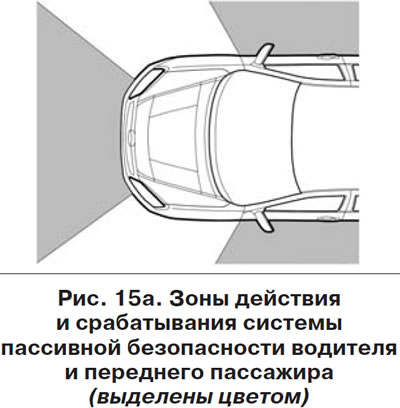
However, they may also be activated in other emergency situations if the vehicle experiences impacts similar to those it would experience in a frontal or side collision.
Examples of situations with activation of the passive safety system:
- collision with a stationary non-deformable obstacle: the airbag may deploy at low speed;
- collision with a moving deformable obstacle (for example, with another car): the airbag is triggered only at increased vehicle speed and in the operating and triggering zone;
- in the case of a sufficiently strong impact acting on the vehicle from the front, some examples are shown in Figure 15b.
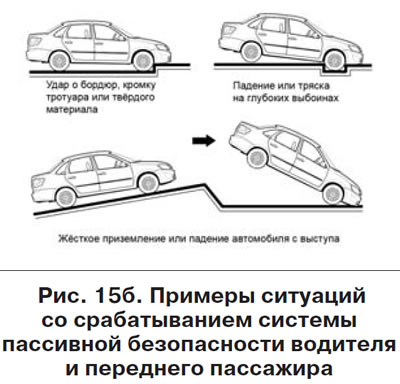
The restraint system does not operate when:
- ignition off;
- insufficient severity of frontal or side collisions;
- car rollover;
- impacts on the vehicle in cases where it cannot contribute to improving safety.
The extent of damage to the car body during a collision (or no serious damage) is not always an indicator of normal or abnormal operation of the passive safety system.
When the airbag deploys, there is virtually no risk of restricted visibility for the driver, as it inflates and deflates in a short period of time.
The airbag provides optimum protection when the seat, seatback and head restraint are adjusted correctly. Your entire back should be supported by the seat back, and the seat should be moved back as far as is practical and comfortable for the driver to maintain control of the vehicle. Move the front passenger seat back as far as possible and adjust the backrest to a vertical position so as not to feel any discomfort or inconvenience. Improper seating position when air bags deploy could result in serious injury or death. An airbag requires space when it is filled with gas.
The driver and front passenger passive safety system is an autonomous, single-use device. After deployment, the control unit, airbag modules and seat belts with pre-tensioning devices must be replaced at a certified SSNS.
Warning!
- 1. An airbag does not replace a seat belt, it only supplements its action, so always wear a seat belt. Those who do not use seat belts risk receiving significantly more serious injuries in an accident or even being thrown from the car. The belt helps you to take the safest seating position in the event of an accident, where the airbag can provide the greatest protection.
- 2. Never attach any objects to the steering wheel or instrument panel as they may cause injury when the air bags deploy. The same danger exists when the driver or passenger smokes a pipe or uses a mobile phone while driving.
- 3. When driving, do not place your forearms/palms on the area where the airbag is mounted.
- 4. When driving, the front seat passenger should not lean on the dashboard or hold any objects in their hands that could cause injury in an accident. They should also not put their feet on the dashboard or on the seat, as this could lead to serious injury in an accident. The passenger is advised to constantly ensure that all parts of their body (knees, arms, head, etc.) were located at a sufficient distance from the instrument panel and the sides of the body.
- 5. It is prohibited to install a rear-facing child seat on the front passenger seat.
- 6. The diagnostic indicator should turn on for 3-4 seconds after the ignition is turned on, and then turn off. Subsequent activation of the diagnostic indicator during vehicle operation means that a malfunction has been detected in the passive safety system and its activation in the event of a frontal or side collision is not guaranteed.
- 7. Unauthorized interference with the restraint system is prohibited. All work on it must be carried out only at certified PSSS by specially trained personnel.
- 8. Immediately after the airbags have deployed, some system components may be at high temperatures. To avoid burns, do not touch hot parts.
- 9. Skin surfaces where signs of irritation appear should be thoroughly washed with soapy water. If eyes become irritated, rinse with clean water. If concerns persist, you should consult a doctor.
Warning!
- The side airbag is an additional means of protecting the driver and front passenger with seat belts fastened in the event of a side collision!
- There must be no foreign objects between the outer side surface of the front seats and the door trim!
- It is prohibited to use covers on seats with driver and front passenger side airbags!
- It is prohibited to hang or attach foreign objects to the handrails.
- To avoid accidental deployment of the side airbags, do not strike the center pillars in the area where the side impact sensors are installed with the ignition on.