



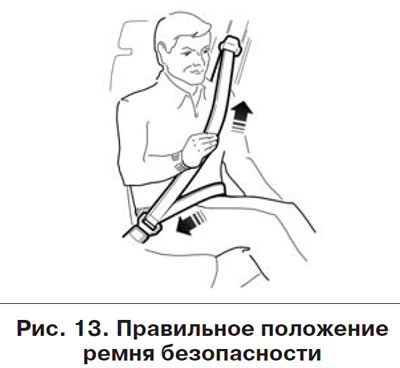
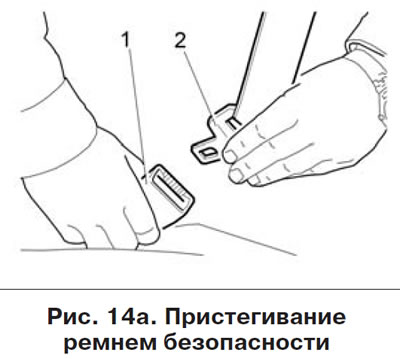
To fasten your seat belt (figure 13), gently pull it out of the reel by grasping the belt tongue (figure 14a), and insert tongue 2 into lock 1 until it clicks, without allowing the tapes to twist. If there is no click, the seat belt will not be fastened correctly. Make sure that the belt tongue is secured in the appropriate belt buckle. Make sure the waist portion of the belt fits snugly across your hips. The waist portion of the belt must not be worn around the waist or under the hips. To unfasten the seat belt, press the red button on the lock, after which the belt will automatically retract into the reel. If the seat belt webbing does not retract effectively, hold the belt tongue in your hand and find the position of the webbing at which it is completely wound onto the reel.
Caution: To avoid damaging the seat belt webbing when closing the vehicle door, do not exit the vehicle without making sure that the seat belt webbing has fully retracted to its original position. If the seat belt is damaged, it may become unsuitable for further use.
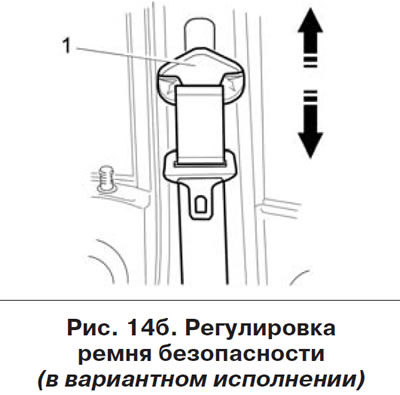
In the optional design, the front seat belts have an adjustable upper anchor point for height. To adjust the seat belt, press the belt guide 1 (figure 14b) and by moving it, select one of five fixed positions. Adjust the height so that the belt is as high as possible without touching your neck.
In the variant version, the car is equipped with front seat belts with a pre-tensioning device and a load limiter located in the front seat belt reels. These systems enhance the effectiveness of seat belts in protecting the driver and front passenger in a frontal collision.
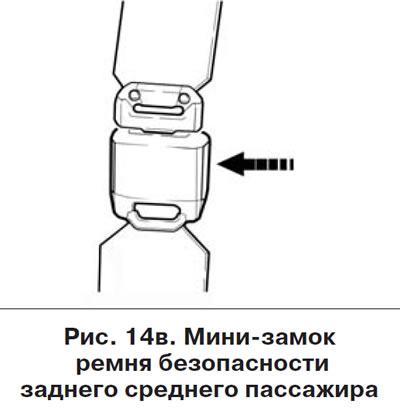
Rear side passengers are fastened with seat belts in the same way as the front ones. For the rear middle passenger, a specially designed belt with two tongues is provided. When operating the vehicle, the rear middle passenger seat belt must be in a position where the lower tongue is inserted into the mini-buckle (figure 14b), except when the rear seat is folded down for cargo transportation. The rear middle passenger's seat belt is fastened in the same way as the rear side passenger's seat belts.
In the absence of medical contraindications, pregnant women should use seat belts according to the following scheme: the waist belt strap should cover the hips, passing significantly below the abdomen, the shoulder belt strap should pass through the middle of the chest, going around the abdomen from above and from the side.
Warning!
- When driving a car, always wear a seat belt and do not transport passengers who are not wearing seat belts!
- Pregnant women should never place the lap portion of the seat belt on the abdominal area where the fetus is located or above the abdomen!
- If the seat belt straps become dirty, clean them with a mild soap solution. Dry the belt straps in the air without heating them. Ironing the straps is not permitted.
- The pre-tensioners operate regardless of whether the seat belt is buckled or not.
- Unauthorized interference with the design of seat belts is prohibited. All troubleshooting work must be performed only on certified PSNS by specially trained personnel. The seat belt must be replaced if it has been subjected to heavy loads during an accident or is damaged.
- Do not fasten seat belts in a manner other than as specified in this manual (do not place the diagonal portion of the belt behind your back or the seat back, do not place the lap portion of the belt under your hips or seat cushion, etc.).