



You can assess the technical condition of the suspension while the car is moving. When driving at low speed on an uneven road, the suspension should operate without knocking, creaking or other extraneous sounds. After driving over an obstacle, the car should not continue to swing.
Recommendation. It is better to check the suspension together with checking the condition of the wheels and tires (see "Checking the technical condition of disks, tires and hubs").
To carry out the work, you will need an inspection pit or overpass.
Recommendation. We check the functionality of the shock absorbers immediately after a long trip, while the working fluid in the shock absorbers has not cooled down.
Sequence of execution
1. Place the vehicle on an inspection ditch or overpass (see "Preparing the car for maintenance and repair").
2. Vigorously rock the rear of the car body in a vertical direction several times. If after the rocking stops, the body continues to oscillate due to inertia (more than two), then one or both shock absorbers are faulty.
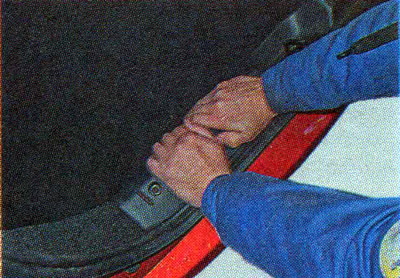
3. To identify a faulty shock absorber, repeat the test, applying force first on one side of the car and then on the other.
Note: This check allows you to identify faulty shock absorbers. The effectiveness of vibration damping by shock absorbers can only be tested on a special stand.
4. Rock the upper part of the rear wheel in the transverse direction.
Note: If you feel any play, even if it is barely noticeable, or hear clicks or knocks, check the condition of the rear suspension and hub more thoroughly (see below).
5. To check the condition of the hub bearing, hang up the rear wheel and swing it in a vertical plane (if the bearing is worn out, there will be play).
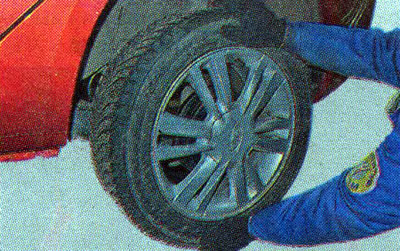
6. To make sure that the play is caused by a faulty bearing hub, repeat the check with the brake pedal pressed.
Note: There should be no noticeable play. The cause of the play may be a worn hub bearing. In this case, the play will disappear when checked again with the brake pedal depressed (see "Checking the technical condition of disks, tires and hubs"). It is also necessary to check the reliability of the hub fastening (for the tightening torque of the hub nut, see. "Rear brake drums - replacement"). If play is detected when the brake pedal is pressed, then it is most likely that the trunnion mount has become loose (hub axles). It is necessary to check the tightening torque of the trunnion mounting bolts (see above, "Reference data").
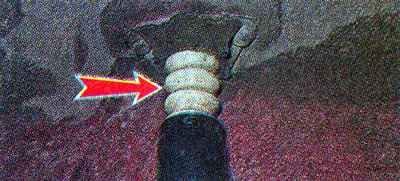
7. Inspect the springs and shock absorbers of the suspension (mechanical damage, fluid leakage from the shock absorbers...
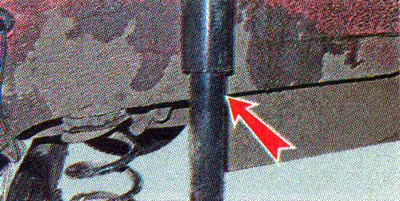
...and bulging of rubber in the joint is unacceptable).
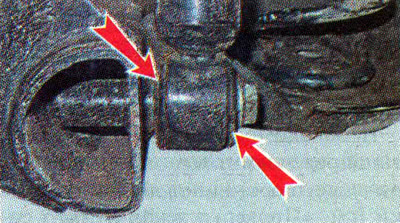
8. Check the reliability of the shock absorber attachment to the lever and the absence of play in the connection.
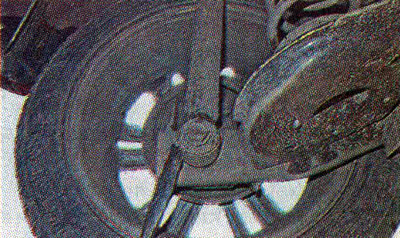
Note: To inspect the upper shock absorber mount support, you can jack up the rear of the car or remove the rear wheels.
9. Using a tire iron as a lever, check the silent blocks of the rear suspension arms.
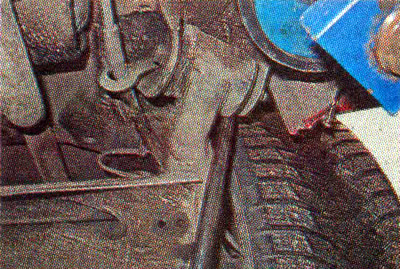
If play is detected or the rubber mass of the silent block is damaged, replace the rear suspension beam (see "Rear suspension beam - removal and installation").