



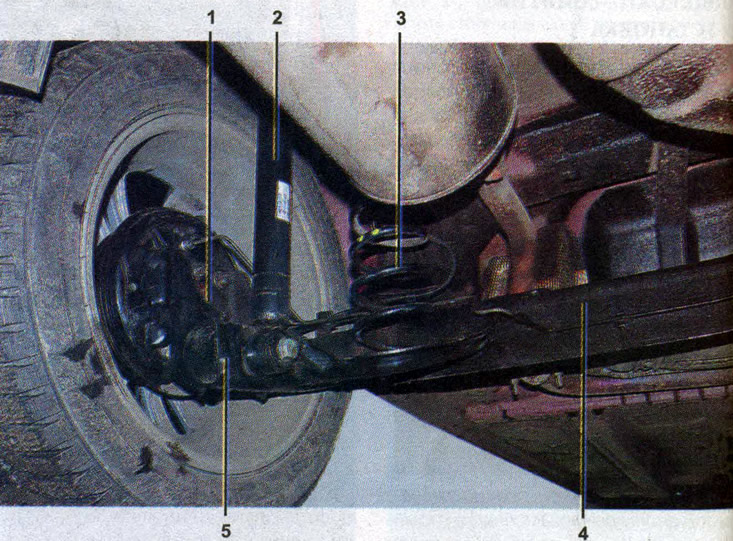
Rear suspension details: 1 - longitudinal arm flange; 2 - shock absorber; 3 - spring; 4 - rear suspension beam; 5 - longitudinal arm of the beam
The rear suspension of the car is semi-independent, made on an elastic beam with longitudinal levers, springs and double-acting shock absorbers.
The rear suspension beam consists of two longitudinal arms connected by a U-shaped cross member. This section provides the crossbar with greater bending rigidity and less torsional rigidity, allowing the arms to rotate relative to each other within small limits. An anti-roll bar is installed inside the crossmember.
At the front, the beam arms are bolted to the body brackets. The mobility of the levers is ensured by rubber-metal hinges (silent blocks), pressed into the eyes of the levers.
The lower spring support cups are welded to the beam and longitudinal arms, and the upper ones are welded to the body side member. The springs are installed separately from the shock absorbers. The shock absorber rod is equipped with a protective cover and an upper support. The shock absorber is attached to the car body via the upper support. The protective cover prevents dust and dirt from getting onto the shock absorber rod.
Also, vertical flanges are installed at the rear of the levers, to which the rear wheel hub axles (trunnions) and brake shields are bolted.
To ensure correct rolling of the vehicle wheels, taking into account the operation of the suspension and steering, the suspension elements must be installed in a certain position.
Recommendation. After repairing any suspension components, be sure to check the wheel alignment angles. A high-quality check and adjustment of wheel alignment angles can only be performed at a service facility that has a special stand for performing adjustment work.