



To carry out the work, you will need an inspection pit or overpass.
Warning: To avoid injury, replace the struts only when the stabilizer is in a relaxed state (both front wheels are suspended or evenly loaded with the weight of the vehicle).
1. Prepare the car for work (see "Preparing the car for maintenance and repair").
2. Place stops under the rear wheels and lift the front part of the car.
3. Remove the front wheels (see "Wheel replacement").
4. Using a metal brush, clean the stabilizer bar pin nuts from dirt and rust...
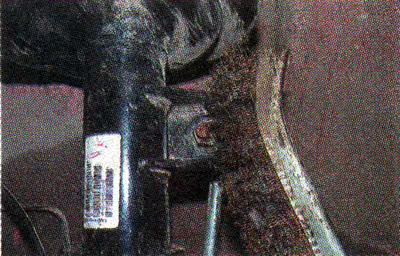
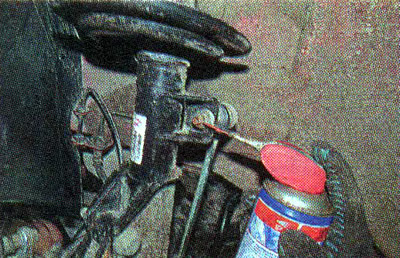
...and treat them with penetrating lubricant.
5. Using a 16 mm open-end wrench, unscrew the nut of the upper stabilizer bar mount, holding the ball joint pin from turning with a 5 mm Allen key.
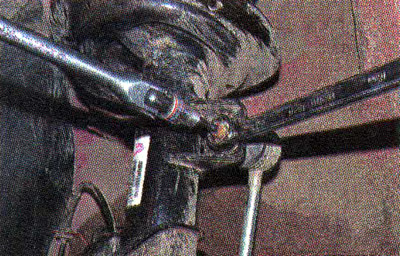
6. Remove the ball joint pin from the bracket.
7. Similarly, unscrew the lower mount nut, disconnect the lower strut hinge from the rod and remove the stabilizer strut.
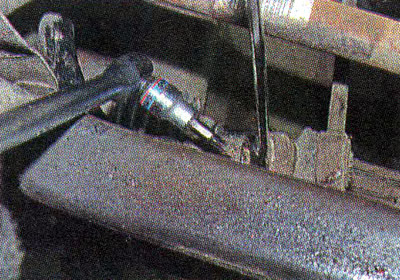
Note. The stabilizer strut is symmetrical and does not have oriented "up" and "down" installation marks. The strut mounting nuts are self-locking and cannot be reused, so they must be replaced with new ones during assembly.
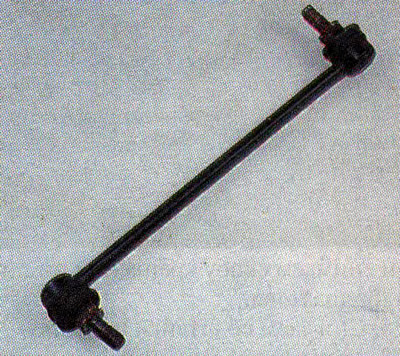
8. Install the stabilizer bar in the reverse order. Tighten the fastening nuts to a torque of 44 Nm.
9. Similarly, replace the second anti-roll bar.