



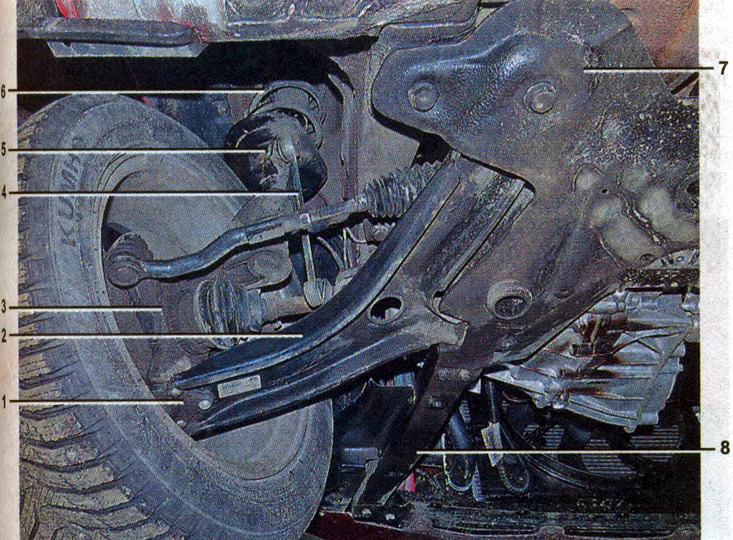
Front suspension parts: 1 - ball joint; 2 - lever; 3 - steering knuckle; 4-strut stabilizer bar; 5 - shock absorber strut; b - spring; 7 - front subframe; 8 - longitudinal beam of the front subframe
The front suspension is independent, with telescopic shock absorber struts, wishbones and a torsion-type anti-roll bar.
The front suspension strut consists of a shock absorber strut, a coil spring, an upper spring support cup and an upper strut support. A bracket for mounting the steering knuckle is welded to the outside of the strut body.
The lower turn of the strut spring rests on the lower support cup, and the upper turn rests on the upper support cup, which is fixed to the shock absorber strut rod. The upper support and thrust bearing are also installed on the shock absorber rod. The bearing allows the shock absorber strut, together with the spring and the upper support cup of the spring, to rotate when the steering wheel is turned, and the rubber cushion prevents the transmission of vibrations to the car body.
The front suspension struts are attached to the car body with three bolts. To protect the shock absorber rod from dirt and dust, a protective cover is installed on it. To protect the car body from sudden impacts when the suspension breaks down, a compression buffer is installed on the shock absorber rod.
At the bottom, the front suspension strut is attached to the steering knuckle with two bolts and nuts, and the steering knuckle, in turn, is attached to the front suspension arm via a ball joint.
A double-row ball bearing is pressed into the hole in the steering knuckle. The wheel hub is pressed into the inner ring of the bearing.
The front suspension arm is attached via silent blocks to the front subframe.
The ball joint consists of a housing. fingers and liners. At one end the support pin has a spherical shape, and at the other it is conical with a threaded shank. The conical part of the pin is attached with a nut to the eye of the steering knuckle.
Original text on the website LADAman
The spherical end of the pin is installed in the housing inserts. The connection is protected by a rubber boot.
During operation, the ball joint experiences heavy loads, which wear out its rubbing surfaces, leading to an increase in the gap between the support body and the pin. As a result, the finger begins to move along its axis, and a knocking sound appears. A rupture of the protective cover will lead to intensive wear of the ball joint, as a result of which dirt and moisture will inevitably get inside. If the support is not replaced in time, it may collapse and cause an emergency situation.
The front suspension anti-roll bar consists of a round steel rod and two struts. The stabilizer bar is secured via rubber cushions on the front subframe, the ends of the bar are connected to the lugs of the shock absorber struts of the car's front suspension using stabilizer struts.
The anti-roll bar is needed to reduce the roll of the car body when cornering - this improves handling and increases the average speed of the car. The anti-roll bar is essentially a torsion bar that connects the suspension elements of the right and left wheels. When turning, they twist, reducing roll. At the same time, the tendency for the car to rock is reduced.
During vehicle operation, the stabilizer bar and its mounting pads wear out slowly and do not require frequent replacement. Carrying out operations to remove the stabilizer bar and replace the cushions is associated with a number of difficulties and is performed on a removed front subframe, therefore, if a malfunction occurs, it is advisable to contact a specialized service station. The main load is borne by the stabilizer strut joints, which is why they fail much more often. If the technical condition check of the front suspension reveals a faulty anti-roll bar, they must be replaced.
To ensure correct rolling of the vehicle wheels, taking into account the operation of the suspension and steering, the front suspension elements must be installed in a certain position.
Recommendation. After repairing any suspension or steering components, be sure to check the wheel alignment angles. A high-quality check and adjustment of wheel alignment angles can only be performed at a service facility that has a special stand for performing adjustment work.
The camber angle of the front wheels is the angle of inclination of the plane of rotation of the wheel relative to the vertical. Uneven camber angles cause the car to pull to the side when driving in a straight line. Large positive camber (when the top of the wheel protrudes outward) leads to accelerated wear of the outer part of the tire tread, and large negative camber leads to wear of the inner part of the tread (see "Wheels, tires and hubs - technical condition check"). The camber angle of the front wheels is specified by design and is not adjustable. The camber angle can be used to diagnose the condition of the front suspension.
Front wheel toe is the angle between the plane of rotation of the wheel and the longitudinal plane of symmetry of the vehicle in a straight-line position. Wheel alignment problems impair the vehicle's handling and directional stability, and also lead to intensive tire wear. The toe-in of the front wheels is adjusted by changing the length of the steering rods, by screwing them into the ends or unscrewing them.
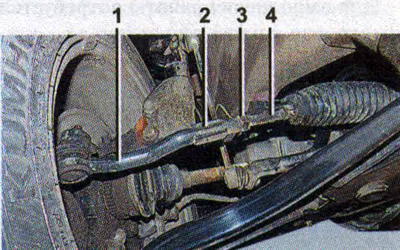
Steering rod parts: 1 - steering rod end; 2 - flats for the key; 3 - lock nut; 4 - hexagonal part of the steering rod under the key
The front wheel caster is the angle between the front wheel turning axis and the vertical in a plane parallel to the vehicle's centerline. Violation of the correct angle of the front wheel steering axis will cause deterioration in vehicle control. At a large longitudinal tilt angle, the resistance to steering wheel rotation increases, and at a small angle, the stabilization of the front wheels in the straight-ahead direction worsens.
The tilt of the wheel pivot axis is determined by design and is not adjustable. If the value of the longitudinal tilt angle of the steering axis goes beyond the permissible limits, then repair of the suspension elements is necessary.