



The front suspension consists of lower transverse stamped arms and an anti-roll bar, fixed to the front suspension subframe.
The front suspension subframe is stamped and welded, box-section, secured in the front part with two bolts to the engine compartment side members, and in the rear part with two bolts to the power elements of the front shield.
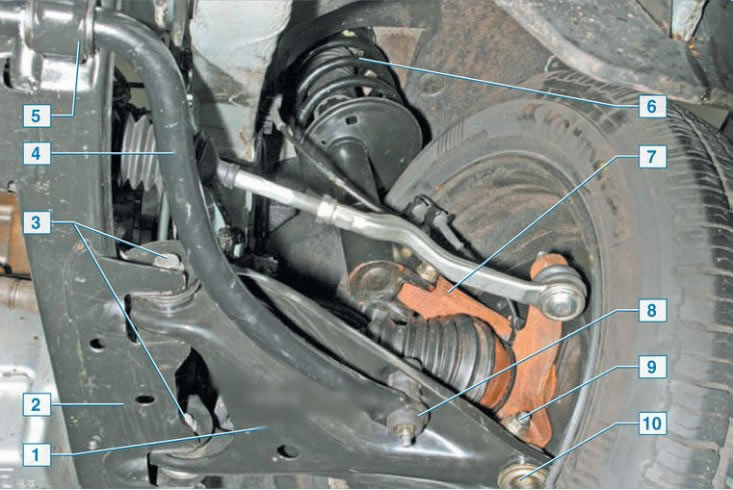
Front suspension: 1 - front suspension arm; 2 - subframe; 3 - suspension arm to subframe mounting bolts; 4 - stabilizer bar for lateral stability; 5 - stabilizer bar mounting bracket; 6 - shock absorber strut and shock absorber spring; 7 - steering knuckle; 8 - anti-roll bar mounting bolt; 9 - tie bolt connecting the steering knuckle and ball joint pin; 10 - ball joint; 11- rear silent block of the lever (the front silent block is not visible)
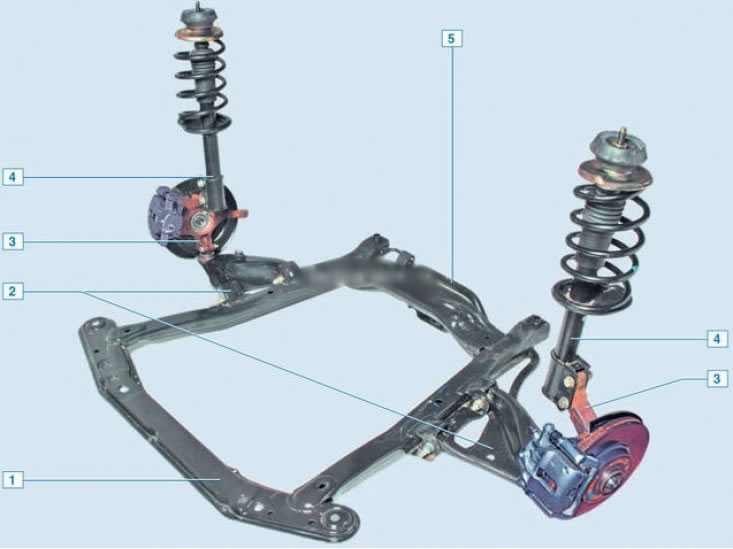
General view of the front McPherson suspension assembly: 1 – suspension subframe; 2 – right and left front suspension arms; 3 – steering knuckle with hub and bearing; 4 – shock absorber; 5 – anti-roll bar
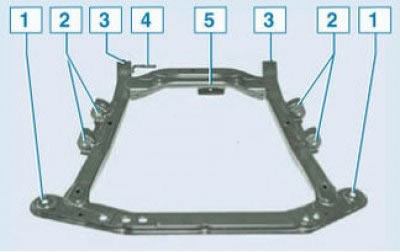
Stretcher: 1 – places of attachment of the subframe to the front part of the body; 2 – places for fastening the front suspension arm to the subframe; 3 – rear subframe and anti-roll bar mounting locations; 4 – bracket for mounting the rubber cushion of the exhaust system suspension; 5 – bracket for securing the rear support of the power unit
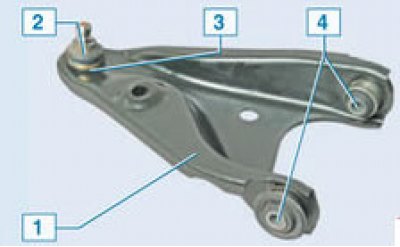
Front suspension arm: 1 – lever; 2 – ball joint; 3 – ball joint boot; 4 – suspension arm silent blocks (front and back)
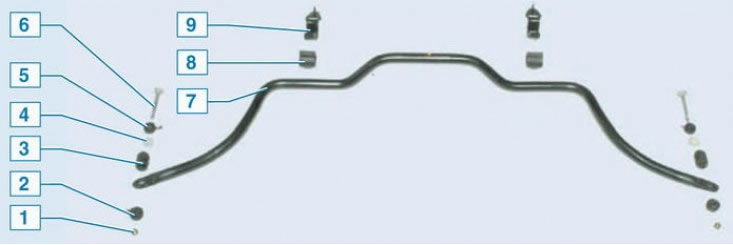
Anti-roll bar: 1 – nut; 2 – lower rubber bushing; 3 – rubber-metal bushing; 4 – plastic washer; 5 – upper rubber bushing; 6 – screw; 7-crossbar stabilizer bar; 8 – rod mounting bracket; 9 – rubber stabilizer cushion
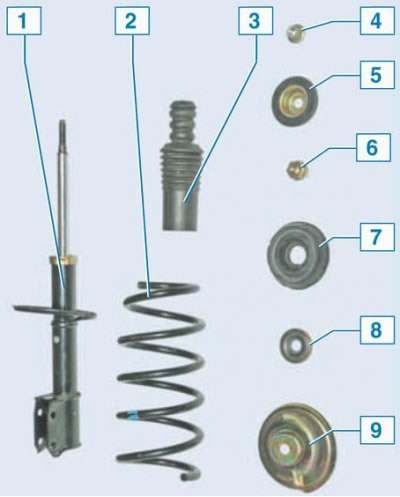
Front suspension shock absorber: 1 – shock absorber strut; 2 – shock absorber spring; 3 – compression buffer with dust cover; 4 – nut for fastening the shock absorber to the body; 5 – support washer; 6 – upper support mounting nut; 7 – upper shock absorber support; 8 – Upper support bearing; 9 – upper spring thrust cup
About modern car suspensions
The suspension connects the body to the wheels, absorbs the forces acting on a moving vehicle, and dampens vibrations. Suspension settings directly affect the vehicle's handling.
In the suspension design, four groups of parts are conventionally distinguished. Conditionally, because in different schemes some elements can perform the functions of two groups, and sometimes even three.
The first group is elastic parts that absorb the impact of forces transmitted from contact with the road surface (springs, leaf springs, torsion bars or hydropneumatic elements). The second group is guide rods that transmit lateral and longitudinal forces and their moments, and also connect the body with other suspension elements, transmission and wheels. The third group - elements that dampen vibrations (shock absorbers or shock absorber struts). The fourth one is the suspension fastening elements.
Also, suspensions can be dependent, independent and semi-independent.
In fact, the first versions of the suspension design were inherited by the car from the cart. The oldest of them is the spring, which was used by the Romans as early as the first century BC. It is still widely used today in commercial vehicles and SUVs. In the production of modern springs, advanced materials are used, for example, instead of metal it can be reinforced plastic.
On front-wheel drive vehicles, McPherson struts are most often used in the front suspension design. In fact, this is a shock absorber and spring assembly. At the bottom it is attached to the steering knuckle, at the top to the mudguard. This design also includes one or two transverse levers. The main advantages of the McPherson suspension are compactness and ease of installation, which is important both for the technological efficiency of production and for the ease of repair. On some vehicles, McPherson struts are also used in the rear suspension.
Also, on modern passenger cars, the design of the front suspension on double levers is widely used. In such a scheme, springs, torsion bars, pneumatic elements or hydropneumatic devices are used as elastic parts.
Multi-link suspension is the name given to a design that includes four or more levers and is used on both the front and rear axles. This suspension provides better handling and was initially used primarily on premium cars. Nowadays it can be found on mass-market cars. This design has one main drawback: high cost and complexity of repair, since many parts and fasteners have to be replaced.
In mass-market cars, the rear suspension design most often uses a torsion beam, also known as a twist beam. This type of suspension is semi-independent, since the wheels can turn at a small angle, as a result of elastic deformation of both the beam itself and the fastening elements. Its main advantages are compactness, low cost, and technological advancement. But there are also serious disadvantages. The main one is that fatigue cracks may appear in the beam during long-term operation, which are difficult to diagnose.
Recently, air suspensions with integrated adjustment have been increasingly used in premium segment cars. They allow you to maintain constant ground clearance regardless of the vehicle load, as well as change the clearance depending on the vehicle speed and road conditions. This scheme is most relevant for crossovers and SUVs. This design uses pneumatic elements or hydropneumatic devices. The suspension operates using microprocessors. The main disadvantages of this scheme are high cost and complexity, both in production and in repair.
Active suspensions have recently become widespread in premium segment cars, in which the rigidity of elements and ground clearance are adjusted using electric drives. Some sports cars even have active anti-roll bars.
In the future, the suspension will be even more integrated into the overall complex of active safety features of the vehicle.